Difference between BA and BS often confuses students when choosing a college degree. Imagine you are applying to a university and see two options: BA and BS. Both look similar, but which one should you choose?
The difference between BA and BS comes down to focus, coursework, and career goals. Both are undergraduate degrees, but they follow different academic paths.
Understanding the difference between BA and BS helps students make smart decisions about their future. It also helps parents and educators guide students better.
Let’s explore these differences step by step.
🔑 Key Difference Between the Both
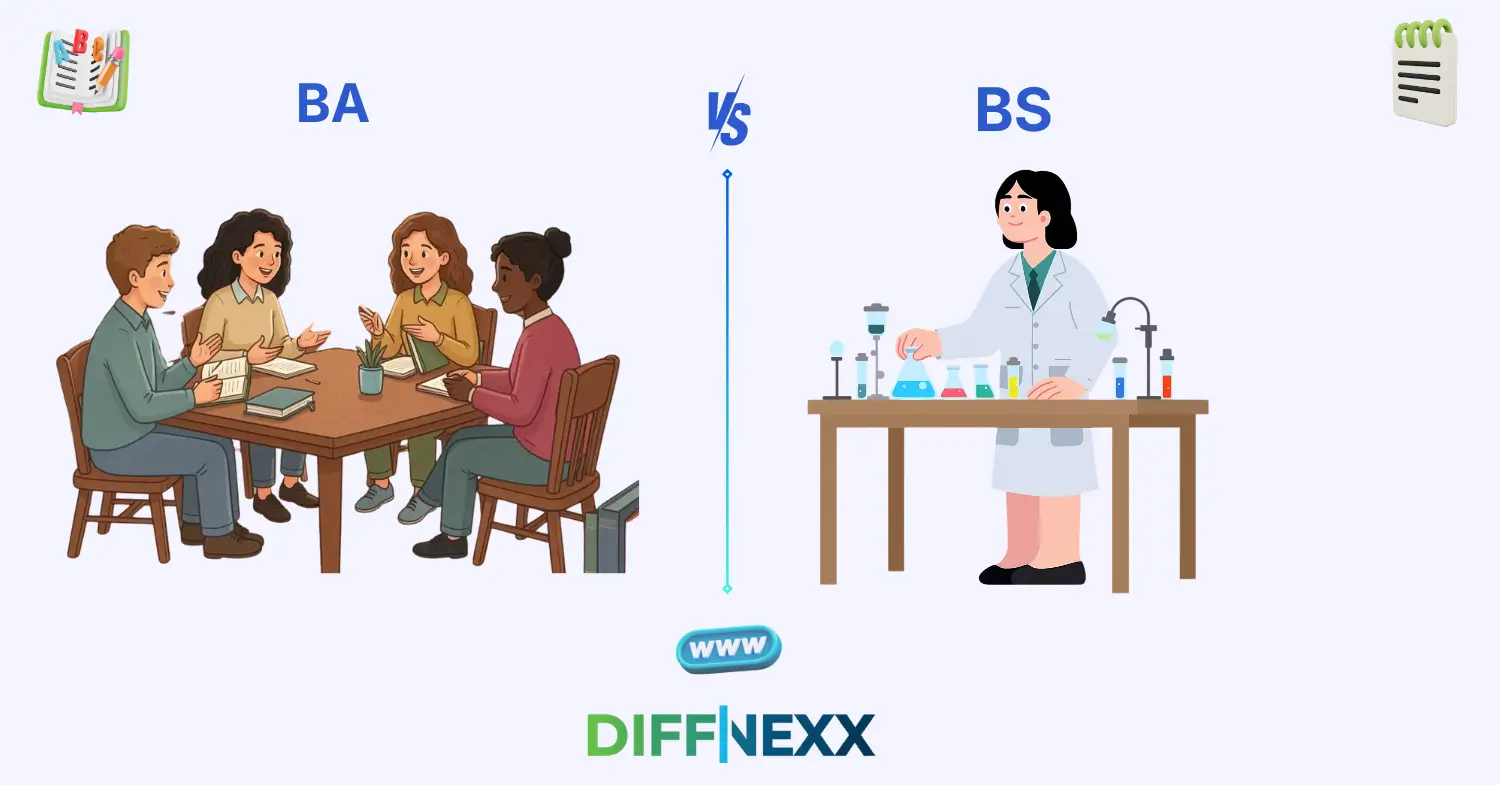
The main difference is academic focus.
- A BA (Bachelor of Arts) focuses on humanities and liberal arts.
- A BS (Bachelor of Science) focuses on science, math, and technical subjects.
🌍 Importance – Why This Difference Matters
Knowing the difference between BA and BS is important for education and career planning.
For students, it helps them choose the right degree based on interests and goals.
For professionals, it shapes career paths. Some jobs prefer technical skills, while others value communication and creativity.
In society, both degrees play key roles. They support diverse industries, from science to arts.
🔊 Pronunciation Section
BA (Bachelor of Arts)
US: /ˌbiː ˈeɪ/
UK: /ˌbiː ˈeɪ/
BS (Bachelor of Science)
US: /ˌbiː ˈɛs/
UK: /ˌbiː ˈɛs/
Now that you know how to say them, let’s define each clearly.
📚 Core Definitions
BA (Bachelor of Arts)
A BA is a degree focused on humanities, arts, and social sciences. It emphasizes critical thinking, communication, and creativity. The tone is flexible and broad.
Example: She earned a BA in English literature.
BS (Bachelor of Science)
A BS is a degree focused on scientific and technical subjects. It emphasizes data, analysis, and practical skills. The tone is structured and analytical.
Example: He completed a BS in computer science.
📊 10 Clear Differences Between BA and BS
1. Academic Focus
BA focuses on arts and humanities. BS focuses on science and technology.
- Example for BA: She studies history and writing.
- Example for BS: He studies physics and coding.
2. Course Structure
BA offers flexible courses. BS has structured and required courses.
- Example for BA: She chooses electives freely.
- Example for BS: He follows a fixed curriculum.
3. Skill Development
BA develops communication skills. BS develops technical skills.
- Example for BA: She improves writing ability.
- Example for BS: He learns data analysis.
4. Math Requirement
BA requires less math. BS requires more math and science.
- Example for BA: She takes minimal math classes.
- Example for BS: He studies advanced mathematics.
5. Career Paths
BA leads to creative or social careers. BS leads to technical or scientific careers.
- Example for BA: She becomes a journalist.
- Example for BS: He becomes an engineer.
6. Flexibility
BA is more flexible. BS is more specialized.
- Example for BA: She explores different subjects.
- Example for BS: He focuses on one field.
7. Research Focus
BS often includes lab work. BA focuses more on theory and discussion.
- Example for BA: She writes essays and reports.
- Example for BS: He conducts experiments.
8. Learning Style
BA encourages creative thinking. BS encourages analytical thinking.
- Example for BA: She analyzes literature.
- Example for BS: He solves scientific problems.
9. Duration
Both usually take the same time, but BS may feel more intensive.
- Example for BA: She manages a balanced schedule.
- Example for BS: He spends more time in labs.
10. Global Perception
Both are respected, but BS is often linked to technical expertise.
- Example for BA: She is valued for communication skills.
- Example for BS: He is valued for technical knowledge.
🎯 Why Knowing the Difference Matters
For students, choosing between BA and BS affects their future studies and career. It helps them align education with interests.
For professionals, the degree influences job opportunities and required skills. Employers often look for specific qualifications.
In society, understanding this difference supports better career guidance and education planning.
Real-world consequences of confusion
Choosing the wrong degree may lead to dissatisfaction. It can also limit career options or require extra training later.
🧠 Why People Get Confused
Similar Names
Both are undergraduate degrees.
Overlapping Fields
Some subjects offer both BA and BS options.
Academic Terms
The abbreviations sound similar.
Informal Use
People often use them interchangeably.
🎭 Connotation & Emotional Tone
Connotation = the emotional meaning associated with a word.
BA
- Positive: Creative and flexible
Example: A BA encourages creative thinking.* - Neutral: General education degree
- Negative: Sometimes seen as less technical
BS
- Positive: Technical and practical
Example: A BS builds strong technical skills.* - Neutral: Science-focused degree
- Negative: May feel rigid or demanding
🗣 Usage in Metaphors, Similes & Idioms
These terms are not common in idioms, but comparisons exist:
- Like a BA degree → Broad and flexible
Example: His approach is like a BA open and creative.* - Like a BS degree → Focused and technical
Example: Her method is like a BS precise and structured.*
📊 Comparison Table
| Feature | BA | BS |
|---|---|---|
| Meaning | Arts degree | Science degree |
| Tone | Flexible | Structured |
| Usage | Humanities | Science & technology |
| Context | Creative fields | Technical fields |
| Formality | Academic | Academic |
⚖️ Which Is Better in What Situation?
When to use BA
Choose BA if you enjoy writing, communication, or creative subjects. It suits careers in media, education, and social sciences.
When to use BS
Choose BS if you enjoy math, science, or technical work. It suits careers in engineering, healthcare, and IT.
Situational Clarity
Your interests and career goals decide the best option.
Contextual Correctness
There is no “better” degree—only the right fit for you.
📖 Literary or Cultural References
- Book: Educated (Memoir, Tara Westover, 2018)
Highlights the value of education and learning paths. - Movie: Good Will Hunting (USA, 1997)
Shows the importance of academic choices and talent.
❓ FAQs
1. Is a BS better than a BA?
Not necessarily. It depends on your career goals and interests.
2. Can I switch from BA to BS?
Yes, but it may require additional courses.
3. Do employers prefer BS over BA?
Some technical jobs prefer BS, but many careers value both equally.
4. Which degree is easier?
BA is often more flexible, while BS is more structured and demanding.
5. Can both lead to good careers?
Yes, both degrees can lead to successful careers.
🏁 Conclusion
The difference between BA and BS mainly lies in focus and structure. A BA offers flexibility and emphasizes creativity, while a BS focuses on technical and scientific skills.
Understanding this difference helps students make better academic and career choices. It ensures that education aligns with personal interests and goals.
Both degrees are valuable and respected. The key is choosing the one that fits your strengths and ambitions.
Keep learning and exploring your future starts with the right decision.

Mira Anand is a writer at Distinly.com who focuses on storytelling, communication, and social perspective. Her work highlights subtle differences in language and meaning across cultures and communities. With a clear and empathetic voice, Mira helps readers understand how narratives shape understanding, relationships, and modern dialogue in an increasingly connected world.