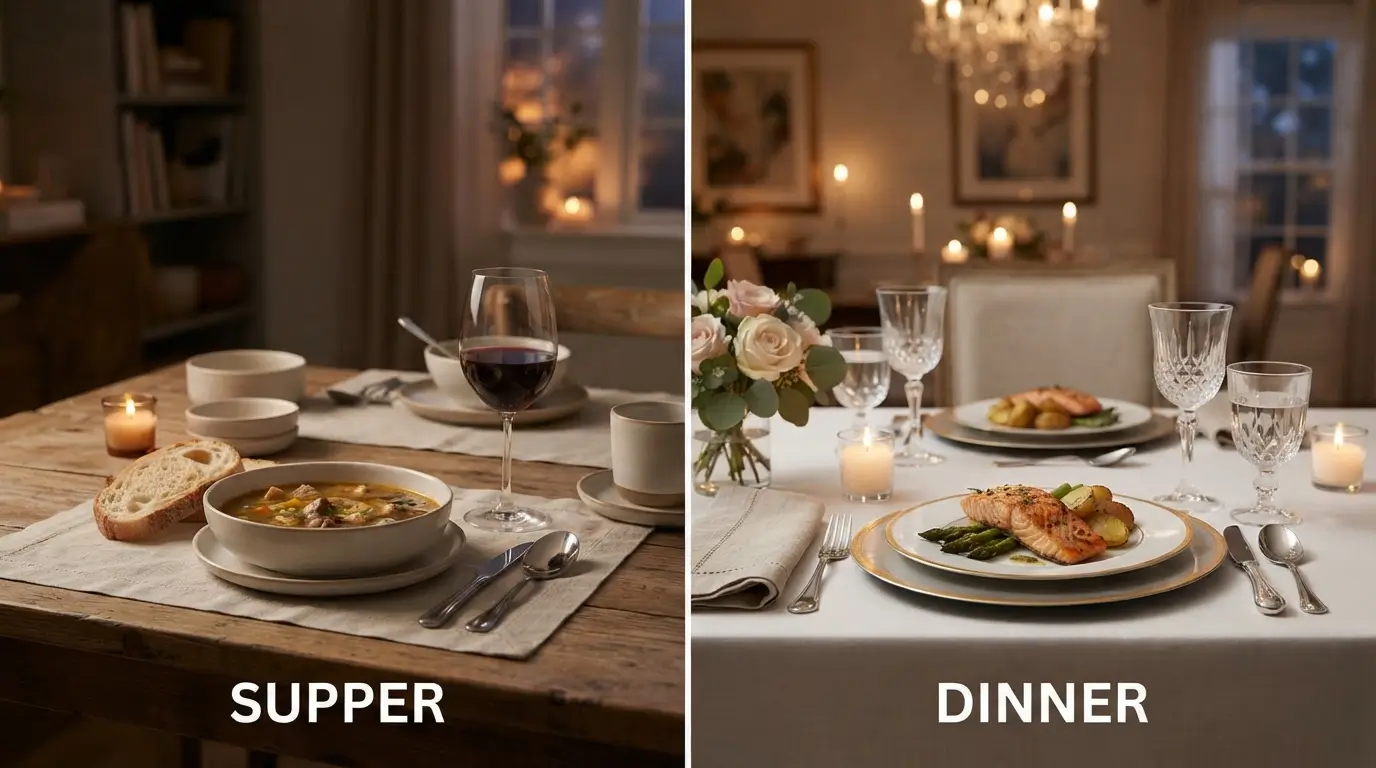
What do you call the evening meal: supper or dinner? The answer can change with region, family tradition, social setting, and even the time of day.
The difference between supper and dinner often confuses English learners because both words can describe an evening meal. In some places, people use them as exact synonyms. In others, dinner means the main meal of the day, while supper means a lighter meal eaten later.
People search for the difference between supper and dinner because dictionaries often give overlapping meanings. A person may also hear one word in a family or community and another word somewhere else. This makes it hard to know whether one term is actually correct.
The difference between supper and dinner is therefore less about a strict rule and more about usage. The difference between supper and dinner can also reflect older meal customs that changed over time.
This guide explains the meanings, origins, regional patterns, common mistakes, and everyday uses of both words in simple English.
Quick Answer
The main difference between supper and dinner is that dinner traditionally refers to the main meal of the day, while supper traditionally refers to a lighter meal, often eaten in the evening.
However, modern English does not follow one universal rule.
For many speakers, dinner simply means the evening meal:
“We are having dinner at 7 p.m.”
For some speakers, especially in certain regional or traditional settings, supper refers to a lighter evening meal:
“We had soup and sandwiches for supper.”
The word dinner can also refer to the main meal at another time of day. For example, a person might have a large midday dinner and a lighter supper later.
So, the words can overlap:
- Dinner = usually the main meal of the day; often the evening meal today.
- Supper = traditionally a lighter evening meal.
- Dinner often sounds more neutral and widely understood.
- Supper can carry a regional, traditional, or informal feel.
There is no rule saying that everyone must use these words in exactly the same way.
The Origin of Supper and Dinner
The history of these words helps explain why their meanings overlap.
Origin of Dinner
Dinner comes from Old French disner or related forms, which meant “to dine” or referred to the first meal of the day. The word ultimately traces back to a Vulgar Latin form related to Latin disieiunare, meaning to break a fast.
Over many centuries, the meaning of dinner changed as meal schedules changed.
In medieval and early modern European society, people did not always eat meals at the same times that are common today. The main meal could occur earlier in the day. As social habits changed, dinner increasingly became associated with the main meal and, in many places, the evening meal.
This historical shift explains why dinner does not have one fixed time.
Origin of Supper
Supper comes from Old French souper, meaning to eat the evening meal or a meal. The word is related to soupe, referring to soup or a dish of food.
The connection with soup reflects older meal traditions in which a light evening meal could include soup or similar foods.
Over time, supper developed the sense of a final or evening meal, often one that was less substantial than the day’s main meal.
However, its meaning has never been identical across all English-speaking communities.
Why Do the Meanings Overlap?
Meal customs changed over time.
When people changed the time and size of their main daily meal, the meanings of dinner and supper changed with them. A meal once called dinner could occur at midday, while supper could follow later in the day.
Today, many people simply call their evening meal dinner. Others continue to use supper, especially in families or regions where that tradition remains common.
The overlap comes from this long history of changing meal patterns.
Supper vs Dinner: Meaning and Usage
What Does Dinner Mean?
Dinner is a noun that usually refers to the main meal of the day.
In modern American English, dinner commonly means the evening meal:
“Dinner is ready.”
“We are going out for dinner tonight.”
The word can also refer to a formal meal or social event:
“The company hosted a dinner for its employees.”
The time of dinner depends on the speaker and context. It may occur in the afternoon or evening.
What Does Supper Mean?
Supper is also a noun.
Traditionally, it refers to a lighter evening meal. In some communities, people still use supper for the meal eaten late in the day.
Examples include:
“We had a simple supper before bed.”
“My grandmother always served supper at six.”
In some parts of the English-speaking world, supper remains a normal everyday word. In other places, it may sound old-fashioned, rural, regional, or less common.
The exact impression depends on the speaker and audience.
Is Dinner Always a Bigger Meal Than Supper?
Not always.
The traditional distinction suggests that dinner is the main meal and supper is lighter. But modern speakers do not always follow that pattern.
For example, someone might say:
“We had a big dinner at noon and a small supper at night.”
Here, dinner clearly means the main meal, while supper describes the smaller evening meal.
Another person might say:
“What are you having for dinner tonight?”
In this sentence, dinner simply means the evening meal. It does not necessarily suggest that the meal will be large.
This is why context matters more than a strict definition.
British English vs American English Spelling
There is no spelling difference between British and American English for dinner or supper.
Both varieties spell the words the same way:
| Word | American English | British English |
|---|---|---|
| Dinner | dinner | dinner |
| Supper | supper | supper |
| Dinners | dinners | dinners |
| Suppers | suppers | suppers |
The main difference is usage, not spelling.
British and American speakers can both use dinner and supper, but individual communities may have different preferences.
In modern American English, dinner is very common for the evening meal. Supper still occurs in some regions and family traditions.
British English also uses dinner for an evening meal, while supper can refer to a lighter meal eaten later or have a more traditional or regional sense.
These patterns vary by speaker, age, location, and family background. They should not be treated as absolute national rules.
Which Spelling Should You Use?
Since both words have the same spelling in British and American English, the real question is which word should you use?
For American Audiences
Use dinner when you mean the evening meal. It is the most broadly understood choice.
For example:
“We are meeting for dinner at 7.”
Use supper when you specifically want its traditional or regional meaning.
For British Audiences
Both dinner and supper are understood, but their meanings can depend strongly on household and regional habits.
If you want a neutral term for the evening meal, dinner is usually a safe choice.
For Global Audiences
Dinner is generally the clearer choice when you mean an evening meal.
If you use supper, context can help:
“We had a light supper before going to bed.”
This sentence makes the intended meaning easy to understand.
Common Mistakes with Supper and Dinner
Mistake 1: Thinking dinner always means an evening meal
Dinner can mean the main meal of the day, regardless of its exact time.
Better:
“We had dinner at noon.”
This can be perfectly correct if lunch was the main meal.
Mistake 2: Thinking supper always means a small meal
A traditional definition often describes supper as lighter, but modern speakers may use it simply for the evening meal.
Better: Consider the speaker’s regional and family usage.
Mistake 3: Treating supper as incorrect English
Supper is a standard English word.
It may be less common in some communities, but that does not make it incorrect.
Mistake 4: Assuming dinner and supper are always interchangeable
They can overlap, but some speakers use them to show a difference in meal size or timing.
Better: Pay attention to context.
Mistake 5: Changing the spelling for British English
Neither word needs a different British spelling.
Dinner remains dinner, and supper remains supper.
Mistake 6: Assuming everyone uses meal words in the same way
Meal vocabulary can reflect local and family traditions.
Better: Treat regional usage as a normal part of English.
Supper and Dinner in Everyday Examples
In an Email
“Would you like to join us for dinner on Saturday?”
This sounds natural and neutral in most English-speaking contexts.
A more traditional sentence might be:
“We would love you to join us for supper after the event.”
The choice depends on the intended tone and the speaker’s usual vocabulary.
In News Writing
A news report might say:
“The leaders met for dinner during the conference.”
Here, dinner can describe a formal social meal.
Supper is less common in this type of formal reporting unless the context or name of an event calls for it.
On Social Media
Someone might post:
“Cooking dinner for the family tonight!”
Another person might write:
“Simple supper after a long day.”
Both sound natural. The second has a slightly more traditional or personal feel for many readers.
In Formal Writing
Dinner often works better in formal contexts:
“The association will host a dinner for its members.”
Supper can appear in formal writing too, especially when describing a specific cultural, historical, or regional setting.
In Daily Conversation
You might hear:
“What are we having for dinner?”
Or:
“Have you had supper yet?”
Both sentences are grammatically correct.
The choice usually reflects the speaker’s habits rather than a universal grammar rule.
Dinner vs Supper: Comparison Table
| Feature | Dinner | Supper |
|---|---|---|
| Part of speech | Noun | Noun |
| Basic meaning | Main meal of the day | Traditionally a lighter evening meal |
| Common modern use | Often the evening meal | Evening or late meal in some communities |
| Can be formal? | Yes | Yes, depending on context |
| Can be regional? | Yes | Strongly regional in some contexts |
| British spelling | dinner | supper |
| American spelling | dinner | supper |
| Refers to a specific time? | Not always | Usually associated with evening |
| Common phrase | “Dinner is ready.” | “Supper is ready.” |
| Meaning varies by family? | Yes | Yes |
Pronunciation of Dinner and Supper
The terms Dinner and supper have different pronunciations.
Dinner
Dinner: /ˈdɪnər/
A simple guide:
DIN-er
Example:
“We had dinner at eight.”
Supper
Supper: /ˈsʌpər/
A simple guide:
SUP-er
Example:
“They served supper late.”
The two words do not sound alike, so pronunciation is usually not the main source of confusion.
The greater challenge comes from their overlapping meanings.
Parts of Speech
Both dinner and supper function mainly as nouns.
Dinner as a Noun
“Dinner was delicious.”
“We ordered dinner.”
The word identifies a meal.
Supper as a Noun
“Supper was ready.”
“They invited us to supper.”
Again, the word identifies a meal.
Neither word normally needs a different grammatical form simply because the speaker uses British or American English.
You can also use both words with common verbs:
- have dinner
- eat dinner
- cook dinner
- make dinner
- have supper
- eat supper
- cook supper
- make supper
Dinner and Supper in Cultural Context
Food vocabulary often reflects more than language.
Family habits can influence whether people say dinner or supper. Older generations may preserve a word that younger speakers use less often. Rural and urban communities may also show different preferences.
Social setting matters too.
For example, dinner party sounds natural when describing a planned social event. Supper can sound more intimate or informal in some contexts.
However, these impressions are not universal. A word that sounds traditional to one speaker may sound completely normal to another.
This is why language learners should avoid treating supper = old-fashioned or dinner = formal as absolute rules.
The safest approach is to understand both meanings and observe how people in the target community use them.
What Does Search Intent Tell Us?
People searching for the difference between supper and dinner usually want to solve a vocabulary or cultural question.
They may have seen supper in a book and wondered why the writer did not use dinner. Others may have heard someone use supper for an evening meal and want to know whether the word is correct.
Common questions include:
- Is supper the same as dinner?
- Is supper an evening meal?
- Is dinner always the biggest meal?
- Do Americans say supper?
- Do British people say supper?
- Is supper old-fashioned?
- Can I use dinner for an afternoon meal?
These searches show that the main issue is not spelling. It is the relationship between traditional definitions and modern regional usage.
Search interest does not prove how often people actually use a word. Without verified live search data, specific search volumes or rankings should not be presented as facts.
FAQs
1. Is supper the same as dinner?
Sometimes. Both can refer to an evening meal, but dinner traditionally refers to the main meal, while supper traditionally refers to a lighter evening meal.
2. Is supper before or after dinner?
There is no universal rule. In a traditional meal pattern, dinner may be the main meal earlier in the day, followed by a lighter supper in the evening.
3. Do Americans say supper?
Yes. Supper is used in American English, although its frequency and meaning vary by region, family, and community.
4. Do British people use the word supper?
Yes. British English uses supper, but individual speakers may use it differently. For some, it means a light meal later in the evening.
5. Is dinner always at night?
No. Dinner can mean the main meal of the day, so it does not have to occur at night.
6. Is supper more informal than dinner?
Not always. Supper can sound informal or traditional to some speakers, but this depends on regional and family usage.
7. Which word should English learners use?
Dinner is usually the safest choice when you mean the evening meal, especially for a broad international audience. Use supper when its regional or traditional meaning fits the context.
Conclusion
The difference between supper and dinner comes from changing meal customs and regional habits, not from a strict rule that applies to every speaker.
Dinner often means the main meal or the evening meal today, while supper traditionally suggests a lighter evening meal in many varieties of English.
Both words remain correct, but their use can change by region, family, age, and social setting. Context helps readers understand the intended meaning.
Practice dinner and supper in emails, essays, and daily conversations. Using both naturally will make your English vocabulary richer and more flexible.

Aamer Shahzad is the founder of Distinly.com, a fast-growing educational platform focused on high-intent “difference between” topics. With over 8 years of experience in English language education and analytical writing, I specialize in breaking down complex “difference between” topics into clear, structured, and easy-to-understand explanations. Distinly.com is your go-to resource for enhancing English skills and writing with confidence.
I specializes in building search-optimized, research-driven comparison content designed for clarity, authority, and long-term digital asset value.