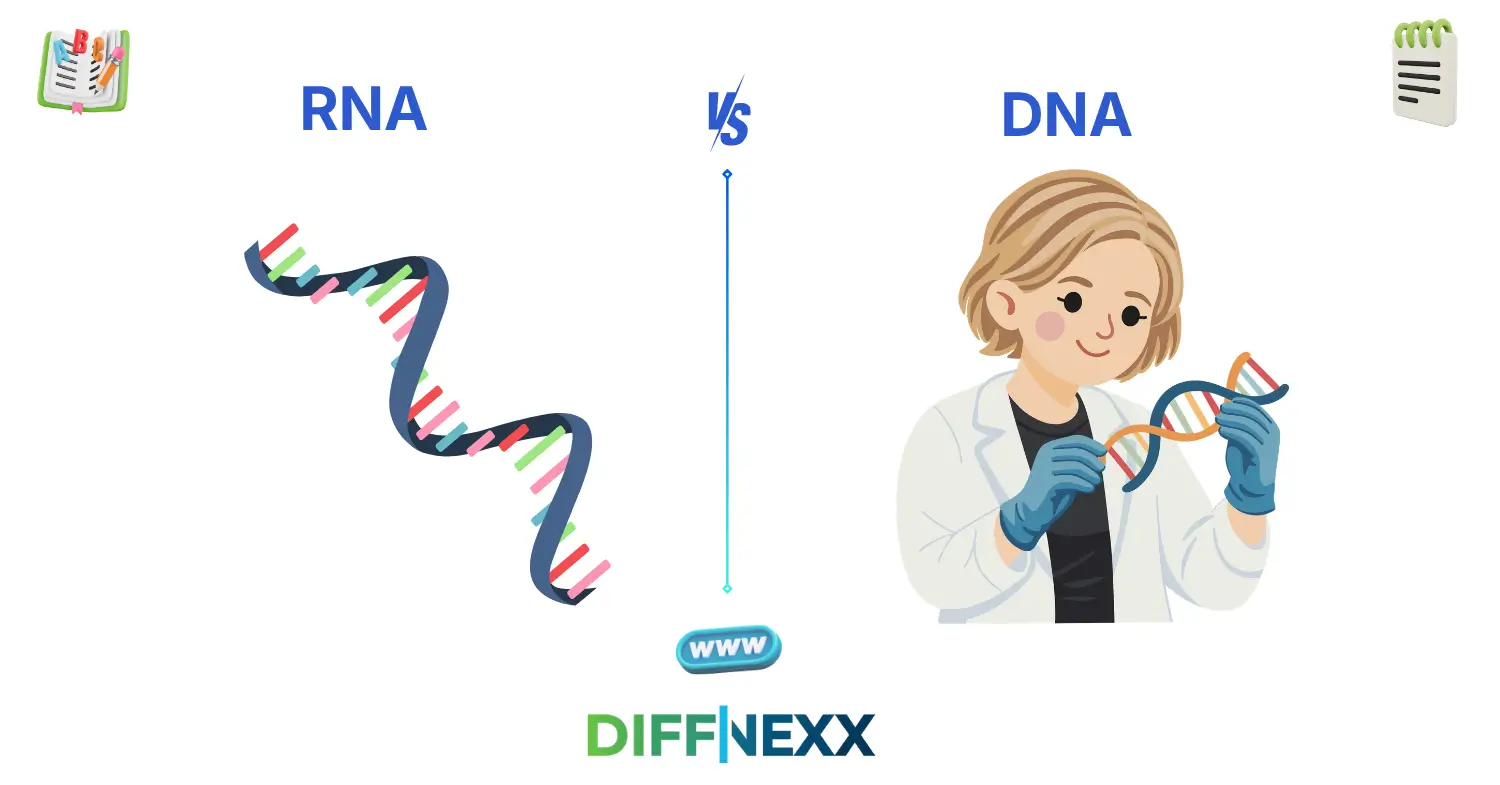
Difference between rna and dna often becomes clear when you learn how your body works. Imagine a blueprint for building a house and a worker following that plan. Both are important, but they have different roles.
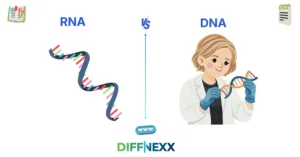
The difference between rna and dna lies in structure, function, and purpose. DNA stores genetic information, while RNA helps use that information to build proteins in the body.
Understanding the difference between rna and dna helps students, teachers, and curious learners understand life at a basic level. It also explains how traits are passed and how cells function.
Let’s explore these two essential molecules step by step in a simple way.
Key Difference Between the Both
The main difference is:
- DNA stores genetic information.
- RNA uses that information to make proteins.
In short, DNA is like a blueprint, and RNA is like a worker that follows instructions.
Importance – Why Their Difference Matters
Knowing this difference is important in science and daily learning.
For students, it builds a strong foundation in biology. It helps in exams and understanding genetics.
For professionals like doctors and researchers, this knowledge is essential. It helps in studying diseases and developing treatments.
In society, understanding DNA and RNA improves awareness about health, medicine, and technology.
🔊 Pronunciation Section
RNA
US: /ˌɑːr ɛn ˈeɪ/
UK: /ˌɑːr ɛn ˈeɪ/
DNA
US: /ˌdiː ɛn ˈeɪ/
UK: /ˌdiː ɛn ˈeɪ/
Now that you know how to pronounce them, let’s understand their meanings.
📚 Core Definitions
RNA
Ribonucleic acid is a molecule that helps carry genetic instructions from DNA to make proteins. It usually exists as a single strand and works actively in cells.
Example: RNA helps your body produce proteins needed for growth.
DNA
Deoxyribonucleic acid is the molecule that stores genetic information in living organisms. It has a double-helix structure and acts as a long-term storage system.
Example: DNA determines traits like eye color.
📚 10 Clear Differences Between RNA and DNA
1. Structure
RNA is single-stranded.
DNA is double-stranded.
- Example for RNA: A single chain molecule.
- Example for DNA: Double helix shape.
2. Function
RNA helps make proteins.
DNA stores genetic information.
- Example for RNA: Carries instructions.
- Example for DNA: Holds genetic code.
3. Stability
RNA is less stable.
DNA is more stable.
- Example for RNA: Breaks down quickly.
- Example for DNA: Lasts longer.
4. Sugar Type
RNA contains ribose sugar.
DNA contains deoxyribose sugar.
- Example for RNA: Ribose present.
- Example for DNA: Deoxyribose present.
5. Location
RNA is found in nucleus and cytoplasm.
DNA is mainly in the nucleus.
- Example for RNA: Moves around the cell.
- Example for DNA: Stays protected in nucleus.
6. Length
RNA is shorter.
DNA is much longer.
- Example for RNA: Small molecules.
- Example for DNA: Long chains.
7. Types
RNA has different types (mRNA, tRNA, rRNA).
DNA has only one main form.
- Example for RNA: Multiple roles.
- Example for DNA: Single structure.
8. Role in Protein Synthesis
RNA directly participates.
DNA provides instructions only.
- Example for RNA: Builds proteins.
- Example for DNA: Stores instructions.
9. Base Pairing
RNA uses uracil (U).
DNA uses thymine (T).
- Example for RNA: A pairs with U.
- Example for DNA: A pairs with T.
10. Lifespan
RNA has a short lifespan.
DNA lasts for the life of the cell.
- Example for RNA: Temporary.
- Example for DNA: Permanent storage.
🎯 Why Knowing the Difference Matters
Students need this knowledge to understand biology clearly. It helps in exams and builds strong concepts.
Professionals use this knowledge in medicine, genetics, and research. It helps in developing treatments and vaccines.
In everyday life, understanding DNA and RNA helps people learn about health and heredity.
Real-world Consequences of Confusion
Confusing RNA and DNA can lead to misunderstandings in science learning. It may also cause errors in research or communication.
🧠 Why People Get Confused
Similar Names
RNA and DNA sound alike, which causes confusion.
Scientific Complexity
Both are complex molecules with related roles.
Context-Based Usage
They are often discussed together in biology.
Informal Learning
Students sometimes memorize without understanding.
🎭 Connotation & Emotional Tone
Connotation = the emotional meaning associated with a word.
RNA
- Neutral: Functional and active
- Example: “RNA carries genetic instructions.”
DNA
- Positive: Identity and uniqueness
- Example: “DNA defines who we are.”
🗣 Usage in Metaphors, Similes & Idioms
These terms are often used metaphorically.
- “It’s in my DNA” (means natural or inherited)
- “RNA acts like a messenger”
Examples:
- “Leadership is in her DNA.”
- “RNA works like a delivery system.”
📊 Comparison Table
| Feature | RNA | DNA |
|---|---|---|
| Meaning | Protein-building molecule | Genetic storage molecule |
| Tone | Neutral | Positive/neutral |
| Usage | Biology | Biology |
| Context | Cell activity | Genetic storage |
| Formality | Scientific | Scientific |
⚖️ Which Is Better in What Situation?
When to Use RNA
Use RNA when discussing protein synthesis or cell activity. It is relevant in processes where genetic instructions are actively used.
When to Use DNA
Use DNA when referring to genetic storage or heredity. It is important in topics like genetics and inheritance.
Situational Clarity
Choose based on function. RNA = action, DNA = storage.
Contextual Correctness
Using the correct term ensures scientific accuracy and clear understanding.
📖 Literary or Cultural References
- Book: “The Double Helix” (Science Memoir, James D. Watson, 1968)
Explains the discovery of DNA structure. - Movie: “Gattaca” (USA, 1997)
Explores genetic identity and DNA.
❓ FAQs
1. What is the main difference between RNA and DNA?
DNA stores genetic information, while RNA uses that information to make proteins.
2. Is RNA more important than DNA?
Both are equally important. DNA stores instructions, and RNA carries them out.
3. Why is DNA double-stranded?
The double structure makes DNA stable and protects genetic information.
4. Can RNA exist without DNA?
In most cases, RNA depends on DNA, but some viruses use RNA as genetic material.
5. Where are RNA and DNA found?
DNA is mainly in the nucleus, while RNA is found in both the nucleus and cytoplasm.
🏁 Conclusion
The difference between rna and dna is simple but essential. DNA stores genetic information, while RNA helps use that information to build proteins. Together, they control how living organisms grow and function.
Understanding this difference improves your knowledge of biology and helps you see how life works at a deeper level. It also supports learning in science, medicine, and genetics.
Keep exploring these concepts. The more you learn, the better you understand the building blocks of life.

Aamer Shahzad is the founder of Distinly.com, a fast-growing educational platform focused on high-intent “difference between” topics. With over 8 years of experience in English language education and analytical writing, I specialize in breaking down complex “difference between” topics into clear, structured, and easy-to-understand explanations. Distinly.com is your go-to resource for enhancing English skills and writing with confidence.
I specializes in building search-optimized, research-driven comparison content designed for clarity, authority, and long-term digital asset value.