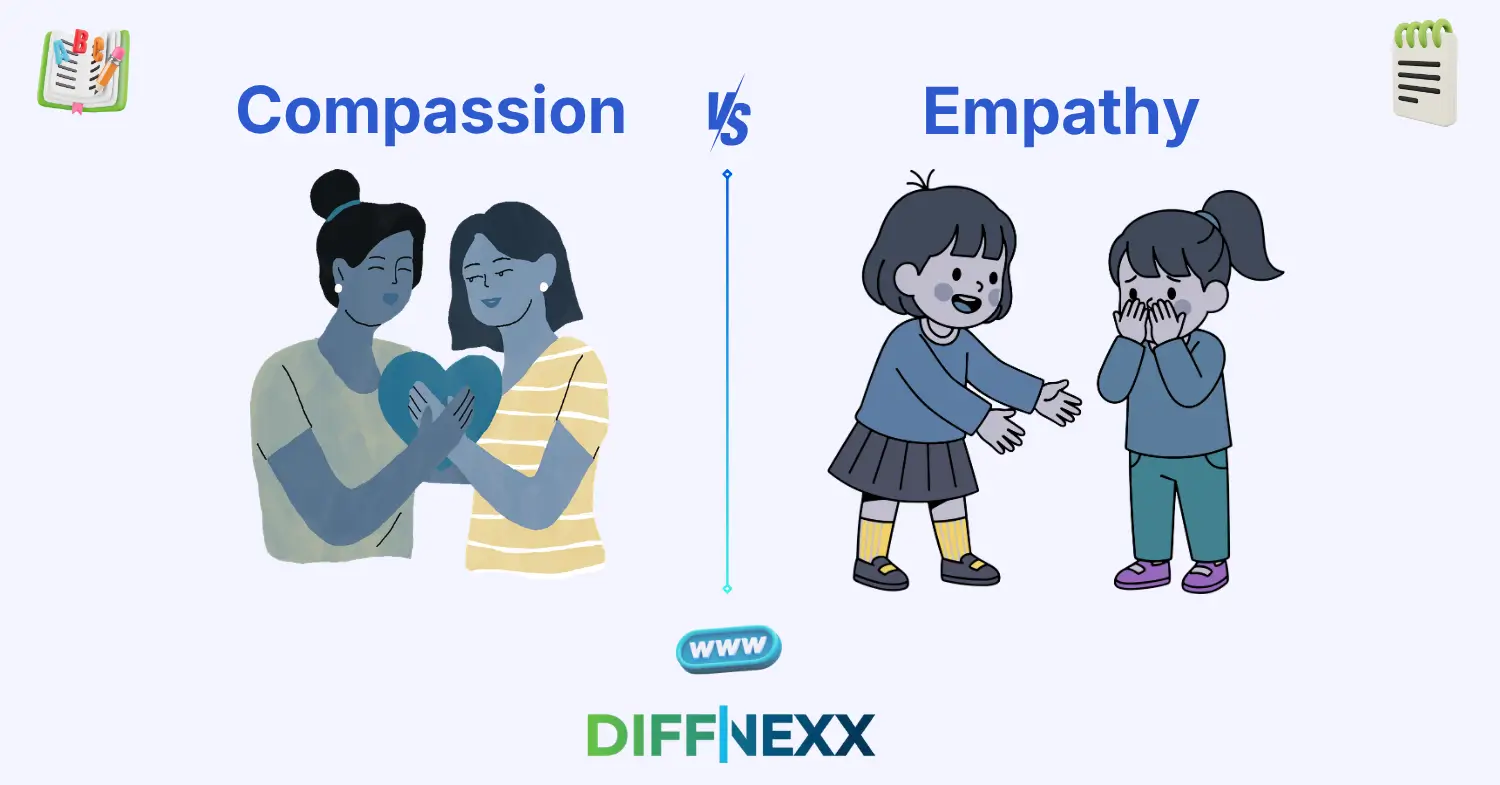
Difference between compassion and empathy often becomes clear in real-life moments. Imagine a friend shares a painful story. You feel their sadness that is empathy. Then you try to help them feel better, that is compassion.
The difference between compassion and empathy lies in feeling versus action. Empathy means understanding and sharing someone’s emotions. Compassion goes a step further; it includes a desire to help.
Many people use these words as if they mean the same thing. However, the difference between compassion and empathy matters in relationships, communication, and emotional intelligence.
Let’s explore this in a simple and practical way. 💙
Key Difference Between the Both
The key difference is:
- Empathy: Feeling and understanding another person’s emotions.
- Compassion: Feeling someone’s pain and wanting to help them.
In short, empathy feels, while compassion acts.
Importance – Why Their Difference Matters
Understanding the difference between compassion and empathy is important for both learners and professionals.
For students, it builds emotional intelligence. It helps them connect with others in a healthy way.
For professionals like teachers, doctors, and leaders, this knowledge improves communication and care. It helps them respond appropriately to others’ needs.
In society, compassion and empathy create stronger relationships. They also promote kindness and understanding.
🔊 Pronunciation Section
Compassion
US: /kəmˈpæʃ.ən/
UK: /kəmˈpæʃ.ən/
Empathy
US: /ˈem.pə.θi/
UK: /ˈem.pə.θi/
Now that you know how to pronounce them, let’s define each clearly.
📚 Core Definitions
Compassion
Compassion is the feeling of concern for someone’s suffering along with a desire to help. It feels warm and caring.
Example: Seeing someone upset and offering support or help.
Empathy
Empathy is the ability to understand and share another person’s feelings. It feels deep and emotional.
Example: Feeling sad when your friend is sad.
📚 10 Clear Differences Between Compassion and Empathy
1. Emotional Intensity
Empathy involves deeply feeling emotions. Compassion balances feeling with care.
- Example for Empathy: Feeling your friend’s sadness strongly.
- Example for Compassion: Caring and offering comfort calmly.
2. Action vs Feeling
Empathy focuses on feeling. Compassion includes action.
- Example for Empathy: “I understand your pain.”
- Example for Compassion: “Let me help you through this.”
3. Focus
Empathy focuses on emotional connection. Compassion focuses on helping.
- Example for Empathy: Sharing emotions.
- Example for Compassion: Taking supportive steps.
4. Emotional Impact
Empathy can feel overwhelming. Compassion feels balanced and supportive.
- Example for Empathy: Feeling emotionally drained.
- Example for Compassion: Feeling motivated to help.
5. Rationality
Empathy is more emotional. Compassion includes emotional and rational thinking.
- Example for Empathy: Reacting emotionally.
- Example for Compassion: Responding thoughtfully.
6. Formality
Empathy is often used in emotional discussions. Compassion appears in both emotional and professional settings.
- Example for Empathy: Talking with a friend.
- Example for Compassion: Healthcare support.
7. Context of Use
Empathy fits emotional understanding. Compassion fits caregiving situations.
- Example for Empathy: Listening to someone’s story.
- Example for Compassion: Helping someone in need.
8. Psychological Impact
Empathy can lead to emotional fatigue. Compassion promotes positive action.
- Example for Empathy: Feeling overwhelmed.
- Example for Compassion: Feeling fulfilled.
9. Tone
Empathy has a soft, emotional tone. Compassion has a warm, active tone.
- Example for Empathy: “I feel your pain.”
- Example for Compassion: “I’m here to help.”
10. Expression Style
Empathy is expressed through understanding. Compassion is expressed through support.
- Example for Empathy: Listening deeply.
- Example for Compassion: Offering help or solutions.
🎯 Why Knowing the Difference Matters
Students need this knowledge to build strong relationships. It helps them respond to others with care and understanding.
Professionals must know when to empathize and when to act. This improves teamwork, leadership, and service quality.
In daily life, understanding both helps avoid emotional burnout. It also improves communication and trust.
Real-world consequences of confusion
If someone only shows empathy without action, the other person may still feel unsupported. On the other hand, acting without empathy may feel cold or insensitive.
🧠 Why People Get Confused
Similar Meaning
Both involve understanding others’ feelings.
Semantic Overlap
Compassion includes empathy, which creates confusion.
Context-Based Usage
People use the words interchangeably in conversations.
Influence of Informal Speech
Everyday language often mixes their meanings.
🎭 Connotation & Emotional Tone
Connotation = the emotional meaning attached to a word.
Compassion
- Positive: Warm, caring, and helpful.
- Example: “She showed compassion by helping others.”
Empathy
- Positive: Deep, emotional, and understanding.
- Example: “He showed empathy by listening carefully.”
🗣 Usage in Metaphors, Similes & Idioms
- “A heart full of compassion” → kindness and care.
- “Walking in someone else’s shoes” → empathy and understanding.
Both highlight emotional connection in different ways.
📊 Comparison Table
| Feature | Compassion | Empathy |
|---|---|---|
| Meaning | Feeling + desire to help | Understanding feelings |
| Tone | Warm and active | Deep and emotional |
| Usage | Helping and caring | Emotional connection |
| Context | Caregiving, support | Emotional understanding |
| Formality | Personal & professional | Mostly personal |
⚖️ Which Is Better in What Situation?
When to use Compassion
Use compassion when someone needs help. It is best in situations where action matters, like caregiving or support.
When to use Empathy
Use empathy when someone needs to feel understood. It works well in conversations and emotional sharing.
Situational clarity
Empathy builds connection. Compassion builds support.
Contextual correctness
Use empathy first to understand. Then use compassion to act.
📖 Literary or Cultural References
- Book: To Kill a Mockingbird (Fiction, Harper Lee, 1960)
Shows empathy and compassion through characters’ actions. - Movie: Inside Out (USA, 2015)
Explores emotions and empathy in a simple way.
❓ FAQs
1. Is compassion stronger than empathy?
Compassion is not stronger, but it goes further. It includes both feeling and action.
2. Can you have empathy without compassion?
Yes, you can feel someone’s emotions without helping them. That is empathy alone.
3. Why is compassion important?
Compassion leads to positive action. It helps people support each other in meaningful ways.
4. Is empathy always good?
Empathy is helpful, but too much can be overwhelming. Balance is important.
5. How can I practice compassion?
Start by understanding others’ feelings, then take small steps to help. Even simple actions matter.
🏁 Conclusion
The difference between compassion and empathy is clear when you understand their roles. Empathy helps you feel and understand others. Compassion pushes you to act and support them.
Both are important for strong relationships and emotional growth. Empathy builds connection, while compassion creates change.
By using both wisely, you can improve communication and help others more effectively.
Keep practicing these qualities they make you a better and more understanding person. 💫

Mira Anand is a writer at Distinly.com who focuses on storytelling, communication, and social perspective. Her work highlights subtle differences in language and meaning across cultures and communities. With a clear and empathetic voice, Mira helps readers understand how narratives shape understanding, relationships, and modern dialogue in an increasingly connected world.