Difference between mouse and rat is a common question when people see small rodents at home, in fields, or even in cartoons. Imagine spotting a tiny creature in your kitchen and wondering, “Is that a mouse or a rat?” That moment of doubt is very real.
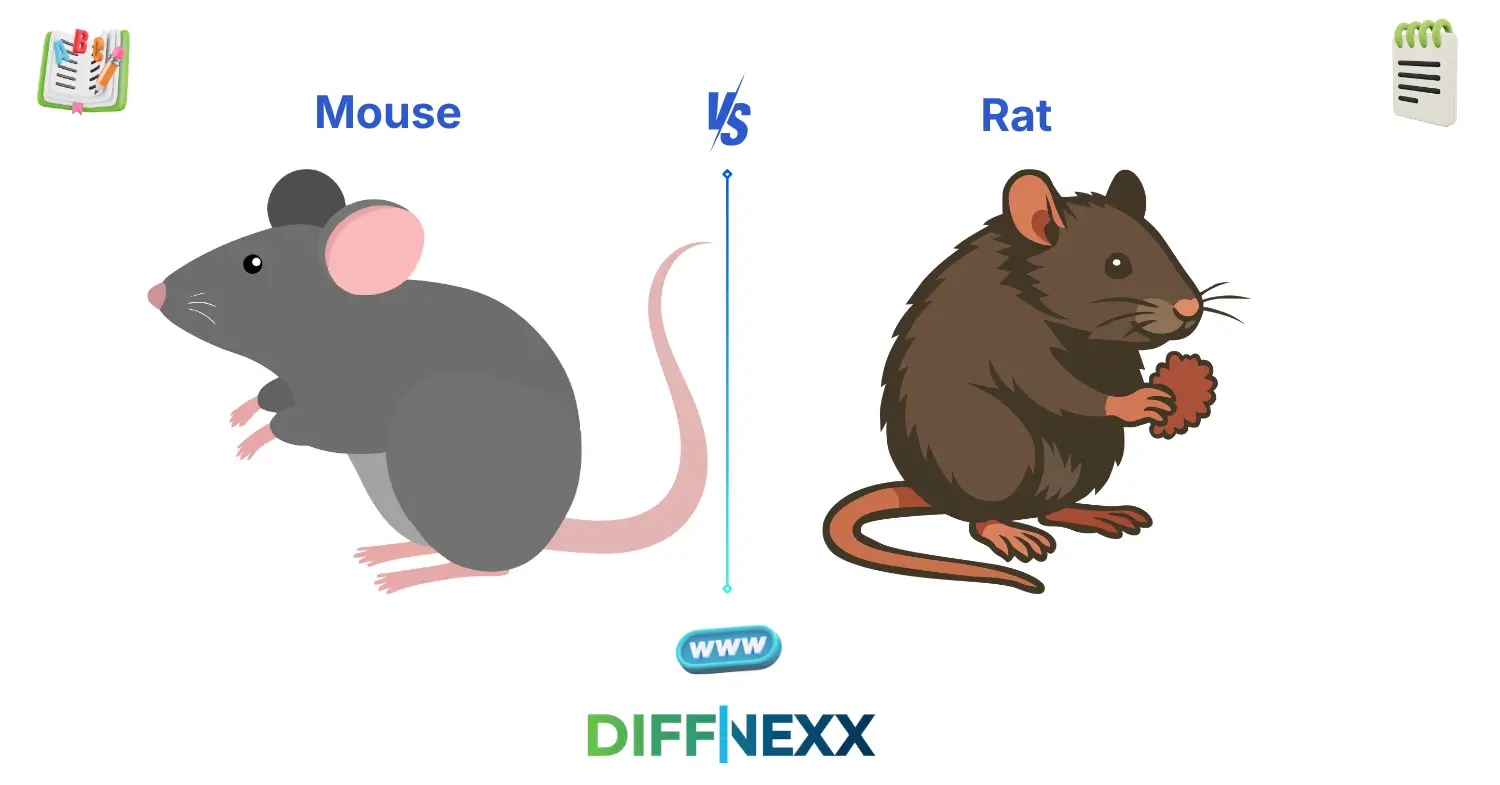
The difference between mouse and rat is mainly about size, behavior, and physical features. Both belong to the rodent family, but they are not the same species. A mouse is usually smaller and lighter, while a rat is larger and stronger.
Understanding the difference between mouse and rat helps you identify them correctly. It also improves your knowledge in science, daily life, and communication.
Let’s explore the differences clearly and simply 🐭🐀
Key Difference Between the Both
The key difference between mouse and rat is size and strength. Mice are smaller, lighter, and more delicate, while rats are larger, heavier, and more robust.
Importance – Why Is Their Difference Necessary to Know
Knowing the difference between mouse and rat is important for learners and experts alike.
For students, it builds basic biological knowledge. It helps them understand animal classification and observation skills.
For professionals, especially in pest control or research, correct identification is essential. It affects treatment methods and study accuracy.
In society, awareness helps maintain hygiene and safety. Different rodents require different control approaches.
🔊 Pronunciation Section
Mouse
US: /maʊs/
UK: /maʊs/
Rat
US: /ræt/
UK: /ræt/
Now that you can pronounce them correctly, let’s define each clearly.
📚 Core Definitions
Mouse
A mouse is a small rodent with a pointed nose, tiny body, and long thin tail. It is often seen as less threatening and sometimes even cute. The tone is neutral to slightly positive.
Example:
“A mouse ran quickly across the floor.”
Rat
A rat is a larger rodent with a thicker body and stronger features. It is often associated with caution due to its size and adaptability. The tone can be neutral or slightly negative.
Example:
“A rat was seen near the garbage area.”
📚 10 Clear Differences Between Mouse and Rat
1. Size 📏
Mice are small and light. Rats are larger and heavier.
- Example for Mouse: “The mouse is tiny.”
- Example for Rat: “The rat looks big.”
2. Body Structure
Mice have slender bodies. Rats have thicker, more muscular bodies.
- Example for Mouse: “It looks delicate.”
- Example for Rat: “It looks strong.”
3. Tail Appearance
Mice have thin, smooth tails. Rats have thicker, scaly tails.
- Example for Mouse: “The tail is thin.”
- Example for Rat: “The tail is thick.”
4. Lifespan ⏳
Mice live shorter lives. Rats tend to live longer.
- Example for Mouse: “It has a short lifespan.”
- Example for Rat: “It lives longer.”
5. Behavior 🧠
Mice are curious and timid. Rats are cautious and intelligent.
- Example for Mouse: “It explores quickly.”
- Example for Rat: “It observes carefully.”
6. Strength 💪
Mice are weaker. Rats are stronger and more capable.
- Example for Mouse: “It cannot carry much.”
- Example for Rat: “It can move heavier objects.”
7. Habitat Preference
Mice prefer indoor spaces. Rats often live in sewers or outdoor areas.
- Example for Mouse: “It hides in walls.”
- Example for Rat: “It lives in drains.”
8. Reproduction Rate 🐣
Mice reproduce very quickly. Rats reproduce at a slower but still high rate.
- Example for Mouse: “They multiply fast.”
- Example for Rat: “They reproduce steadily.”
9. Social Perception 🌍
Mice are sometimes seen as cute. Rats are often seen as pests.
- Example for Mouse: “People find it adorable.”
- Example for Rat: “People avoid it.”
10. Expression Style ✍️
“Mouse” is used in softer expressions. “Rat” appears in stronger or negative expressions.
- Example for Mouse: “Quiet as a mouse.”
- Example for Rat: “He’s a rat (betrayer).”
🎯 Why Knowing the Difference Matters
Students must know the difference to improve their scientific understanding. It helps them identify animals correctly.
Professionals rely on accurate identification for pest control and research. Mistakes can lead to ineffective solutions.
In daily life, knowing the difference helps maintain hygiene and safety. It also improves awareness in shared environments.
Real-world consequences of confusion
Confusing a rat for a mouse may lead to underestimating risks. Rats can cause more damage and require stronger control measures.
🧠 Why People Get Confused
Similar Appearance
Both are small rodents with similar features.
Semantic Overlap
People often use “mouse” and “rat” interchangeably.
Context-Based Usage
In casual speech, the terms are not used carefully.
Influence of Informal Speech
Media and cartoons blur the difference.
🎭 Connotation & Emotional Tone
Connotation = the emotional meaning associated with a word.
Mouse
Positive to neutral. It suggests smallness and gentleness.
- Example: “The mouse is harmless.”
Rat
Neutral to negative. It suggests danger or distrust.
- Example: “The rat spread disease.”
🗣 Usage in Metaphors, Similes & Idioms
- “Quiet as a mouse” – very silent.
- “Smell a rat” – suspect something wrong.
📊 Comparison Table
| Feature | Mouse | Rat |
|---|---|---|
| Meaning | Small rodent | Large rodent |
| Tone | Soft, neutral | Strong, sometimes negative |
| Usage | Gentle contexts | Serious contexts |
| Context | Homes, fields | Sewers, urban areas |
| Formality | Neutral | Neutral |
⚖️ Which Is Better in What Situation?
When to use Mouse
Use “mouse” when referring to a small rodent or in gentle expressions. It suits neutral or positive contexts.
When to use Rat
Use “rat” when referring to a larger rodent or in serious discussions. It fits stronger or warning contexts.
Situational clarity
Choose based on size and tone. Smaller means mouse; larger means rat.
Contextual correctness
Using the correct word ensures clarity and accurate communication.
📖 Literary or Cultural References
- Book: Of Mice and Men (Fiction, John Steinbeck, 1937) – explores themes using “mice” symbolically.
- Movie: Ratatouille (USA, 2007) – features a rat as a main character.
❓ FAQs
1. Are mice and rats the same?
No, they are different species of rodents. They share similarities but differ in size, behavior, and appearance.
2. Which is more dangerous, mouse or rat?
Rats are generally more dangerous due to their size and strength. They can cause more damage.
3. Can mice turn into rats?
No, a mouse cannot turn into a rat. They are completely different animals.
4. Why are rats seen as worse than mice?
Rats are larger and often linked to disease and damage. This gives them a negative image.
5. Are mice harmless?
Mice are less harmful than rats, but they can still spread germs and damage property.
🏁 Conclusion
The difference between mouse and rat is clear when you look closely. Mice are smaller, lighter, and often seen as less threatening. Rats are larger, stronger, and more associated with risk.
Understanding this difference helps you identify them correctly and respond appropriately. It also improves your vocabulary and general knowledge.
Clear communication depends on accurate word choice. Knowing when to use “mouse” or “rat” makes your language more precise.
Keep observing, keep learning, and build your knowledge step by step.

Ezra Hale is a thoughtful contributor to Distinly.com, where he explores philosophical ideas and the subtle differences behind everyday concepts. His writing blends logic, language, and human insight to clarify complex distinctions. Ezra encourages readers to think deeper, question assumptions, and appreciate the meaning behind words and ideas in modern discourse.