Difference between arteries and veins becomes clear the moment you think about your heartbeat. Imagine placing your hand on your chest you feel a steady pulse. That pulse is blood moving through your body, carried by vessels called arteries and veins.
The difference between arteries and veins lies in how they carry blood and where they take it. Both are part of the circulatory system, but they work in opposite directions. Arteries carry blood away from the heart, while veins bring it back.
Many learners confuse them because they sound similar and both deal with blood flow. However, once you understand the difference between arteries and veins, everything becomes much easier.
Let’s explore their roles and differences step by step.
Key Difference Between the Both ⚖️
The main difference between arteries and veins is direction of blood flow:
- Arteries carry blood away from the heart.
- Veins carry blood toward the heart.
This simple idea explains most of their structural and functional differences.
Importance – Why Knowing the Difference Matters 🎯
Understanding the difference between arteries and veins is important in both education and real life.
For students, it builds a strong foundation in biology and helps in exams and medical studies. It also improves understanding of how the human body works.
For professionals like doctors and nurses, this knowledge is critical. It helps them diagnose diseases, give injections, and treat patients correctly.
In society, awareness of these differences supports better health decisions. It helps people understand conditions like high blood pressure or poor circulation.
Pronunciation Section 🔊
Arteries
US: /ˈɑːr.t̬ɚ.iːz/
UK: /ˈɑː.tər.iz/
Veins
US: /veɪnz/
UK: /veɪnz/
Now that you can say them clearly, let’s define them in simple terms.
Core Definitions 📚
Arteries
Arteries are blood vessels that carry oxygen-rich blood away from the heart to the body. They have thick, strong walls to handle high pressure. They feel firm and elastic.
Example: The artery carries oxygenated blood from the heart to the brain.
Veins
Veins are blood vessels that carry oxygen-poor blood back to the heart. They have thinner walls and contain valves to prevent backflow. They feel softer.
Example: The vein returns blood from the legs back to the heart.
10 Clear Differences Between Arteries and Veins 🩸
1. Direction of Blood Flow
Arteries move blood away from the heart. Veins return blood to the heart.
- Example for Arteries: Blood travels from the heart to the body.
- Example for Veins: Blood flows back to the heart.
2. Oxygen Content
Arteries usually carry oxygen-rich blood. Veins usually carry oxygen-poor blood.
- Example for Arteries: Oxygenated blood reaches muscles.
- Example for Veins: Deoxygenated blood returns to lungs.
3. Wall Thickness
Arteries have thick, muscular walls. Veins have thinner walls.
- Example for Arteries: Strong walls handle pressure.
- Example for Veins: Thin walls suit low pressure.
4. Blood Pressure
Arteries carry blood under high pressure. Veins carry blood under low pressure.
- Example for Arteries: Blood moves forcefully.
- Example for Veins: Blood moves slowly.
5. Presence of Valves
Veins have valves to stop backflow. Arteries usually do not need valves.
- Example for Arteries: Blood flows forward naturally.
- Example for Veins: Valves keep blood moving upward.
6. Pulse
Arteries have a noticeable pulse. Veins do not.
- Example for Arteries: Pulse felt at the wrist.
- Example for Veins: No pulse is felt.
7. Location in the Body
Arteries are usually deeper in the body. Veins are often closer to the skin.
- Example for Arteries: Protected inside muscles.
- Example for Veins: Visible under the skin.
8. Shape
Arteries keep a round shape. Veins can collapse easily.
- Example for Arteries: Stay open due to strong walls.
- Example for Veins: Flatten when empty.
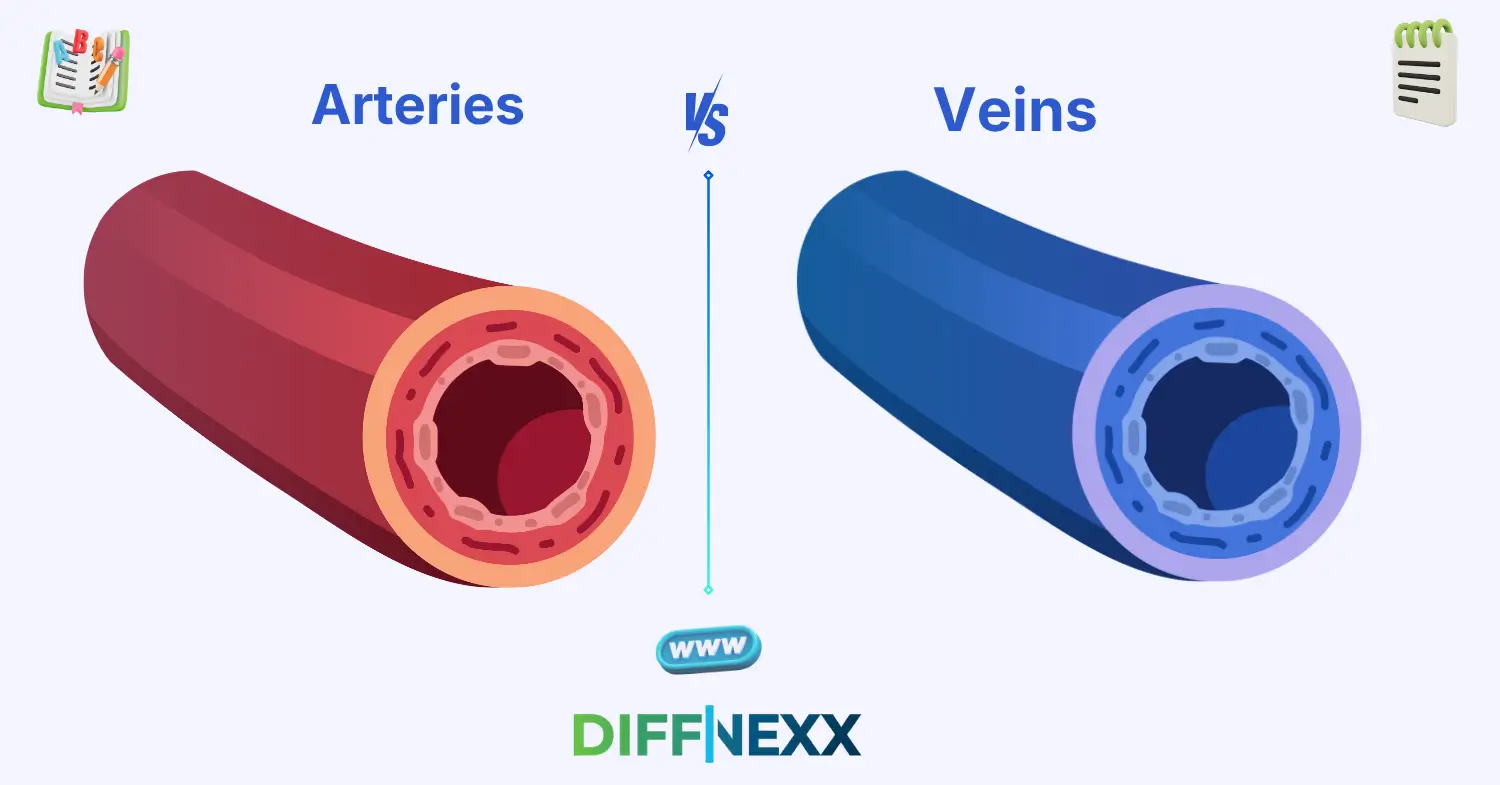
9. Color (In Diagrams)
Arteries are shown as red. Veins are shown as blue.
- Example for Arteries: Red lines in diagrams.
- Example for Veins: Blue lines in diagrams.
10. Function Focus
Arteries focus on delivery. Veins focus on return.
- Example for Arteries: Deliver oxygen and nutrients.
- Example for Veins: Remove waste and carbon dioxide.
Why Knowing the Difference Matters 🎯
Students need this knowledge to understand biology clearly. It helps them connect theory with real-life body functions.
Professionals rely on this difference during medical procedures. It ensures safe injections and accurate diagnosis.
Socially, it helps people understand health risks and symptoms better.
Real-world Consequences of Confusion
Confusing arteries and veins can lead to medical errors, wrong treatments, or misunderstanding of health conditions.
Why People Get Confused 🤔
Similar Terms
The words sound alike and belong to the same system.
Semantic Overlap
Both deal with blood transport, which creates confusion.
Context-Based Usage
Teachers often explain them together, making differences less clear.
Informal Speech
People use them interchangeably in casual talk.
Connotation & Emotional Tone 🎭
Connotation = the emotional meaning associated with a word.
Arteries
- Positive: Strong, vital pathways
- Neutral: Biological structure
- Example: Arteries feel powerful and essential.
Veins
- Positive: Supportive return system
- Neutral: Biological structure
- Example: Veins feel calm and steady.
Usage in Metaphors, Similes & Idioms 🗣
- “Lifeblood flows through arteries” → symbol of energy
- “City veins” → roads carrying movement
Examples:
- The highways are the arteries of the city.
- Small streets act like veins connecting areas.
Comparison Table 📊
| Feature | Arteries | Veins |
|---|---|---|
| Meaning | Carry blood away | Carry blood back |
| Tone | Strong, active | Calm, returning |
| Usage | Oxygen delivery | Waste removal |
| Context | High pressure | Low pressure |
| Formality | Scientific | Scientific |
Which Is Better in What Situation? ⚖️
When to Use Arteries
Use “arteries” when discussing blood moving away from the heart or oxygen delivery. For example, in biology class, arteries explain how oxygen reaches organs.
When to Use Veins
Use “veins” when talking about blood returning to the heart. For example, doctors refer to veins when giving injections.
Situational Clarity
Choose the correct term based on blood direction.
Contextual Correctness
In medical and academic contexts, accuracy is essential.
Literary or Cultural References 📖
- Book: Gray’s Anatomy (Medical, Henry Gray, 1858)
- Movie: The Human Body (Documentary, UK, 1998)
These works explain the human body and circulatory system.
FAQs ❓
1. Do arteries always carry oxygen-rich blood?
Most arteries carry oxygen-rich blood, but there are exceptions. For example, pulmonary arteries carry oxygen-poor blood to the lungs. So, the rule is not absolute.
2. Why do veins have valves?
Veins have valves to prevent blood from flowing backward. This is important because blood in veins moves at low pressure. The valves help it return to the heart.
3. Can you see arteries under the skin?
Arteries are usually deep inside the body, so they are not visible. Veins, however, are often visible because they lie closer to the skin.
4. Which is more dangerous to damage—arteries or veins?
Damage to arteries is usually more dangerous because of high pressure. It can cause rapid blood loss. Vein injuries are generally less severe.
5. How can I remember the difference easily?
Think: “A” in arteries = “Away from the heart.”
Veins = “Visit the heart” (return blood).
Conclusion 🏁
The difference between arteries and veins is simple but very important. Arteries carry blood away from the heart under high pressure, while veins bring it back under low pressure. Their structure, function, and roles all support this basic idea.
Understanding this difference helps you learn biology more effectively and make sense of how your body works. It also improves your awareness of health and medical terms.
Keep exploring these concepts, and you will build a strong foundation in science. Small knowledge today leads to better understanding tomorrow.

Aamer Shahzad is the founder of Distinly.com, a fast-growing educational platform focused on high-intent “difference between” topics. With over 8 years of experience in English language education and analytical writing, I specialize in breaking down complex “difference between” topics into clear, structured, and easy-to-understand explanations. Distinly.com is your go-to resource for enhancing English skills and writing with confidence.
I specializes in building search-optimized, research-driven comparison content designed for clarity, authority, and long-term digital asset value.