Imagine you receive an elegant, thick envelope in the mail. It is an invitation to a gala. The bottom corner reads: “Black Tie Optional.” You open your closet and stare at your navy blue outfit. Is it enough? Or do you need that sharp, black ensemble with the shiny lapels you saw in the movies?
The difference between tux and suit is a common puzzle for individuals today. While both consist of a jacket and matching trousers, they carry very different social weights. A suit is your reliable partner for a business meeting or a nice dinner. A tuxedo, or “tux,” is a specialized garment reserved for the most significant moments in life.
Understanding the difference between tux and suit ensures you never feel underdressed at a wedding or overdressed at a job interview. By learning these nuances, you can navigate social waters with grace. Let’s explore the difference between tux and suit to help you make the right choice for your next big event. 👔
Key difference between the both
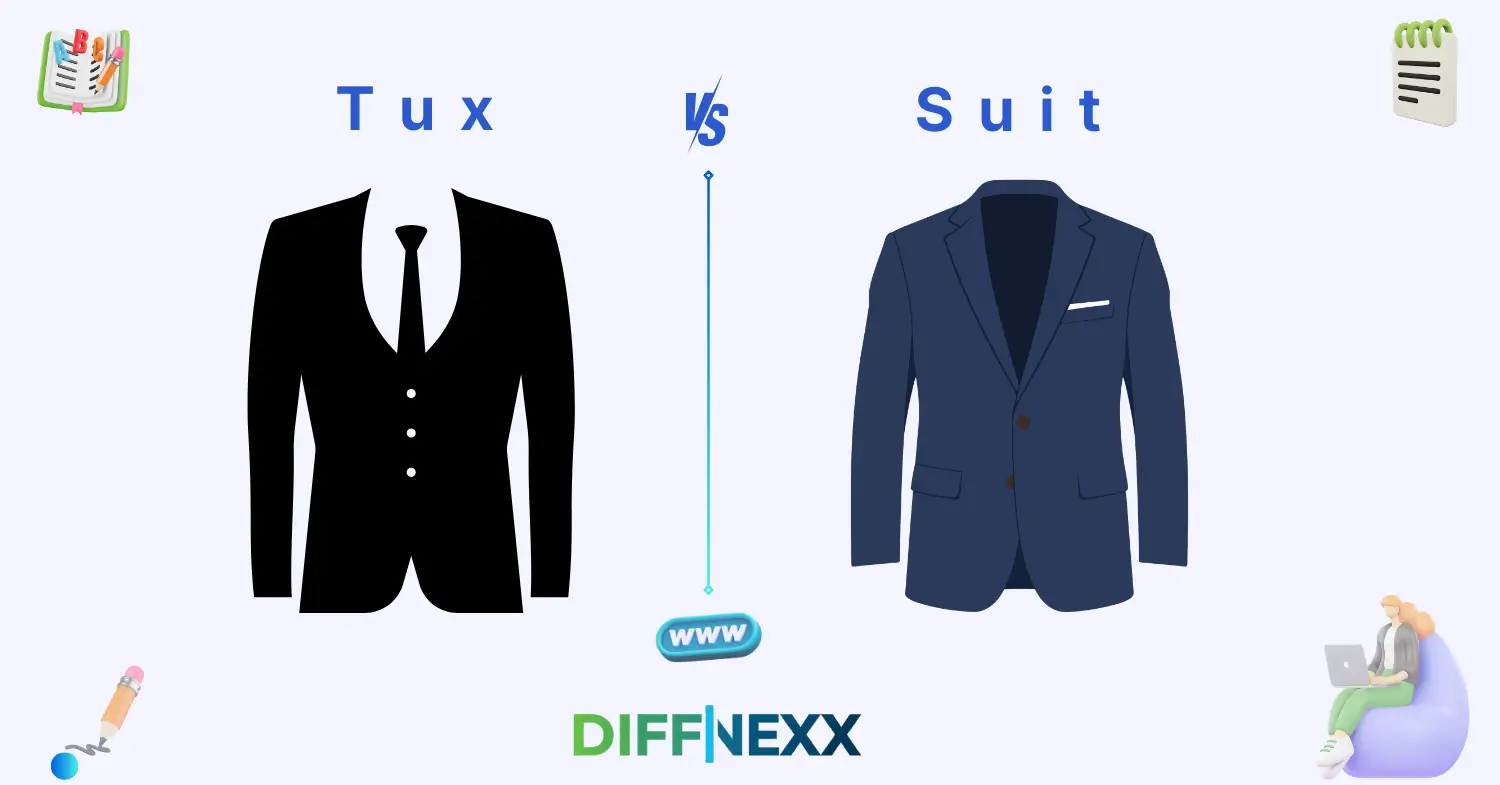
The primary difference between tux and suit is the presence of satin. A tuxedo features satin details—usually on the lapels, buttons, and a stripe down the side of the trousers. A suit is made of the same consistent fabric (usually wool or a blend) throughout the entire garment, including the buttons.
Importance for learners and experts
For English learners, knowing the difference between tux and suit is essential for cultural literacy. In many Western cultures, clothing is a language of its own. Using the term “tux” when you mean “suit” can cause confusion when planning events or shopping. It helps you understand specific vocabulary found in literature and film.
For experts in fashion or hospitality, this distinction is a mark of professionalism. Professionals must know which garment fits a specific dress code to provide accurate advice. In society, respecting these differences shows a high level of social awareness and respect for the host of an event. It tells the world you understand the “rules of the game.”
Pronunciation Section
Tux (Tuxedo)
US: /tʌkˈsiːdoʊ/
UK: /tʌkˈsiːdəʊ/
Suit
US: /suːt/
UK: /sjuːt/
Now that we can speak the names clearly, let’s define what makes each piece of clothing unique.
Core Definitions
Tux
A tuxedo is a formal evening suit traditionally worn for “black tie” events. It is characterized by satin accents and is meant to create a uniform, polished look for celebratory occasions. The emotional tone is one of high prestige and celebration. 🥂
- Example: A groom wearing a black tuxedo with a bow tie for a formal evening wedding.
Suit
A suit is a set of outer clothes made of the same fabric, designed for business or semi-formal wear. It is versatile and comes in many colors, patterns, and styles. The emotional tone is professional, organized, and reliable.
- Example: A lawyer wearing a charcoal grey suit to represent a client in court.
10 Clear Differences Between Tux and Suit
1. Satin Details
The most obvious physical difference is the use of satin. Tuxedos have satin-faced lapels and satin-covered buttons. Suits use the same fabric as the rest of the jacket for the lapels and usually have plastic or bone buttons.
- Tux Example: A jacket with shiny silk lapels that catch the light.
- Suit Example: A jacket where the lapels look exactly like the sleeves.
2. The Trousers
Tuxedo trousers feature a thin satin stripe running down the outer seam of the leg. Suit trousers do not have this stripe; they are plain and matching the jacket fabric perfectly.
- Tux Example: Pants that have a decorative black ribbon on the side.
- Suit Example: Standard slacks that you might wear with a dress shirt.
3. Shirt Style
Tuxedos require a specific “tuxedo shirt,” which often has a wing collar or a bibbed front with pleats. Suits are worn with standard long-sleeve dress shirts in various colors and patterns.
- Tux Example: A crisp white shirt with small black studs instead of buttons.
- Suit Example: A light blue button-down shirt with a standard pointed collar.
4. Neckwear
Traditionally, a tuxedo is always worn with a bow tie. While you can wear a bow tie with a suit, suits are much more commonly paired with a long necktie.
- Tux Example: A black silk bow tie tied by hand.
- Suit Example: A striped silk necktie tied in a Windsor knot.
5. Accessories
Tuxedos are often worn with a waistcoat (vest) or a cummerbund to cover the waist. Suits are typically worn with a leather belt or just a waistcoat for a “three-piece” look.
- Tux Example: A black pleated cummerbund worn around the waist.
- Suit Example: A brown leather belt that matches the shoes.
6. Footwear
A tuxedo demands highly polished, black patent leather shoes or velvet loafers. Suits are much more flexible, allowing for matte leather, suede, or even high-end sneakers in creative settings.
- Tux Example: Shiny shoes that look like a mirror.
- Suit Example: Classic brown brogues or oxfords.
7. Time of Day
Etiquette suggests that tuxedos are “evening wear,” meaning they should only be worn after 6:00 PM. Suits are appropriate for any time of day, from morning meetings to late-night dinners.
- Tux Example: Changing into a tuxedo for a gala held at sunset.
- Suit Example: Wearing a navy suit to an 11:00 AM brunch.
8. Color Palette
Tuxedos are traditionally limited to black or midnight blue, though “white dinner jackets” are common in summer. Suits come in an endless variety of colors like tan, olive, grey, and maroon.
- Tux Example: A classic James Bond black-and-white ensemble.
- Suit Example: A forest green wool suit for a fall office party.
9. Pocket Styles
Tuxedo pockets are usually “jetted,” meaning they are just a thin slit to keep the silhouette sleek. Suit pockets often have “flaps” that can be seen on the outside of the jacket.
- Tux Example: A pocket that looks like a subtle horizontal line.
- Suit Example: A pocket with a piece of fabric hanging over the opening.
10. Formality Level
The tuxedo is the pinnacle of formal wear below “White Tie.” The suit is considered semi-formal or business-professional. You cannot swap one for the other without changing the “message” of your outfit.
- Tux Example: Standing out as a guest of honor at a charity ball.
- Suit Example: Blending in perfectly at a corporate networking event.
Why Knowing the Difference Matters
Students must know the difference between tux and suit to prepare for future milestones like proms or graduations. Misunderstanding a dress code can lead to social anxiety or feeling out of place during important memories. It also helps students understand the symbolism used in classic literature when a character “dresses up.”
Professionals must know the difference to maintain a high-level image. In industries like finance, law, or high-end sales, wearing a tuxedo to a regular meeting would seem eccentric or strange. Conversely, wearing a business suit to a high-profile award ceremony might make you look like you didn’t put in enough effort.
The social consequences of confusion are usually mild but can be embarrassing. If you show up in a tuxedo to a “casual” wedding, you might be mistaken for the groom or the waitstaff. Being “the guy in the suit” at a black-tie gala makes you look like you didn’t read the invitation carefully.
Real-world consequences of confusion
In the luxury fashion industry, confusing these terms can lead to expensive mistakes. Ordering a “suit” for a wedding when the bride expects a “tuxedo” can result in last-minute tailoring fees and high stress. Always double-check the invite! 📅
Why People Get Confused
Semantic Overlap
Because both are “sets of matching clothes,” people assume the words are synonyms. In casual conversation, many use “suit” as a general category that includes tuxedos.
Influence of Informal Speech
Pop culture often uses the terms loosely. You might hear someone say, “I’m going to get suited up,” while they are actually putting on a tuxedo for a movie premiere.
Context-based Usage
In some regions, the distinction is fading. Some modern weddings allow “tuxedos with neckties,” which blurs the lines and makes it harder for observers to tell which is which.
Connotation & Emotional Tone
(Connotation = the emotional meaning attached to a word.)
For Tux:
- Positive: Glamorous, celebratory, “once-in-a-lifetime.”
- Neutral/Negative: Stiff, expensive, or overly formal.
- Example: “He looked like a movie star in his wedding tux.”
For Suit:
- Positive: Smart, professional, capable.
- Neutral/Negative: Corporate, routine, or “boring.”
- Example: “She wore her power suit to the board meeting.”
Usage in Metaphors, Similes & Idioms
- “The suits”: A metonym for high-level corporate executives or bureaucrats.
- Sentence: “The suits in the front office made the decision to cut the budget.”
- “Suit yourself”: An idiom meaning “do what you want,” though usually said with a bit of annoyance.
- Sentence: “If you don’t want to come to the party, suit yourself.”
Comparison Table
| Feature | Tux (Tuxedo) | Suit |
| Meaning | Formal evening wear | Professional/Semi-formal wear |
| Tone | Highly Formal / Glamorous | Professional / Versatile |
| Usage | Special Events / Black Tie | Office / Meetings / Parties |
| Context | Nighttime celebrations | Daily professional life |
| Formality | 10/10 | 6/10 to 8/10 |
Which Is Better in What Situation?
When to use Tux
Use a tuxedo when the invitation explicitly says “Black Tie” or “White Tie.” It is also the best choice for your own wedding if it is held in the evening.
When to use Suit
Use a suit for job interviews, funerals, church, and most weddings. If you aren’t sure about the dress code, a dark suit (navy or charcoal) is the safest “all-around” choice.
Situational Clarity
If the event is outdoors during the day (like a garden party), a suit is almost always better. If the event is in a ballroom after dark, a tuxedo is the way to go.
Contextual Correctness
If you are the host, you set the tone. If you wear a tuxedo, your guests will feel more comfortable dressing up.
Literary or Cultural References
- The Great Gatsby (Book, F. Scott Fitzgerald, 1925): Features many descriptions of “tuxedo-clad” guests at extravagant parties.
- James Bond Franchise (Movies, UK/USA): The tuxedo is the signature outfit of the world’s most famous spy.
- Kingsman: The Secret Service (Movie, UK, 2014): Focuses heavily on the philosophy that “the suit is the modern gentleman’s armor.”
FAQs
1. Can I wear a tuxedo to a job interview?
No. A tuxedo is for celebrations and parties. Wearing one to an interview will make you look like you don’t understand professional norms. Stick to a conservative suit.
2. Is a black suit the same as a tuxedo?
No. Even if the suit is black, if it lacks the satin lapels and the satin stripe on the leg, it is just a black suit. It is formal, but not “Black Tie” formal.
3. Do I have to wear a bow tie with a tuxedo?
Traditionally, yes. While some modern celebrities wear long ties with tuxedos on the red carpet, a bow tie remains the standard for true tuxedo etiquette.
4. Can women wear tuxedos?
Absolutely! “Le Smoking” (the female tuxedo) was popularized by Yves Saint Laurent in the 1960s. It remains a very chic, powerful alternative to an evening gown.
5. Why are tuxedos so expensive?
They often use higher-quality wools and real silk or satin. Because they are specialty items, they require more precise tailoring to look correct.
Conclusion
The difference between tux and suit comes down to the details. While a suit is a versatile tool for your daily life, the tuxedo is a costume for life’s most magical moments.
One says, “I am here to work,” while the other says, “I am here to celebrate.”
By paying attention to the satin, the shoes, and the clock, you can always ensure you are dressed perfectly for the occasion.
Clarity in your wardrobe leads to confidence in your social life. Whether you are stepping into a boardroom or a ballroom, knowing which garment to choose shows that you are a person of detail and style. Enjoy your next event and wear your choice with pride! ✨

Mira Anand is a writer at Distinly.com who focuses on storytelling, communication, and social perspective. Her work highlights subtle differences in language and meaning across cultures and communities. With a clear and empathetic voice, Mira helps readers understand how narratives shape understanding, relationships, and modern dialogue in an increasingly connected world.