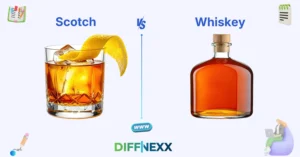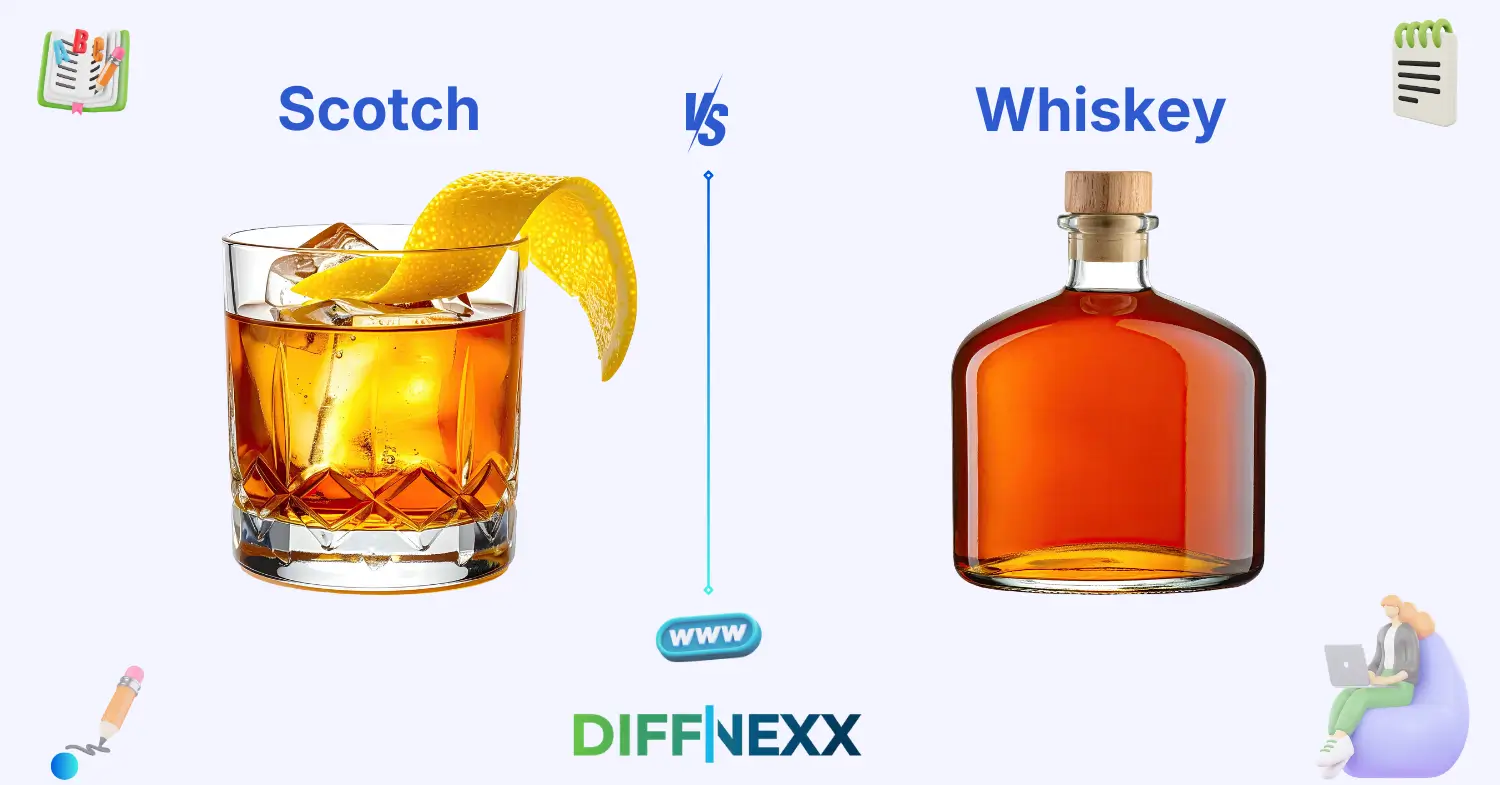
Difference between scotch and whiskey is something many people wonder about when they see different bottles on a store shelf or hear these words in movies. Imagine you are at a dinner, and someone offers you scotch while another person asks if you prefer whiskey. Both sound similar, but they are not exactly the same.
The difference between scotch and whiskey mainly comes from where the drink is made, how it is produced, and the rules that control its quality. Many learners think scotch and whiskey are two completely different drinks, but actually, scotch is a type of whiskey.
Understanding the difference between scotch and whiskey helps you speak correctly, especially in formal conversations, travel situations, or cultural discussions. These words also appear in books, films, and daily talk, so knowing their meaning is useful.
Before comparing them in detail, let us first look at the key difference between the two.
Key Difference Between the Both
The main difference is simple:
All scotch is whiskey, but not all whiskey is scotch.
Scotch must be made in Scotland, following strict rules.
Whiskey is a general term used for similar drinks made in different countries, such as Ireland and the United States.
Because of this, scotch is a specific category, while whiskey is a broader name.
Importance – Why Knowing the Difference Matters in Society
Knowing the difference between scotch and whiskey is useful for both learners and experts. Language is not only about words; it is also about culture, history, and correct communication.
For learners, understanding this difference improves vocabulary and helps avoid mistakes in speaking or writing. Many English learners confuse these terms because they sound similar.
For professionals, especially in hospitality, travel, writing, or education, using the correct term shows knowledge and respect for tradition. In society, correct word choice often reflects education and awareness.
Because these drinks are connected to culture and history, knowing the difference also helps people understand traditions in different countries.
🔊 Pronunciation Section
Scotch
US: /skɑːtʃ/
UK: /skɒtʃ/
Whiskey
US: /ˈwɪski/
UK: /ˈwɪski/
Although the pronunciation is not very difficult, the meanings are different.
Now let us define each word clearly before comparing them.
Core Definitions
Scotch
Scotch is a type of whiskey that must be made in Scotland.
It is produced using special rules about ingredients, aging, and location.
Scotch often has a strong, smoky, or rich flavor.
Example:
He ordered a glass of scotch after dinner.
Whiskey
Whiskey is a general name for distilled drinks made from grains.
It can be produced in many countries, and each place has its own style.
The taste can be light, sweet, strong, or smoky depending on the method.
Example:
She bought Irish whiskey as a gift.
10 Clear Differences Between Scotch and Whiskey
1. Country of Origin
Scotch is only made in Scotland, while whiskey can be made in many countries.
- Example for Scotch:
This bottle is real scotch from Scotland. - Example for Whiskey:
American whiskey has a sweeter taste.
2. Legal Rules
Scotch must follow strict laws about aging and ingredients.
Whiskey rules depend on the country where it is made.
- Example for Scotch:
Scotch must age at least three years. - Example for Whiskey:
Some whiskey types age for a shorter time.
3. Ingredients Used
Scotch usually uses malted barley.
Whiskey can use corn, rye, wheat, or barley.
- Example for Scotch:
Malted barley gives scotch its flavor. - Example for Whiskey:
Corn is common in American whiskey.
4. Flavor Style
Scotch often tastes smoky or earthy.
Whiskey flavors vary from sweet to strong.
- Example for Scotch:
This scotch has a smoky smell. - Example for Whiskey:
This whiskey tastes sweet and smooth.
5. Spelling Difference
Scotch uses the word “whisky” without e in some countries.
American and Irish whiskey often uses “whiskey” with e.
- Example for Scotch:
Scotch whisky is spelled without e. - Example for Whiskey:
Irish whiskey uses the letter e.
6. Aging Method
Scotch must age in oak barrels for at least three years.
Whiskey aging rules are different in each country.
- Example for Scotch:
This scotch aged for 10 years. - Example for Whiskey:
This whiskey aged for 4 years.
7. Production Location Importance
Location is very important for scotch.
For whiskey, location matters but rules are flexible.
- Example for Scotch:
It cannot be called scotch if made outside Scotland. - Example for Whiskey:
Whiskey can be made in many countries.
8. Cultural Identity
Scotch is strongly linked to Scottish culture.
Whiskey belongs to many cultures.
- Example for Scotch:
Scotch is part of Scottish tradition. - Example for Whiskey:
Whiskey is popular in Ireland and America.
9. Variety Types
Scotch has fewer types but strict quality.
Whiskey has many styles.
- Example for Scotch:
Single malt scotch is famous. - Example for Whiskey:
Bourbon is a type of whiskey.
10. Usage in Language
People use “whiskey” as a general word.
“Scotch” is used when the origin matters.
- Example for Scotch:
He prefers scotch over other drinks. - Example for Whiskey:
Whiskey is served in many countries.
Why Knowing the Difference Matters
Students must know the difference to avoid vocabulary mistakes. Using the wrong word can make writing unclear.
Professionals need this knowledge in hospitality, travel, and education. Correct terms show accuracy and respect for tradition.
In society, using the right word helps people communicate better, especially in formal settings.
Real-world consequences of confusion
If someone asks for scotch but receives another whiskey, the meaning changes.
In business or writing, such mistakes may look unprofessional.
Why People Get Confused
Similar spelling or pronunciation
Scotch and whiskey sound related, so learners think they are the same.
Semantic overlap
Scotch is a type of whiskey, so both words refer to similar drinks.
Context-based usage
People often say whiskey for all types, even when they mean scotch.
Influence of informal speech
In casual talk, rules are ignored, which creates confusion.
Connotation & Emotional Tone
Connotation = the emotional meaning associated with a word.
Scotch
Positive: luxury, tradition, quality
Example: He bought expensive scotch for the celebration.
Neutral: a type of drink
Example: Scotch is popular in Scotland.
Negative: strong alcohol
Example: Too much scotch can be harmful.
Whiskey
Positive: variety, culture
Example: Whiskey is enjoyed in many countries.
Neutral: general drink name
Example: Whiskey is made from grains.
Negative: strong liquor
Example: He drinks too much whiskey.
Usage in Metaphors, Similes & Idioms
- “Smooth as whiskey” – very calm
- “Strong like scotch” – powerful personality
Example with scotch:
His voice was strong like scotch.
Example with whiskey:
Her words were smooth as whiskey.
These are informal but common in speech.
Comparison Table
| Feature | Scotch | Whiskey |
|---|---|---|
| Meaning | Whiskey from Scotland | General distilled drink |
| Tone | Specific | General |
| Usage | Formal / specific | Common / general |
| Context | Cultural / legal | Worldwide |
| Formality | More formal | Neutral |
Which Is Better in What Situation?
When to use Scotch
Use scotch when talking about drinks made in Scotland.
Example: He collects rare scotch bottles.
When to use Whiskey
Use whiskey when speaking generally about the drink.
Example: Whiskey is popular worldwide.
Situational clarity
In formal writing, be specific.
In casual talk, general words may be fine.
Contextual correctness
Correct usage depends on origin and meaning.
Literary or Cultural References
- Book: Whisky: The Manual (Food & Drink, Dave Broom, 2014)
- Movie: Lost in Translation (USA, 2003) – shows whiskey culture in Japan.
These works show how the drink is part of culture.
FAQs
1. Is scotch the same as whiskey?
No. Scotch is a type of whiskey made in Scotland, but whiskey can be made anywhere.
2. Why is scotch called scotch?
It is named after Scotland, where it must be produced.
3. Which is stronger, scotch or whiskey?
Both can be strong. Strength depends on alcohol content, not the name.
4. Why is whiskey spelled differently?
Different countries use different spelling traditions.
5. Can all whiskey be called scotch?
No. Only whiskey made in Scotland can be called scotch.
Conclusion
The difference between scotch and whiskey is mainly about origin, rules, and usage. Scotch is a specific type of whiskey made in Scotland, while whiskey is a general name for similar drinks made in many countries. Knowing this difference helps learners speak clearly and correctly.
Understanding these words is useful in conversation, writing, and cultural knowledge. Small vocabulary differences often carry important meaning, and learning them improves confidence in English.
Keep practicing word comparisons like this. The more you learn, the easier it becomes to use the right word in the right situation.

Ezra Hale is a thoughtful contributor to Distinly.com, where he explores philosophical ideas and the subtle differences behind everyday concepts. His writing blends logic, language, and human insight to clarify complex distinctions. Ezra encourages readers to think deeper, question assumptions, and appreciate the meaning behind words and ideas in modern discourse.