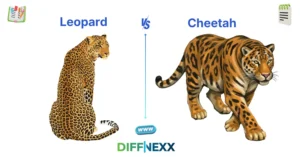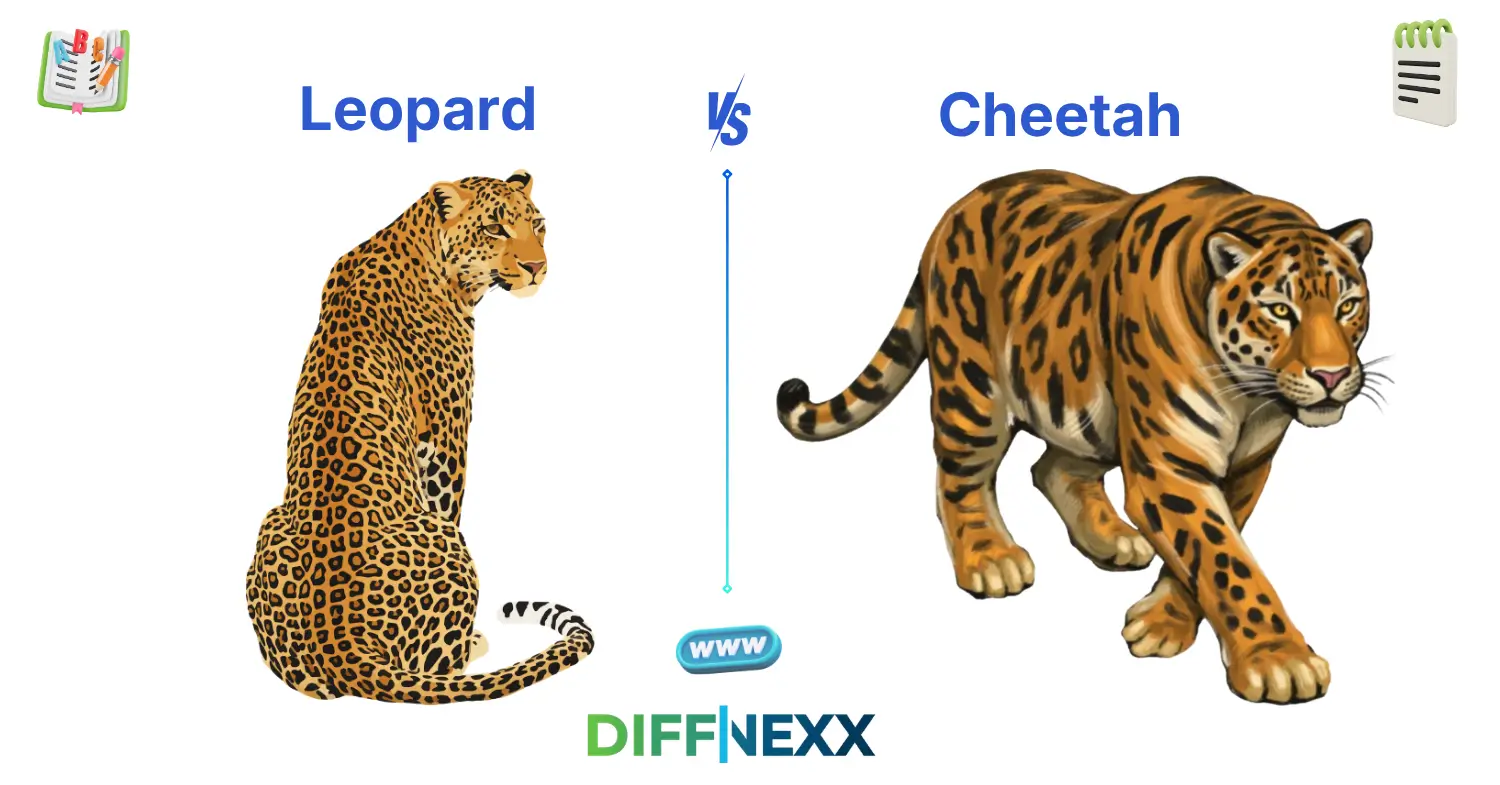
Difference between leopard and cheetah often comes up when watching wildlife documentaries or visiting a zoo. You might see two spotted big cats and wonder, “Are they the same?” At first glance, they look similar, but they are quite different.
The difference between leopard and cheetah lies in their speed, body shape, hunting style, and markings. Both are powerful predators, yet each has unique traits that set them apart.
Many learners struggle with the difference between leopard and cheetah because both animals share similar habitats and spotted coats. However, careful observation reveals clear distinctions.
Let’s break down these differences step by step so you can identify them easily.
Key Difference Between the Both 🧠
The main difference is that cheetahs are built for speed, while leopards are built for strength and stealth.
Cheetahs run very fast to catch prey in open areas. Leopards rely on power and climbing skills to hunt and store food.
Importance – Why Their Difference Matters 🌍
Understanding the difference between leopard and cheetah is important for learners and experts.
For students, it builds knowledge of animal classification and adaptation. It helps them understand how animals survive in different environments.
For wildlife experts, this knowledge supports conservation efforts and accurate research.
In society, it improves awareness about wildlife and reduces misinformation about these animals.
🔊 Pronunciation Section
Leopard
US: /ˈlep.ɚd/
UK: /ˈlep.əd/
Cheetah
US: /ˈtʃiː.tə/
UK: /ˈtʃiː.tə/
Now that you know how to say them, let’s define them clearly.
📚 Core Definitions
Leopard
A leopard is a strong and adaptable big cat known for its rosette-shaped spots. It is a skilled climber and often hunts quietly at night. It gives a sense of power and stealth.
Example: A leopard carried its prey up a tree to keep it safe.
Cheetah
A cheetah is the fastest land animal, built for speed and agility. It has solid black spots and distinctive tear marks on its face. It represents speed and precision.
Example: A cheetah chased its prey across the open grassland.
📚 10 Clear Differences Between Leopard and Cheetah
1. Speed
Cheetahs are the fastest land animals. Leopards are not as fast but are stronger.
- Example for leopard: The leopard moved slowly and carefully.
- Example for cheetah: The cheetah sprinted at high speed.
2. Body Structure
Leopards have muscular, heavy bodies. Cheetahs have slim, lightweight bodies.
- Example for leopard: The leopard looked powerful.
- Example for cheetah: The cheetah looked thin and fast.
3. Spot Patterns
Leopards have rosette-shaped spots. Cheetahs have solid round spots.
- Example for leopard: The coat had complex patterns.
- Example for cheetah: The coat had simple black dots.
4. Face Markings
Cheetahs have tear-like black lines on their face. Leopards do not.
- Example for leopard: The face looked plain.
- Example for cheetah: Dark lines ran from eyes to mouth.
5. Climbing Ability
Leopards are excellent climbers. Cheetahs rarely climb trees.
- Example for leopard: The leopard rested on a tree branch.
- Example for cheetah: The cheetah stayed on the ground.
6. Hunting Style
Leopards use stealth and ambush. Cheetahs rely on speed and chase.
- Example for leopard: The leopard hid before attacking.
- Example for cheetah: The cheetah ran after prey.
7. Habitat Preference
Leopards adapt to forests and mountains. Cheetahs prefer open grasslands.
- Example for leopard: The leopard lived in dense forest.
- Example for cheetah: The cheetah lived in open plains.
8. Strength vs Speed
Leopards focus on strength. Cheetahs focus on speed.
- Example for leopard: The leopard dragged heavy prey.
- Example for cheetah: The cheetah relied on quick bursts.
9. Behavior
Leopards are solitary and secretive. Cheetahs can be more social.
- Example for leopard: The leopard stayed hidden.
- Example for cheetah: Cheetahs moved in small groups.
10. Vocal Sounds
Leopards roar or growl. Cheetahs chirp and purr.
- Example for leopard: The leopard growled loudly.
- Example for cheetah: The cheetah made soft chirping sounds.
🎯 Why Knowing the Difference Matters
Students benefit by understanding animal adaptations and ecosystems. It improves their scientific knowledge.
Professionals, such as wildlife researchers, rely on accurate identification for conservation work and data collection.
In daily life, correct knowledge prevents misinformation and improves awareness about wildlife.
Real-world Consequences of Confusion
Confusing these animals can lead to incorrect reports or misunderstandings in education and media. It may also affect conservation efforts.
🧠 Why People Get Confused
Similar Appearance
Both animals have spotted coats, which makes them look alike.
Semantic Overlap
People often use “big cat” without specifying the species.
Context-Based Usage
In fast-moving scenes, it is hard to distinguish them.
Influence of Informal Speech
Casual language ignores scientific accuracy.
🎭 Connotation & Emotional Tone
Connotation = the emotional meaning associated with a word.
Leopard
- Positive: Strength and stealth (e.g., “He moved like a leopard.”)
- Neutral: A wild predator
Cheetah
- Positive: Speed and agility (e.g., “Fast as a cheetah.”)
- Neutral: A hunting animal
🗣 Usage in Metaphors, Similes & Idioms
- “A leopard cannot change its spots” → people cannot change their nature
- Example: He kept repeating mistakes; a leopard cannot change its spots.
- “Fast as a cheetah” → extremely fast
- Example: The athlete ran as fast as a cheetah.
📊 Comparison Table
| Feature | Leopard | Cheetah |
|---|---|---|
| Meaning | Strong big cat | Fast big cat |
| Tone | Powerful | Speed-focused |
| Usage | Wildlife & metaphor | Speed comparisons |
| Context | Forests, trees | Open grasslands |
| Formality | Neutral | Neutral |
⚖️ Which Is Better in What Situation?
When to use Leopard
Use “leopard” when describing strength, stealth, or climbing ability.
When to use Cheetah
Use “cheetah” when focusing on speed and agility.
Situational Clarity
If the animal runs fast in open land, it is likely a cheetah. If it climbs trees, it is likely a leopard.
Contextual Correctness
Choose the word based on physical traits and behavior for accuracy.
📖 Literary or Cultural References
- Book: The Jungle Book (Fiction, Rudyard Kipling, 1894) – features big cats
- Movie: The Lion King (USA, 1994) – represents African wildlife
These works highlight the role of big cats in storytelling.
❓ FAQs
1. Which is faster, leopard or cheetah?
Cheetah is much faster and is the fastest land animal.
2. Can leopards and cheetahs live in the same area?
Yes, but they prefer different environments and avoid direct competition.
3. Are leopards stronger than cheetahs?
Yes, leopards are stronger and more muscular.
4. Why do cheetahs have tear marks?
They help reduce sunlight glare and improve focus during hunting.
5. Can cheetahs climb trees?
They can climb slightly, but they are not strong climbers like leopards.
🏁 Conclusion
The difference between leopard and cheetah becomes clear when you focus on their key traits. Leopards are strong, stealthy, and excellent climbers. Cheetahs are fast, agile, and built for speed.
Understanding this difference helps improve knowledge, supports wildlife awareness, and enhances communication. It also allows you to identify these animals correctly in real life or media.
Next time you see a spotted big cat, look closely at its body, behavior, and movement. With practice, you will easily tell whether it is a leopard or a cheetah and that knowledge makes observing nature even more exciting. 🐾

Mira Anand is a writer at Distinly.com who focuses on storytelling, communication, and social perspective. Her work highlights subtle differences in language and meaning across cultures and communities. With a clear and empathetic voice, Mira helps readers understand how narratives shape understanding, relationships, and modern dialogue in an increasingly connected world.