Difference between recession and depression becomes important when you hear news about the economy slowing down. Imagine businesses closing, jobs becoming scarce, and people spending less. But is it just a recession, or something worse?
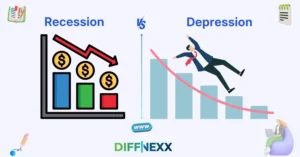
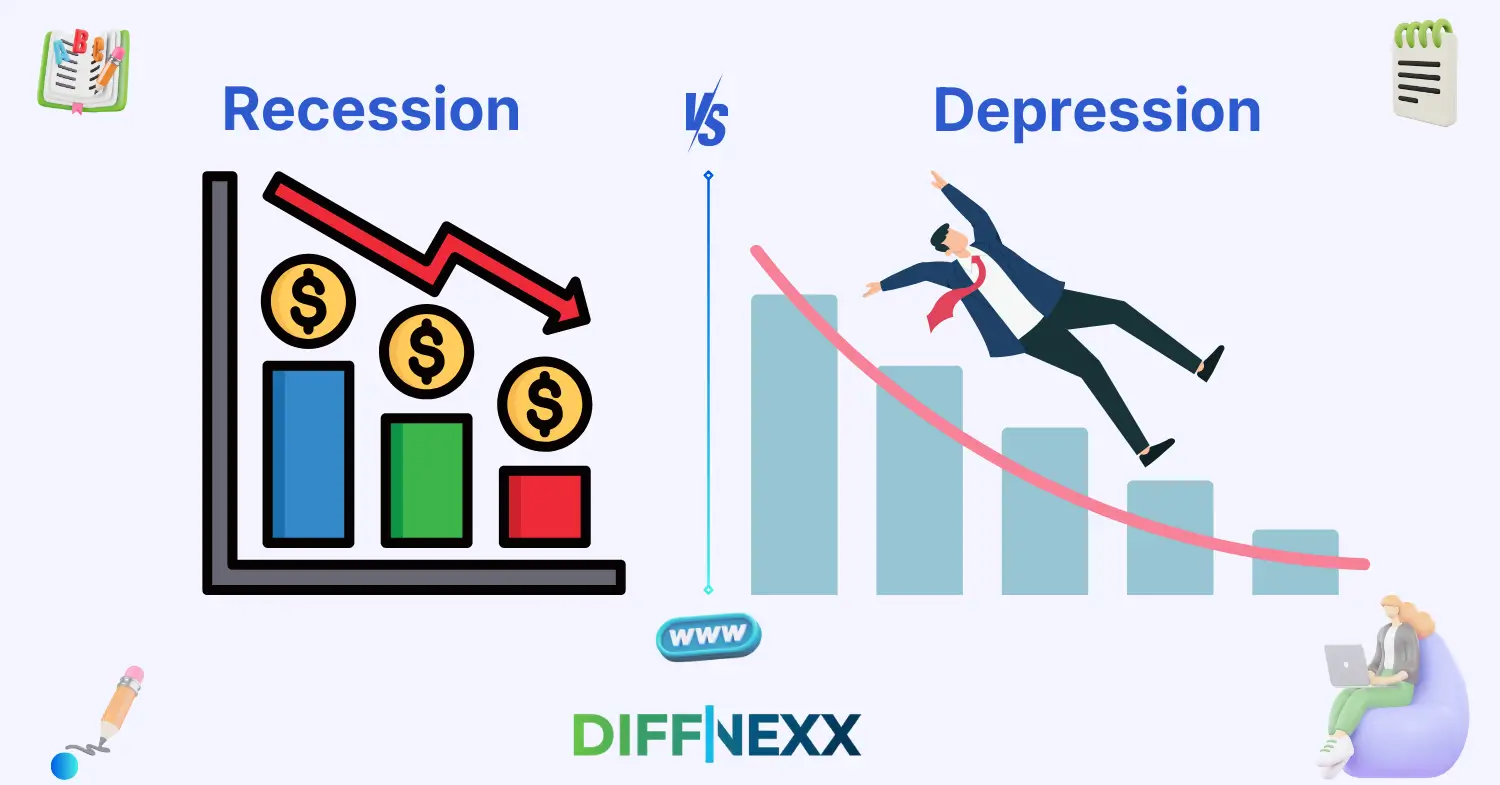
The difference between recession and depression is mainly about how deep and how long the economic decline lasts. A recession is a short-term slowdown, while a depression is a severe and long-lasting crisis.
Many people use these terms loosely, but they are not the same. Understanding the difference between recession and depression helps you follow economic news and make smarter decisions.
Let’s break it down in a clear and simple way.
Key Difference Between the Both
The main difference between recession and depression lies in severity and duration.
- Recession = Mild to moderate economic decline, short-term
- Depression = Severe economic collapse, long-term
A recession slows the economy. A depression can deeply damage it.
Importance – Why Is Their Difference Necessary to Know
Knowing the difference between recession and depression helps students understand basic economic concepts and global events.
For professionals like economists, business owners, and policymakers, this knowledge is essential for planning and decision-making.
In society, economic conditions affect jobs, prices, and daily life. Clear understanding helps people stay informed and prepared.
🔊 Pronunciation Section
Recession
US: /rɪˈsɛʃən/
UK: /rɪˈseʃən/
Depression
US: /dɪˈprɛʃən/
UK: /dɪˈpreʃən/
Now that you know how to pronounce them, let’s define each term clearly.
📚 Core Definitions
Recession
A recession is a period when economic activity slows down for a few months or years. Businesses earn less, and unemployment may rise. The tone feels concerning but manageable.
Example:
The country faced a recession after a drop in exports.
Depression
A depression is a long and severe economic downturn with major job losses and business failures. It affects many sectors deeply. The tone feels serious and alarming.
Example:
The Great Depression caused widespread poverty.
📚 10 Clear Differences Between Recession and Depression
1. Emotional Intensity
A recession creates worry. A depression creates fear and panic.
- Example for Recession: People feel uncertain about jobs.
- Example for Depression: People fear losing homes and savings.
2. Duration
Recessions last months or a few years. Depressions last many years.
- Example for Recession: Economic slowdown for one year.
- Example for Depression: Crisis lasting a decade.
3. Focus
Recessions affect certain sectors. Depressions affect the entire economy.
- Example for Recession: Manufacturing slows down.
- Example for Depression: All industries collapse.
4. Severity
Recessions are moderate declines. Depressions are extreme downturns.
- Example for Recession: Small drop in GDP.
- Example for Depression: Massive drop in GDP.
5. Rationality (Response)
Governments can often manage recessions. Depressions are harder to control.
- Example for Recession: Interest rates are adjusted.
- Example for Depression: Large-scale reforms are needed.
6. Formality (Usage in Language)
“Recession” is commonly used in news. “Depression” is used rarely for extreme cases.
- Example for Recession: News reports a mild economic decline.
- Example for Depression: Used only in severe crises.
7. Context of Use
Recession appears in regular economic cycles. Depression appears in rare, historic events.
- Example for Recession: Happens every few years.
- Example for Depression: Happens once in generations.
8. Psychological Impact
Recessions cause stress. Depressions cause deep social distress.
- Example for Recession: People reduce spending.
- Example for Depression: People struggle to survive.
9. Tone
Recession has a cautious tone. Depression has a serious and alarming tone.
- Example for Recession: Economy is slowing down.
- Example for Depression: Economy is collapsing.
10. Expression Style
Recession is described with mild terms. Depression uses strong language.
- Example for Recession: “Economic slowdown.”
- Example for Depression: “Economic disaster.”
🎯 Why Knowing the Difference Matters
Students must understand the difference between recession and depression to study economics correctly and interpret global events.
Professionals need this knowledge to make smart financial and business decisions during economic changes.
In society, people rely on accurate information to plan spending, saving, and investments.
Real-world consequences of confusion
If people confuse the two, they may panic unnecessarily or underestimate serious risks. This can lead to poor financial decisions.
🧠 Why People Get Confused
Similar Spelling or Pronunciation
Both words end in “-cession” and “-pression,” which sound alike.
Semantic Overlap
Both describe economic decline, so people mix their meanings.
Context-Based Usage
Media sometimes uses dramatic language, causing confusion.
Influence of Informal Speech
People use “depression” casually to describe any bad economy.
🎭 Connotation & Emotional Tone
Connotation = the emotional meaning associated with a word.
Recession
- Positive: Temporary challenge
- Neutral: Economic slowdown
- Example: The recession slowed growth but recovery followed.
Depression
- Negative: Crisis, hardship, suffering
- Neutral: Severe economic collapse
- Example: The depression caused long-term damage.
🗣 Usage in Metaphors, Similes & Idioms
- “The market is in a recession phase.” (slow decline)
- “The economy fell into a depression.” (deep crisis)
These phrases show levels of economic trouble.
📊 Comparison Table
| Feature | Recession | Depression |
|---|---|---|
| Meaning | Short-term slowdown | Long-term collapse |
| Tone | Mild concern | Serious alarm |
| Usage | Common economic term | Rare extreme term |
| Context | Regular cycles | Historic crises |
| Formality | Common usage | Formal and rare |
⚖️ Which Is Better in What Situation?
When to Use Recession
Use “recession” when describing a temporary economic slowdown. For example, a country facing reduced growth for a year.
When to Use Depression
Use “depression” when describing a severe and long-lasting crisis. It fits major historical events.
Situational Clarity
Choose recession for mild decline. Choose depression for extreme collapse.
Contextual Correctness
In formal writing or news, always use the correct term based on severity and duration.
📖 Literary or Cultural References
- Book: The Great Crash 1929 (Economic History, John Kenneth Galbraith, 1955)
- Movie: Cinderella Man (USA, 2005) – Shows life during the Great Depression
❓ FAQs
1. Is a recession the same as a depression?
No, a recession is a mild economic decline, while a depression is much more severe and long-lasting.
2. How long does a recession last?
A recession usually lasts from a few months to a couple of years.
3. What causes a depression?
A depression can result from major financial crises, bank failures, and economic mismanagement.
4. Has the world experienced a depression before?
Yes, the most famous example is the Great Depression of the 1930s.
5. Can a recession turn into a depression?
Yes, if a recession becomes very severe and lasts for many years, it can develop into a depression.
🏁 Conclusion
The difference between recession and depression lies in how serious and how long the economic decline is. A recession is a temporary slowdown, while a depression is a deep and lasting crisis.
Understanding this difference helps you stay informed and make better financial and career decisions. It also allows you to interpret news and global events more accurately.
Economic changes are part of life, but knowledge gives you control. Keep learning, stay aware, and make smart choices for a stable future 📊.

Mira Anand is a writer at Distinly.com who focuses on storytelling, communication, and social perspective. Her work highlights subtle differences in language and meaning across cultures and communities. With a clear and empathetic voice, Mira helps readers understand how narratives shape understanding, relationships, and modern dialogue in an increasingly connected world.