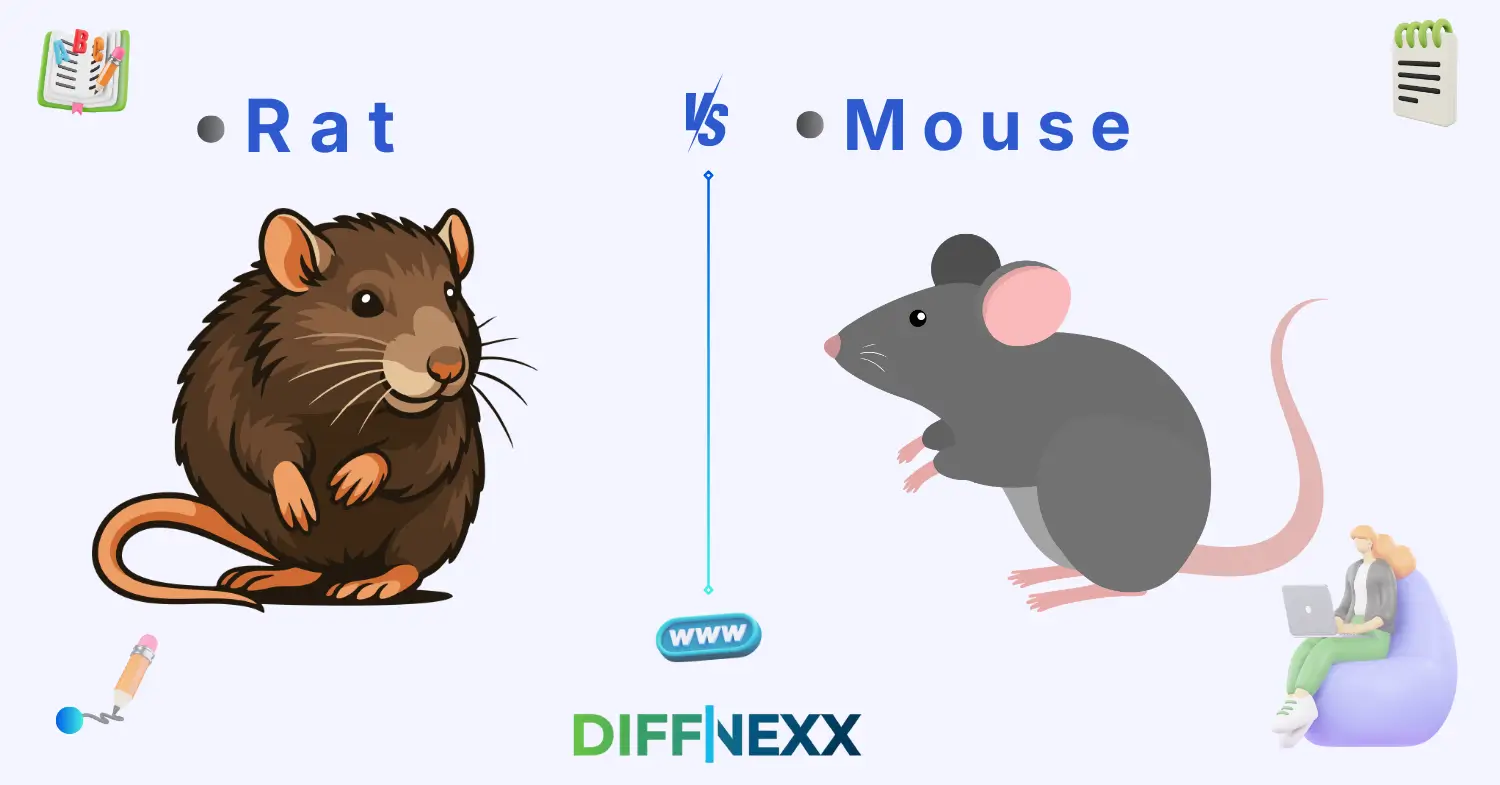
Difference between rat and mouse becomes important the moment you hear scratching in the wall at night. You grab a flashlight. You see a small, fast-moving rodent. But is it a rat or a mouse?
The difference between rat and mouse may seem simple at first. Both are small rodents. Both belong to the same scientific family. Yet they differ in size, behavior, and impact on human environments.
Many people confuse them because they look similar. However, the difference between rat and mouse matters in homes, farms, research labs, and public health systems.
Understanding this difference helps students, homeowners, and professionals respond correctly. Let’s explore it step by step.
Key Difference Between the Two
The key difference is size and physical build.
A rat is larger, heavier, and stronger.
A mouse is smaller, lighter, and more delicate.
This size difference also affects behavior, habitat, and risk level.
Why Is Their Difference Necessary to Know
Students studying biology must identify species accurately. Clear identification improves scientific learning and observation skills.
Health professionals and pest control experts need precise knowledge. Rats often cause more structural damage and health risks than mice.
Society benefits when people respond correctly to infestations. Proper identification leads to safer and more effective solutions.
Now, let’s clarify pronunciation before comparing them deeply.
🔊 Pronunciation
Rat
US: /ræt/
UK: /ræt/
Mouse
US: /maʊs/
UK: /maʊs/
Both words are short and easy to say. Now let’s define them clearly before comparing.
📚 Core Definitions
Rat
A rat is a medium-sized rodent belonging to the genus Rattus. It has a long tail, strong body, and sharp teeth. People often associate rats with urban environments and sewers.
The word sometimes carries a negative emotional tone because of disease concerns.
Example:
City Alley – “A rat ran across the garbage bins.”
Mouse
A mouse is a small rodent belonging to the genus Mus. It has a tiny body, pointed nose, and thin tail. Many people see mice as less threatening than rats.
The word can even sound gentle or harmless in tone.
Example:
Kitchen Corner – “A mouse hid behind the cupboard.”
📚 10 Clear Differences Between Rat and Mouse
1. Size
Rats are significantly larger than mice. Adult rats can grow up to 9–11 inches long, excluding the tail. Mice usually measure about 2–4 inches.
Example for Rat: “The rat was nearly the size of a small kitten.”
Example for Mouse: “The mouse fit easily in a small trap.”
2. Body Structure
Rats have thick, heavy bodies. Mice have slim and delicate frames.
Example for Rat: “The rat’s body looked strong and muscular.”
Example for Mouse: “The mouse had a tiny, fragile shape.”
3. Head and Face Shape
Rats have blunt snouts. Mice have pointed noses and larger ears compared to their head size.
Example for Rat: “The rat’s face appeared wide.”
Example for Mouse: “The mouse’s nose was sharp and pointed.”
4. Tail Thickness
Rats have thicker, heavier tails. Mice have thin, delicate tails.
Example for Rat: “The rat’s tail looked strong.”
Example for Mouse: “The mouse’s tail looked like a thin string.”
5. Behavior
Rats are cautious and intelligent. They avoid new objects at first. Mice are curious and explore quickly.
Example for Rat: “The rat avoided the new trap.”
Example for Mouse: “The mouse entered the trap immediately.”
6. Damage Level
Rats cause more structural damage because of their size and teeth strength. Mice cause smaller-scale damage.
Example for Rat: “The rat chewed through thick wood.”
Example for Mouse: “The mouse gnawed on food packaging.”
7. Reproduction Rate
Both reproduce quickly, but mice mature faster. They reach breeding age sooner.
Example for Rat: “The rat population grew steadily.”
Example for Mouse: “The mouse population increased rapidly.”
8. Lifespan
Rats usually live 2–3 years in safe conditions. Mice often live 1–2 years.
Example for Rat: “The pet rat lived for three years.”
Example for Mouse: “The mouse survived only one year.”
9. Social Structure
Rats form complex social groups. Mice show simpler social patterns.
Example for Rat: “The rats lived in organized colonies.”
Example for Mouse: “The mice scattered quickly.”
10. Public Perception
People often fear rats more. Mice sometimes appear in cartoons as cute characters.
Example for Rat: “The rat caused panic in the building.”
Example for Mouse: “The mouse looked harmless.”
🎯 Why Knowing the Difference Matters
Students must distinguish rats from mice in biology classes. Accurate identification builds scientific understanding.
Professionals such as pest control officers rely on correct identification. Different species require different treatment strategies.
Public health systems depend on clear communication. Mislabeling a rat as a mouse can delay serious action.
Real-World Consequences of Confusion
If someone assumes a rat infestation is just mice, they may underestimate structural damage or health risks. Quick and accurate identification protects homes and communities.
🧠 Why People Get Confused
Similar Appearance
Both are small, gray or brown rodents with long tails.
Same Family
They belong to the rodent family Muridae, which creates biological overlap.
Informal Language
People casually call any small rodent a “mouse” or “rat.”
Media Influence
Cartoons and movies simplify the distinction.
🎭 Connotation & Emotional Tone
Connotation = the emotional meaning attached to a word.
Connotation (bold) = the emotional meaning associated with a word.
Rat
Positive: Intelligence and survival skill.
Example: “The rat adapted quickly.”
Negative: Betrayal or dirtiness in slang.
Example: “He acted like a rat.”
Neutral: Scientific classification.
Example: “The rat belongs to the genus Rattus.”
Mouse
Positive: Gentleness or quietness.
Example: “She was as quiet as a mouse.”
Negative: Timidity.
Example: “He acted like a mouse during the debate.”
Neutral: Animal species reference.
Example: “The mouse lives in small burrows.”
🗣 Usage in Metaphors, Similes & Idioms
Common idioms include:
- “Smell a rat” (suspect something wrong).
- “Quiet as a mouse” (very silent).
Example Sentence:
“I smelled a rat in the deal.”
“She stayed quiet as a mouse during class.”
These expressions show cultural meaning beyond biology.
📊 Comparison Table
| Feature | Rat | Mouse |
|---|---|---|
| Meaning | Larger rodent (Rattus) | Smaller rodent (Mus) |
| Tone | Often negative | Often neutral or mild |
| Usage | Urban infestations | Household or lab reference |
| Context | Greater structural risk | Minor household presence |
| Formality | Neutral scientific term | Neutral scientific term |
⚖️ Which Is Better in What Situation?
When to Use Rat
Use “rat” when referring to a larger rodent with strong physical features. Example: “A rat damaged the storage area.”
When to Use Mouse
Use “mouse” for smaller rodents. Example: “A mouse hid under the sink.”
Situational Clarity
Choose based on size and species identification.
Contextual Correctness
In scientific writing, use precise classification like Rattus or Mus.
📖 Literary or Cultural References
- “Mrs. Frisby and the Rats of NIMH” (Fantasy, Robert C. O’Brien, 1971) features intelligent rats.
- Film: “Ratatouille” (USA, 2007) portrays a rat in a positive light.
- Film: “Stuart Little” (USA, 1999) presents a friendly mouse character.
These works shape public perception.
❓ FAQs
1. Are rats and mice the same species?
No. Rats and mice belong to different genera. Rats belong to Rattus, while mice belong to Mus. They share a family but differ genetically and physically.
2. Which is more dangerous?
Rats generally pose greater structural and health risks due to their size. They can chew through stronger materials and spread diseases. Mice also carry risks but on a smaller scale.
3. Can a mouse grow into a rat?
No. A mouse will never grow into a rat. They are separate species with different growth limits.
4. Do they live in the same places?
They can share similar environments like urban areas. However, rats prefer sewers and basements. Mice often live inside walls and cupboards.
5. Are both used in scientific research?
Yes. Both rats and mice are widely used in laboratory research. Scientists select species based on study requirements.
🏁 Conclusion
The difference between rat and mouse centers on size, structure, behavior, and impact. Rats are larger, stronger, and often more destructive. Mice are smaller and generally less threatening.
Understanding this distinction improves scientific knowledge, public health awareness, and everyday communication. Clear identification leads to better decisions and safer responses.
Next time you see a small rodent, observe carefully. Knowledge turns confusion into clarity. Keep learning and stay curious. 🐭✨

Ezra Hale is a thoughtful contributor to Distinly.com, where he explores philosophical ideas and the subtle differences behind everyday concepts. His writing blends logic, language, and human insight to clarify complex distinctions. Ezra encourages readers to think deeper, question assumptions, and appreciate the meaning behind words and ideas in modern discourse.