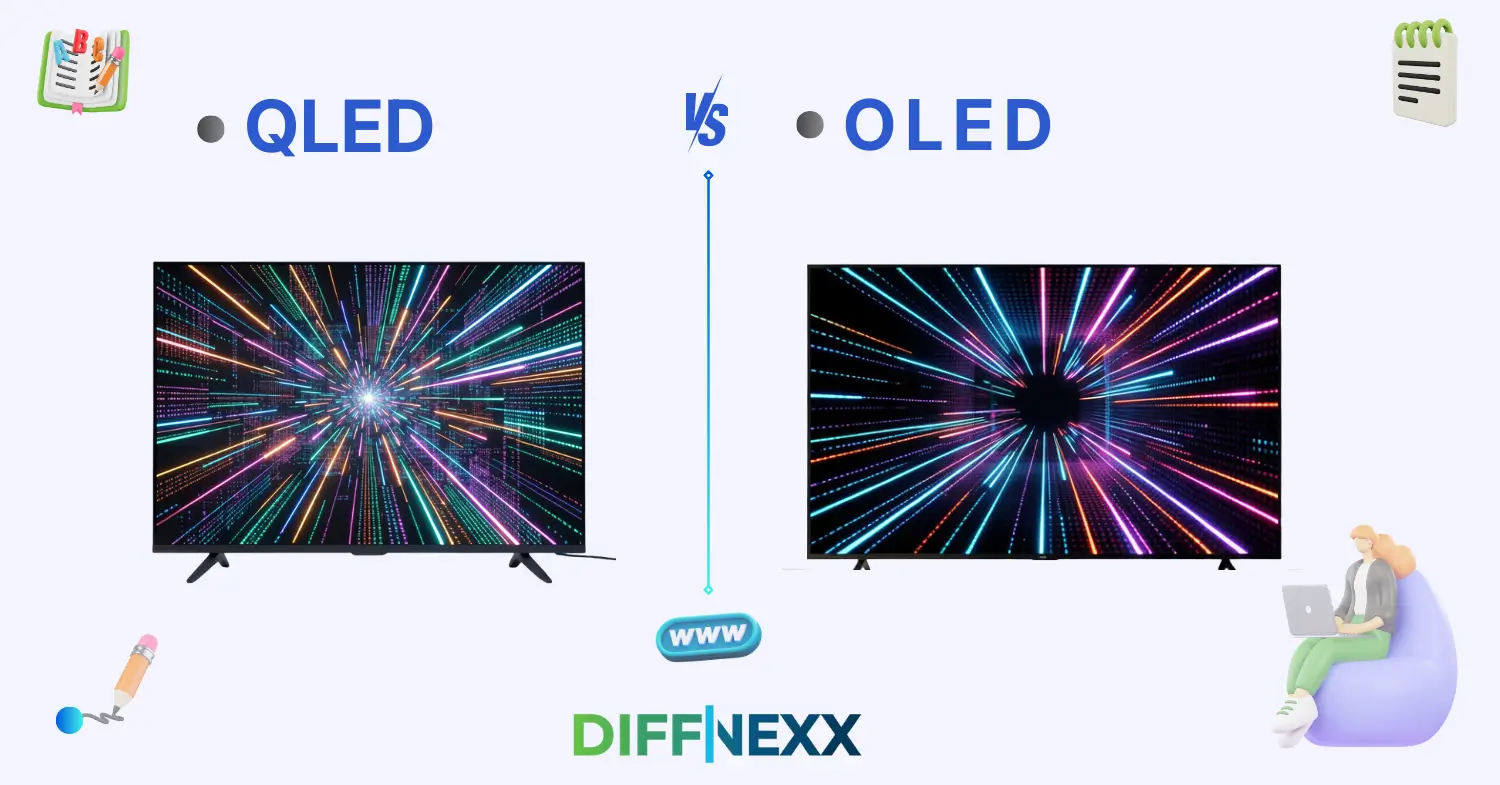
Difference between QLED and OLED often becomes confusing when you walk into an electronics store. The screens look bright. The colors look stunning. Sales labels shout “QLED” and “OLED.” But what do those words really mean?
The difference between QLED and OLED starts with how each display creates light. QLED stands for Quantum Light-Emitting Diode. It uses a backlight and quantum dots to enhance color. OLED stands for Organic Light-Emitting Diode. It uses self-lighting pixels that turn on and off individually.
Understanding the difference between QLED and OLED helps you choose the right TV for your space, lighting, and viewing habits. Both look impressive. Yet they work very differently.
Let’s explore their key differences step by step.
Key Difference Between the Two
The core difference is simple.
QLED uses a backlight behind the screen.
OLED does not use a backlight. Each pixel creates its own light.
This single technical difference changes brightness, contrast, and overall picture quality.
Why Is Their Difference Necessary to Know
Consumers need this knowledge to make informed buying decisions. A bright living room and a dark home theater need different display strengths.
Technology students and media professionals must understand display systems. It improves design, editing, and product recommendations.
In society, screens shape entertainment, gaming, and digital learning. Knowing the difference prevents overspending or choosing the wrong display for your needs.
Now, let’s look at pronunciation.
🔊 Pronunciation
QLED
US: /ˈkjuːˌlɛd/
UK: /ˈkjuːˌlɛd/
OLED
US: /ˈoʊˌlɛd/
UK: /ˈəʊˌlɛd/
Although they sound similar, their technology is quite different. Let’s define them clearly.
📚 Core Definitions
QLED
QLED is a display technology that uses quantum dots with an LED backlight. It enhances brightness and color accuracy. The screen depends on external lighting behind the panel.
It feels bright and vivid, especially in well-lit rooms.
Example:
Bright Living Room – “The QLED TV looked clear even with sunlight in the room.”
OLED
OLED is a display technology where each pixel produces its own light. It does not need a backlight. Pixels can turn completely off to create true black.
It feels cinematic and deep, especially in dark rooms.
Example:
Home Theater Night – “The OLED TV created deep blacks during the movie.”
📚 10 Clear Differences Between QLED and OLED
1. Light Source
QLED uses a backlight.
OLED uses self-lighting pixels.
Example for QLED: “The QLED screen stayed bright all day.”
Example for OLED: “The OLED pixels turned off for perfect black.”
2. Black Levels
QLED cannot achieve perfect black because the backlight remains active.
OLED achieves true black by turning pixels off.
Example for QLED: “Dark scenes looked slightly gray.”
Example for OLED: “The night sky looked completely black.”
3. Brightness
QLED TVs are usually brighter.
OLED TVs are bright but not as intense in peak brightness.
Example for QLED: “The QLED handled sunlight easily.”
Example for OLED: “The OLED looked best in dim lighting.”
4. Contrast Ratio
QLED offers strong contrast but depends on local dimming.
OLED offers near-infinite contrast due to pixel control.
Example for QLED: “Contrast improved with dimming zones.”
Example for OLED: “Contrast felt dramatic and sharp.”
5. Risk of Burn-In
QLED has minimal burn-in risk.
OLED may experience burn-in with static images over time.
Example for QLED: “The QLED showed no logo marks.”
Example for OLED: “Static images can affect OLED over years.”
6. Viewing Angles
QLED viewing angles vary by model.
OLED offers wide and consistent viewing angles.
Example for QLED: “Colors faded from the side.”
Example for OLED: “The picture stayed clear from every seat.”
7. Thickness
QLED TVs are thin but use layered panels.
OLED TVs are extremely thin because no backlight exists.
Example for QLED: “The QLED looked sleek.”
Example for OLED: “The OLED panel appeared almost paper-thin.”
8. Energy Efficiency
QLED uses constant backlighting.
OLED saves power in dark scenes because pixels turn off.
Example for QLED: “Energy use stayed steady.”
Example for OLED: “Dark movies used less power.”
9. Gaming Performance
QLED handles bright HDR gaming well.
OLED delivers fast response time and deep contrast.
Example for QLED: “The QLED shined in daytime gaming.”
Example for OLED: “The OLED felt smoother in fast scenes.”
10. Price Range
QLED often offers more budget options.
OLED usually costs more due to advanced panel design.
Example for QLED: “The QLED fit my budget.”
Example for OLED: “The OLED felt premium.”
🎯 Why Knowing the Difference Matters
Students studying media technology must understand display mechanics. It builds technical awareness.
Professionals in video editing and gaming industries need precise color and contrast. Choosing the wrong display affects output quality.
Consumers may overspend or underperform if they ignore this difference.
Real-world Consequences of Confusion
Buying OLED for a bright office may cause glare frustration. Choosing QLED for a dark cinema room may limit deep blacks. Clarity saves money and improves experience.
🧠 Why People Get Confused
Similar Acronyms
Both names end in “LED.” This creates instant confusion.
Marketing Language
Brands highlight features without explaining core technology.
Visual Similarity
In stores, both screens look impressive under bright lighting.
🎭 Connotation & Emotional Tone
Connotation = the emotional meaning attached to a word.
QLED
Positive: Bright and vibrant.
Example: “QLED feels lively and colorful.”
Negative: Less cinematic in deep blacks.
Example: “QLED struggles slightly in dark scenes.”
Neutral: Modern LED technology.
Example: “QLED uses quantum dots.”
OLED
Positive: Premium and cinematic.
Example: “OLED delivers theater-like contrast.”
Negative: Sensitive to burn-in concerns.
Example: “OLED requires mindful use.”
Neutral: Self-lighting display system.
Example: “OLED pixels emit their own light.”
🗣 Usage in Metaphors, Similes & Idioms
While not idioms, metaphorical uses appear in tech discussions.
“OLED-level black” describes something extremely deep or dark.
“QLED brightness” suggests vivid clarity.
Example sentence:
“The night scene looked OLED-deep, while the daylight felt QLED-bright.”
📊 Comparison Table
| Feature | QLED | OLED |
|---|---|---|
| Meaning | Quantum dot LED with backlight | Self-lighting organic diode |
| Tone | Bright & vibrant | Cinematic & deep |
| Usage | Bright rooms, daytime viewing | Dark rooms, home theater |
| Context | Sports, TV shows | Movies, dramatic visuals |
| Formality | Tech retail term | Advanced display term |
⚖️ Which Is Better in What Situation?
When to Use QLED
Choose QLED for bright rooms with lots of sunlight. It works well for sports and daytime viewing.
When to Use OLED
Choose OLED for dark rooms and movie nights. It delivers deep blacks and cinematic contrast.
Situational Clarity
Think about lighting conditions before buying.
Contextual Correctness
For gaming in bright spaces, QLED shines. For immersive film experiences, OLED excels.
📖 Literary or Cultural References
- “The Visual Display of Quantized Energy” (Science Text, 20th Century Physics Studies) explains quantum light principles.
- Film: “Tron: Legacy” (USA, 2010) showcases high-contrast digital visuals that highlight deep blacks similar to OLED strengths.
❓ FAQs
1. Is OLED always better than QLED?
Not always. OLED excels in dark rooms and contrast. QLED performs better in very bright spaces. Your environment matters more than the label.
2. Does QLED burn in like OLED?
QLED has very low burn-in risk. OLED can experience burn-in over long periods with static images. Modern OLED models reduce this risk significantly.
3. Which lasts longer?
Both technologies are durable. OLED panels may degrade slightly faster over many years. However, typical users will not notice quickly.
4. Which is better for gaming?
OLED offers faster response time and deeper contrast. QLED offers strong brightness for HDR games. Both can work well depending on lighting.
5. Why is OLED more expensive?
OLED panels require advanced manufacturing. Each pixel emits its own light. This increases production cost.
🏁 Conclusion
The difference between QLED and OLED comes down to light source and picture control. QLED relies on a backlight and excels in brightness. OLED uses self-lighting pixels and delivers perfect blacks and cinematic contrast.
Your room lighting, viewing habits, and budget should guide your choice. There is no universal winner. Instead, there is a right fit for your space.
When you understand the technology, you make smarter decisions. Stay informed, compare wisely, and choose the display that matches your lifestyle. 📺✨

Aamer Shahzad is the founder of Distinly.com, a fast-growing educational platform focused on high-intent “difference between” topics. With over 8 years of experience in English language education and analytical writing, I specialize in breaking down complex “difference between” topics into clear, structured, and easy-to-understand explanations. Distinly.com is your go-to resource for enhancing English skills and writing with confidence.
I specializes in building search-optimized, research-driven comparison content designed for clarity, authority, and long-term digital asset value.