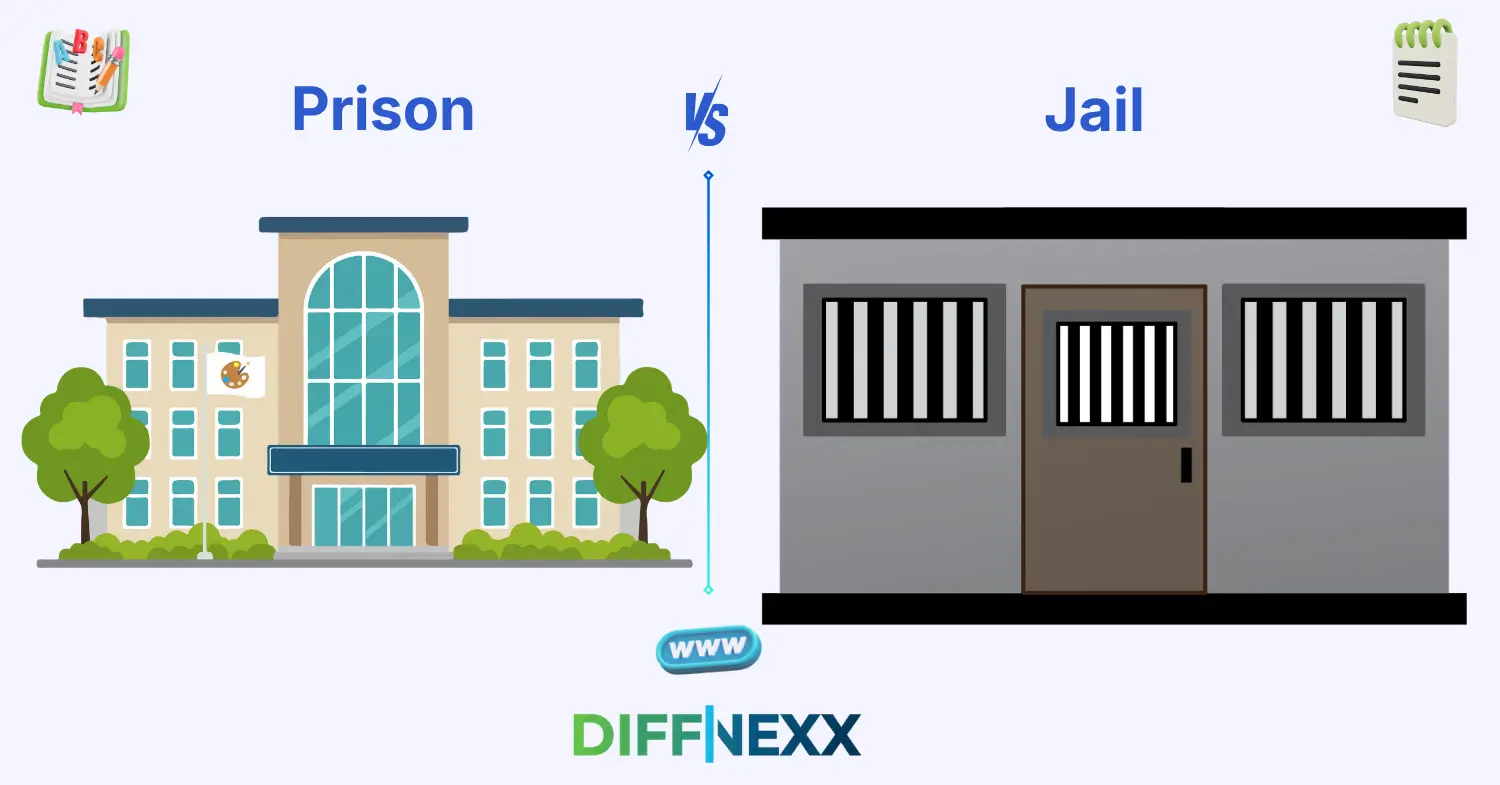
Difference between prison and jail is a question many people ask when they hear crime news or watch movies about law and punishment. Imagine hearing that someone was arrested and sent to jail, and later another person was sentenced to prison. Many people think both words mean the same place, but they are not exactly the same.
The difference between prison and jail is important because these two places are used for different purposes in the legal system. Jail is usually for short stays or for people waiting for trial, while prison is for people who have been convicted of serious crimes and must stay for a longer time.
Understanding the difference between prison and jail helps learners read news reports correctly and use the right word in conversation. These terms are common in law, movies, and daily speech, so knowing the correct meaning is useful.
In this guide, we will clearly explain both terms, compare them step by step, and show why knowing the difference matters.
Key difference between the both ⚖️
The main difference between prison and jail is the length and purpose of confinement.
A jail is usually a local facility where people stay for a short time, often before trial or for minor crimes.
A prison is a larger facility where people stay for a long time after being convicted of serious crimes.
Jails are often run by local authorities, while prisons are usually run by state or national governments.
Importance — Why their difference is necessary to know 🧠
Knowing the difference between prison and jail is important for students, readers, and professionals. These words appear in news, books, and legal discussions, so using the wrong word can change the meaning of a sentence.
In society, clear language helps people understand crime reports correctly. If someone says prison instead of jail, people may think the crime was more serious than it really was.
Experts such as lawyers, police officers, and journalists must know the difference because legal terms must be exact. For learners, understanding these words improves vocabulary and reading skills.
🔊 Pronunciation Section
Prison
US: /ˈprɪzən/
UK: /ˈprɪzən/
Jail
US: /dʒeɪl/
UK: /dʒeɪl/
These words sound very different, but they are often used in the same context. Now let us define each one before comparing them.
Core Definitions 📚
Prison 🔒
A prison is a large government facility where people stay after they are convicted of serious crimes. Prison sentences are usually long, and the goal is punishment and rehabilitation.
Example: He was sent to prison for ten years after the trial.
Jail 🚓
A jail is a local facility where people stay for a short time. People in jail may be waiting for trial, paying a fine, or serving a short sentence.
Example: She stayed in jail for two days after the arrest.
10 Clear Differences Between Prison and Jail 🔍
1. Emotional intensity 😟
Prison sounds more serious and strict.
Jail sounds less severe because the stay is shorter.
Example for Prison:
He was afraid of going to prison.
Example for Jail:
He spent one night in jail.
2. Duration ⌛
Prison stays are long.
Jail stays are short.
Example for Prison:
Five-year prison sentence.
Example for Jail:
One-week jail time.
3. Focus 🎯
Prison focuses on punishment after conviction.
Jail focuses on holding people before trial.
Example for Prison:
Serving a sentence.
Example for Jail:
Waiting for court.
4. Severity ⚠️
Prison is used for serious crimes.
Jail is used for minor crimes or temporary holding.
Example for Prison:
Robbery case.
Example for Jail:
Traffic violation arrest.
5. Rationality ⚖️
Prison follows long legal process.
Jail may be used immediately after arrest.
Example for Prison:
Sentenced after trial.
Example for Jail:
Taken to jail after arrest.
6. Formality 📄
Prison is common in legal writing.
Jail is common in everyday speech.
Example for Prison:
The court sent him to prison.
Example for Jail:
He went to jail last night.
7. Context of use 🏛️
Prison is used in court decisions.
Jail is used in police situations.
Example for Prison:
State prison sentence.
Example for Jail:
City jail arrest.
8. Psychological impact 🧠
Prison may cause long-term stress.
Jail may cause short-term fear.
Example for Prison:
Life in prison is difficult.
Example for Jail:
One night in jail was scary.
9. Tone in discussion 🗣️
Prison sounds stronger.
Jail sounds lighter in tone.
Example for Prison:
He faces prison time.
Example for Jail:
He spent time in jail.
10. Expression style ✍️
Prison appears in legal reports.
Jail appears in conversation and news.
Example for Prison:
The judge ordered prison.
Example for Jail:
Police took him to jail.
Why Knowing the Difference Matters 🎯
Students need to know the difference to understand news, books, and legal stories correctly. These words often appear in exams and reading passages.
Professionals must know the difference because law and journalism require exact language. Using the wrong word can give wrong information.
Clear communication also helps society understand crime and punishment without confusion.
Real-world consequences of confusion ⚠️
People may think a crime is more serious than it is.
News reports may sound incorrect.
Legal meaning may change.
Why People Get Confused 🤔
Similar meaning
Both involve being locked up.
Semantic overlap
Both are part of the justice system.
Context-based usage
Movies often use the words the same way.
Influence of informal speech
People say jail for all situations.
Connotation & Emotional Tone 🎭
Connotation = the emotional meaning associated with a word.
Prison
Strong negative tone.
Example: He feared going to prison.
Jail
Negative but lighter tone.
Example: He spent a night in jail.
Usage in Metaphors, Similes & Idioms 🗣️
Common idioms use jail more often.
Example:
Get out of jail free card.
Example:
He said the job felt like prison.
Comparison Table 📊
| Feature | Prison | Jail |
|---|---|---|
| Meaning | Long-term facility | Short-term facility |
| Tone | Serious | Less serious |
| Usage | Legal | Everyday |
| Context | After conviction | Before trial |
| Formality | Formal | Less formal |
Which Is Better in What Situation? ⚖️
When to use Prison
Use prison when talking about long sentences after conviction.
When to use Jail
Use jail when talking about short stays or arrest.
Situational clarity
Think about length of stay.
Contextual correctness
Correct word makes legal meaning clear.
Literary or Cultural References 🎬
Book:
The Shawshank Redemption (1982, Stephen King)
Movie:
The Shawshank Redemption (USA, 1994)
Both show life in prison and explain the difference from jail.
FAQs ❓
1. Is jail the same as prison?
No. Jail is for short stays, prison is for long sentences.
2. Who goes to jail?
People waiting for trial or serving short sentences.
3. Who goes to prison?
People convicted of serious crimes.
4. Can someone go from jail to prison?
Yes, after the court decision.
5. Why do people mix these words?
Because both mean being locked up.
Conclusion 🏁
The difference between prison and jail is mainly about time, purpose, and seriousness. Jail is used for short stays, often before trial or for small crimes, while prison is used for long sentences after conviction. Even though both are part of the justice system, they are not the same.
Knowing the correct meaning helps students, readers, and professionals understand legal news and stories clearly. It also makes communication more accurate and prevents confusion. When you learn the difference between these words, your vocabulary becomes stronger and more precise.
Keep practicing these terms, and you will use them correctly with confidence.

Ezra Hale is a thoughtful contributor to Distinly.com, where he explores philosophical ideas and the subtle differences behind everyday concepts. His writing blends logic, language, and human insight to clarify complex distinctions. Ezra encourages readers to think deeper, question assumptions, and appreciate the meaning behind words and ideas in modern discourse.