Difference between possum and opossum often confuses people during late-night wildlife sightings. Imagine you step outside and see a small gray animal near your trash bin. Someone says, “That’s a possum!” Another replies, “No, it’s an opossum!” Who is right?
The difference between possum and opossum is more than spelling. These animals live in different parts of the world. They also belong to different biological groups. Understanding the difference between possum and opossum helps you speak accurately and avoid common mistakes.
Both are marsupials, meaning they carry babies in a pouch. However, they are not the same species. Let us explore what truly sets them apart.
🐾 Key Difference Between the Both
The key difference is geography and species.
Opossums live in North and South America.
Possums live mainly in Australia and nearby regions.
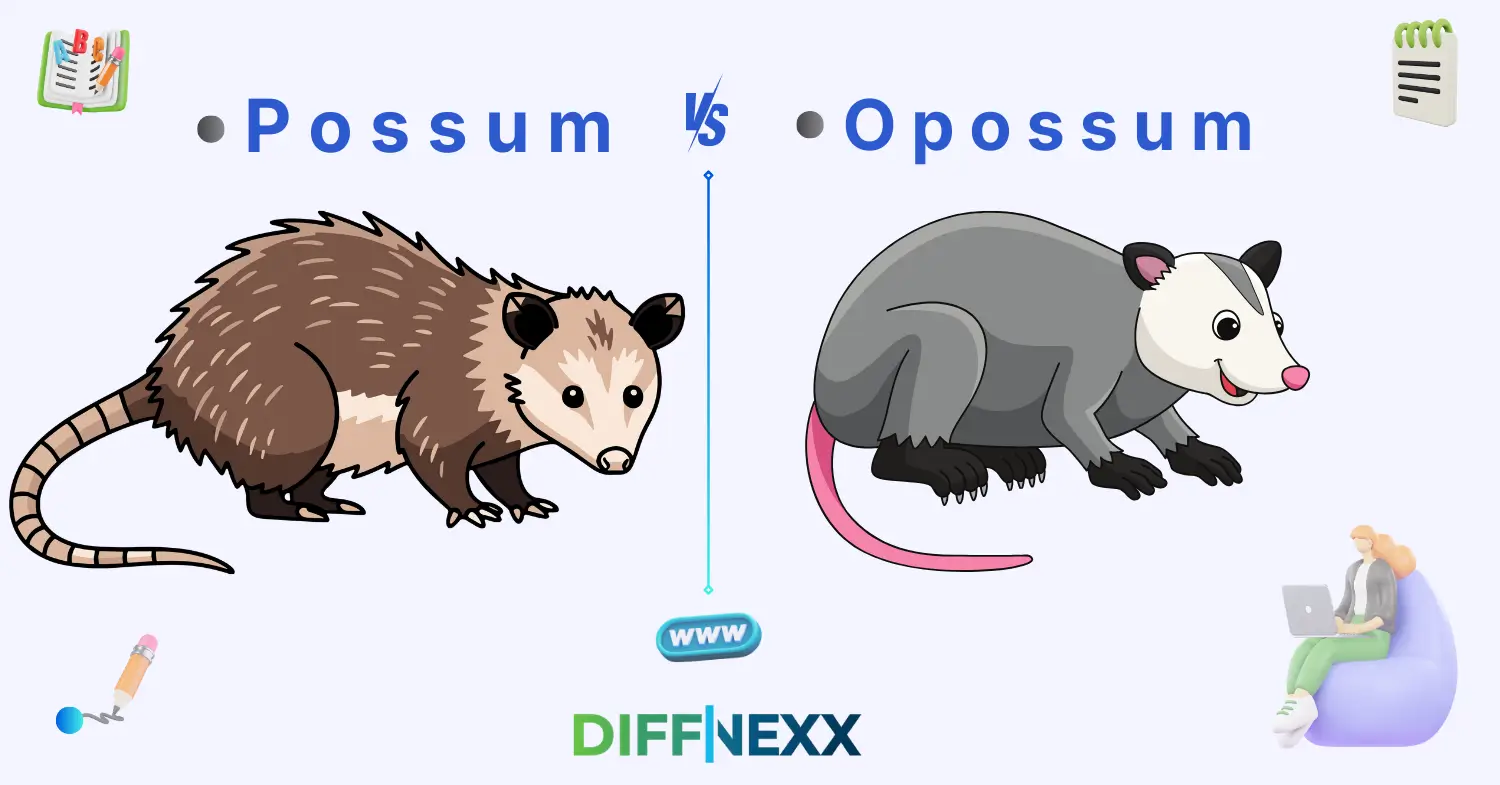
They look similar at first glance. Yet their faces, tails, and behavior differ clearly.
🌍 Why Is Their Difference Necessary to Know for Learners and Experts in Society?
Students must understand the difference to improve vocabulary and science knowledge. Biology classes often mention opossums when discussing North American wildlife.
Experts in wildlife management and journalism need correct terminology. Using the wrong term can reduce credibility.
In society, correct naming prevents confusion in conversations, media reports, and educational materials. Clear language supports accurate communication.
🔊 Pronunciation Section
Possum
US (Possum): /ˈpɑːsəm/
UK (Possum): /ˈpɒsəm/
Opossum
US (Opossum): /əˈpɑːsəm/
UK (Opossum): /əˈpɒsəm/
Notice the extra “o” sound at the beginning of opossum. Now, let us define each animal clearly.
📚 Core Definitions
🐾 Possum
A possum is a tree-dwelling marsupial found mainly in Australia and New Guinea. It has thick fur and a bushy tail. The emotional tone of the word often feels cute or harmless.
Example: A possum climbed the eucalyptus tree at night.
🐾 Opossum
An opossum is a marsupial native to the Americas. It has a long snout, sharp teeth, and a hairless tail. The emotional tone can feel neutral or slightly negative due to its appearance.
Example: The opossum played dead when it felt threatened.
📚 10 Clear Differences Between Possum and Opossum
🌎 1. Geographic Location
Possums live in Australia.
Opossums live in the Americas.
- Example 1 for Possum: The possum hid in an Australian forest.
- Example 2 for Opossum: The opossum wandered through a Texas backyard.
🧬 2. Biological Classification
Possums belong to the suborder Phalangeriformes.
Opossums belong to the order Didelphimorphia.
- Example 1 for Possum: Scientists study possums in Australian ecosystems.
- Example 2 for Opossum: Researchers examine opossums in American habitats.
🐱 3. Appearance
Possums look fluffy and round-faced.
Opossums have pointed faces and bare tails.
- Example 1 for Possum: The possum’s fur looked soft and thick.
- Example 2 for Opossum: The opossum’s tail looked long and hairless.
🌙 4. Behavior
Both are nocturnal, but opossums often scavenge in urban areas.
Possums mostly stay in trees.
- Example 1 for Possum: The possum slept in a tree hollow.
- Example 2 for Opossum: The opossum searched through trash cans.
😨 5. Defense Mechanism
Opossums “play dead” when scared.
Possums usually hiss or climb away.
- Example 1 for Possum: The possum escaped up a branch.
- Example 2 for Opossum: The opossum fell still and pretended to be dead.
🐾 6. Tail Function
Possums often have bushy tails.
Opossums have prehensile, hairless tails for gripping.
- Example 1 for Possum: The possum’s tail looked fluffy.
- Example 2 for Opossum: The opossum hung briefly using its tail.
🌳 7. Habitat Preference
Possums prefer forests.
Opossums adapt easily to cities and suburbs.
- Example 1 for Possum: The possum stayed high in forest trees.
- Example 2 for Opossum: The opossum crossed a city street at night.
🧠 8. Psychological Perception
People often see possums as cute.
People sometimes view opossums as unattractive.
- Example 1 for Possum: Children find possums adorable.
- Example 2 for Opossum: Some people fear opossums because of their teeth.
📚 9. Linguistic Usage
In American English, people often shorten opossum to “possum.”
In Australian English, possum refers only to the native animal.
- Example 1 for Possum: Australians say possum correctly for their species.
- Example 2 for Opossum: Americans casually say possum instead of opossum.
🌐 10. Cultural Context
Possums appear in Australian wildlife stories.
Opossums appear in American folklore.
- Example 1 for Possum: The possum appears in Australian children’s books.
- Example 2 for Opossum: The opossum features in Southern U.S. tales.
🎯 Why Knowing the Difference Matters
Students improve biological accuracy by knowing the difference. Clear naming supports science education.
Professionals in journalism, wildlife care, and tourism must use correct terms. Accuracy builds trust.
Clear language prevents misinformation. Small word changes can affect public understanding.
⚠️ Real-World Consequences of Confusion
If a wildlife report in Australia mentions an “opossum,” readers may question the writer’s expertise. Precision protects credibility.
🧠 Why People Get Confused
🔤 Similar Spelling
The words differ by just one letter. Many people overlook the first “o.”
🔄 Semantic Overlap
Both animals are marsupials and look similar.
📍 Context-Based Usage
Americans often drop the “o” sound in speech.
🗣 Informal Speech Influence
In casual talk, “possum” replaces “opossum,” increasing confusion.
🎭 Connotation & Emotional Tone
Connotation = the emotional meaning associated with a word.
🐾 Possum
Positive: Cute, gentle forest animal.
Example: The possum looked sweet in the tree.
Negative: Rarely negative.
Neutral: Scientific discussions in Australia.
🐾 Opossum
Positive: Helpful in ecosystems by eating pests.
Example: The opossum reduced tick populations.
Negative: Associated with scavenging.
Example: The opossum rummaged through garbage.
Neutral: Used in wildlife biology.
🗣 Usage in Metaphors, Similes & Idioms
“Playing possum” is an idiom. It means pretending to be asleep or unaware. It actually refers to the behavior of the opossum.
Example: He was playing possum during the meeting.
This idiom shows how language shapes meaning.
📊 Comparison Table
| Feature | Possum | Opossum |
|---|---|---|
| Meaning | Australian marsupial | American marsupial |
| Tone | Cute, gentle | Neutral to rough |
| Usage | Australian context | American context |
| Habitat | Forest trees | Urban & rural |
| Formality | Regional term | Scientific term |
⚖️ Which Is Better in What Situation?
🐾 When to Use Possum
Use possum when discussing Australian wildlife.
🐾 When to Use Opossum
Use opossum in scientific or American contexts.
🎯 Situational Clarity
Match the term to the animal’s location.
📌 Contextual Correctness
Correct naming improves accuracy and credibility.
📖 Literary or Cultural References
- Possum Magic (Children’s Fiction, Mem Fox, 1983) – Features Australian possums.
- Pogo (Comic Strip, Walt Kelly, 1948) – Famous opossum character.
These works highlight cultural differences.
❓ FAQs
1. Are possums and opossums the same animal?
No. They belong to different groups and live on different continents.
2. Why do Americans say possum?
It is a shortened form of opossum used in informal speech.
3. Do both animals have pouches?
Yes. Both are marsupials and carry babies in pouches.
4. Which one plays dead?
The American opossum is famous for playing dead.
5. Which is more common in cities?
Opossums are more common in American urban areas.
🏁 Conclusion
The difference between possum and opossum lies in geography, biology, and usage. Possums live in Australia and look fluffy and tree-friendly. Opossums live in the Americas and have pointed faces and hairless tails.
Although people often mix the terms, clear understanding improves communication and scientific accuracy. Precise vocabulary builds confidence and credibility.
Language matters, especially when describing animals and nature. By learning small differences, you strengthen your knowledge and speak with clarity. Keep exploring words and their meanings every detail counts. 🐾

Mira Anand is a writer at Distinly.com who focuses on storytelling, communication, and social perspective. Her work highlights subtle differences in language and meaning across cultures and communities. With a clear and empathetic voice, Mira helps readers understand how narratives shape understanding, relationships, and modern dialogue in an increasingly connected world.