Difference between orthodox and catholic often comes up when people visit different churches while traveling. You may notice similar rituals, yet something feels different. Why is that?
The difference between orthodox and catholic lies in history, leadership, and traditions. Both belong to Christianity, but they follow different paths.
Understanding the difference between orthodox and catholic helps you respect beliefs, communicate better, and learn about global cultures.
Let’s explore their differences in a simple and respectful way.
🔑 Key Difference Between the Both
The main difference is authority and tradition.
- Orthodox churches follow shared leadership and ancient traditions.
- Catholic churches follow the authority of the Pope and centralized structure.
🌍 Importance – Why This Difference Matters
Knowing the difference between orthodox and catholic is important in education and society.
For students, it builds knowledge of world religions and history.
For professionals, especially in education or global work, it helps in respectful communication.
In society, it promotes tolerance, understanding, and cultural awareness.
🔊 Pronunciation Section
Orthodox
US: /ˈɔːr.θə.dɑːks/
UK: /ˈɔː.θə.dɒks/
Catholic
US: /ˈkæθ.lɪk/
UK: /ˈkæθ.əl.ɪk/
Now that you can pronounce both clearly, let’s define them.
📚 Core Definitions
Orthodox
Orthodox refers to Eastern Orthodox Christianity, which follows ancient traditions and shared leadership among bishops. It emphasizes continuity with early church practices.
Example: He attends an Orthodox church on Sundays.
Catholic
Catholic refers to Roman Catholic Christianity, led by the Pope and known for its global structure. It emphasizes unity under one central authority.
Example: She is part of the Catholic Church.
📊 10 Clear Differences Between Orthodox and Catholic
1. Leadership
Orthodox churches have shared leadership. Catholic churches follow the Pope.
- Example for Orthodox: Decisions by councils.
- Example for Catholic: Pope leads the church.
2. Authority Structure
Orthodox authority is decentralized. Catholic authority is centralized.
- Example for Orthodox: Independent churches.
- Example for Catholic: One central authority.
3. Historical Split
They separated in 1054 (Great Schism).
- Example for Orthodox: Eastern tradition continued.
- Example for Catholic: Western church developed.
4. Language in Worship
Orthodox often use traditional languages. Catholic uses local languages widely.
- Example for Orthodox: Greek or Church Slavonic.
- Example for Catholic: English, Spanish, etc.
5. Clergy Marriage
Orthodox priests may marry. Catholic priests usually remain unmarried.
- Example for Orthodox: Married priest allowed.
- Example for Catholic: Celibacy required.
6. Worship Style
Orthodox worship is highly traditional. Catholic worship varies more.
- Example for Orthodox: Long liturgical services.
- Example for Catholic: Flexible service styles.
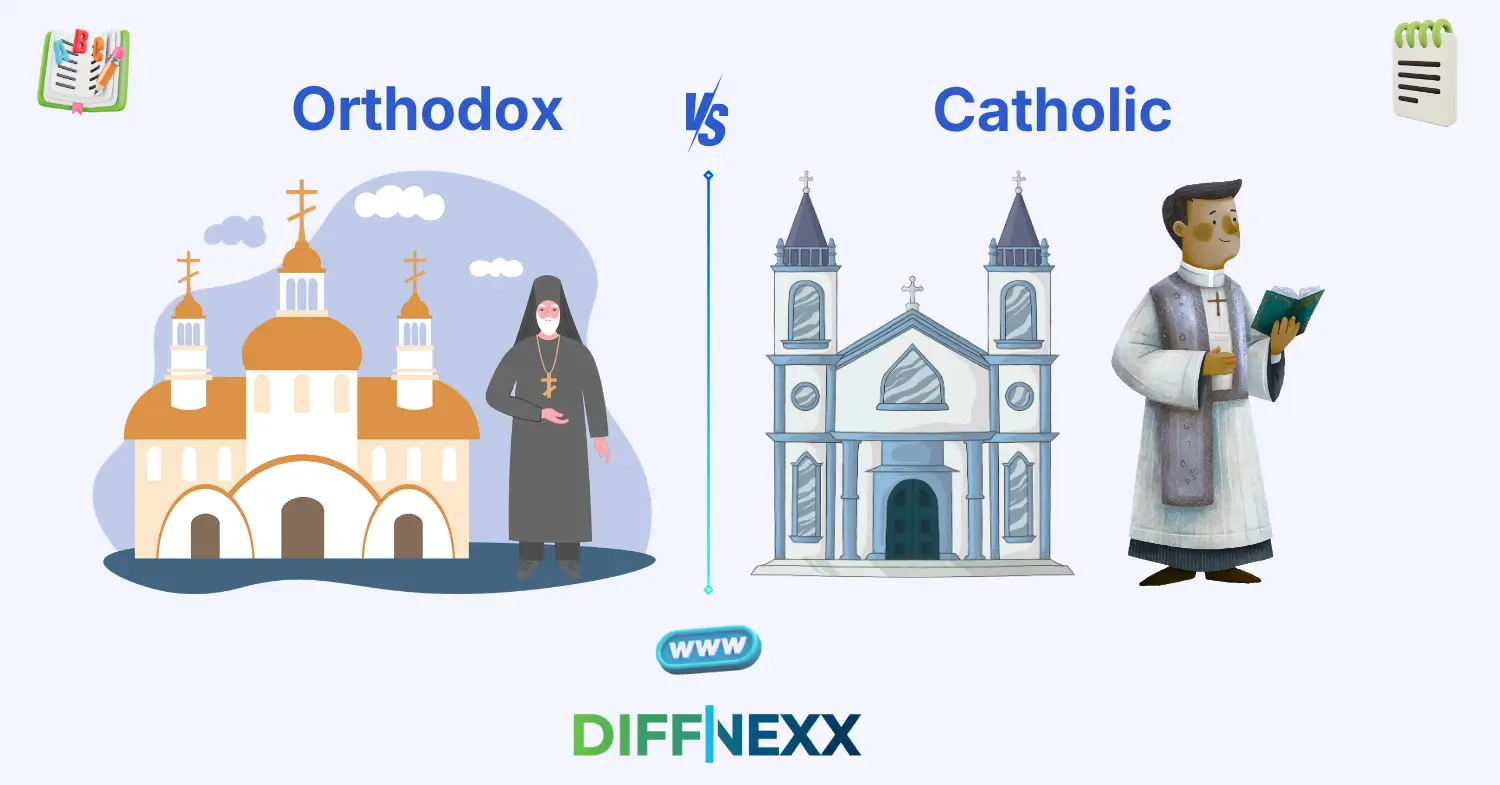
7. Church Architecture
Orthodox churches have domes and icons. Catholic churches vary widely.
- Example for Orthodox: Icon-filled interiors.
- Example for Catholic: Diverse designs.
8. Religious Practices
Orthodox emphasizes rituals and continuity. Catholic includes structured practices and teachings.
- Example for Orthodox: Strong focus on tradition.
- Example for Catholic: Organized doctrines.
9. Global Presence
Orthodox is strong in Eastern Europe. Catholic is global.
- Example for Orthodox: Greece, Russia.
- Example for Catholic: Worldwide presence.
10. Theological Approach
Orthodox focuses on mystery and tradition. Catholic emphasizes doctrine and teaching clarity.
- Example for Orthodox: Spiritual mystery.
- Example for Catholic: Defined teachings.
🎯 Why Knowing the Difference Matters
For students, understanding these traditions helps in history and cultural studies. It builds awareness and respect.
For professionals, especially in global settings, it improves communication and avoids misunderstandings.
In everyday life, it helps people respect religious diversity and interact thoughtfully.
Real-world consequences of confusion
Confusing the two may lead to misunderstandings in religious discussions or cultural settings.
🧠 Why People Get Confused
Similar Names
Both are part of Christianity.
Shared Origins
They share early Christian history.
Similar Practices
Some rituals look alike.
Informal Usage
People often use the terms loosely.
🎭 Connotation & Emotional Tone
Connotation = the emotional meaning associated with a word.
Orthodox
- Positive: Traditional and authentic
Example: Orthodox values ancient practices.* - Neutral: Religious tradition
- Negative: Seen as strict by some
Catholic
- Positive: Unified and global
Example: Catholic Church connects people worldwide.* - Neutral: Religious institution
- Negative: Seen as hierarchical by some
🗣 Usage in Metaphors, Similes & Idioms
- Orthodox → Traditional thinking
Example: His ideas are orthodox.* - Catholic (lowercase) → Broad or universal
Example: She has catholic tastes in music.*
📊 Comparison Table
| Feature | Orthodox | Catholic |
|---|---|---|
| Meaning | Eastern Christian branch | Roman Christian branch |
| Tone | Traditional | Structured |
| Usage | Religious context | Religious context |
| Context | Decentralized | Centralized |
| Formality | Formal | Formal |
⚖️ Which Is Better in What Situation?
When to use Orthodox
Use Orthodox when referring to Eastern Christian traditions or decentralized church systems.
When to use Catholic
Use Catholic when referring to the Roman Catholic Church and its global structure.
Situational Clarity
Choose based on historical and cultural context.
Contextual Correctness
Using the correct term shows respect and accuracy.
📖 Literary or Cultural References
- Book: The Orthodox Church (Religion, Kallistos Ware, 1963)
- Movie: The Two Popes (UK/USA, 2019)
❓ FAQs
1. Are Orthodox and Catholic the same?
No, they are different branches of Christianity.
2. Do they believe in the same God?
Yes, both follow Christianity and believe in the same God.
3. Why did they split?
They split due to differences in authority and theology.
4. Can people attend both churches?
Yes, visitors can attend services in both traditions.
5. Which is older?
Both come from early Christianity but developed separately after the split.
🏁 Conclusion
The difference between orthodox and catholic lies mainly in leadership, traditions, and historical development. Orthodox churches follow shared authority and ancient practices, while Catholic churches follow centralized leadership under the Pope.
Understanding these differences helps you appreciate religious diversity and communicate respectfully. It also deepens your knowledge of global cultures.
Both traditions share common roots but express faith in different ways. Learning about them builds awareness and respect in today’s diverse world.

Mira Anand is a writer at Distinly.com who focuses on storytelling, communication, and social perspective. Her work highlights subtle differences in language and meaning across cultures and communities. With a clear and empathetic voice, Mira helps readers understand how narratives shape understanding, relationships, and modern dialogue in an increasingly connected world.