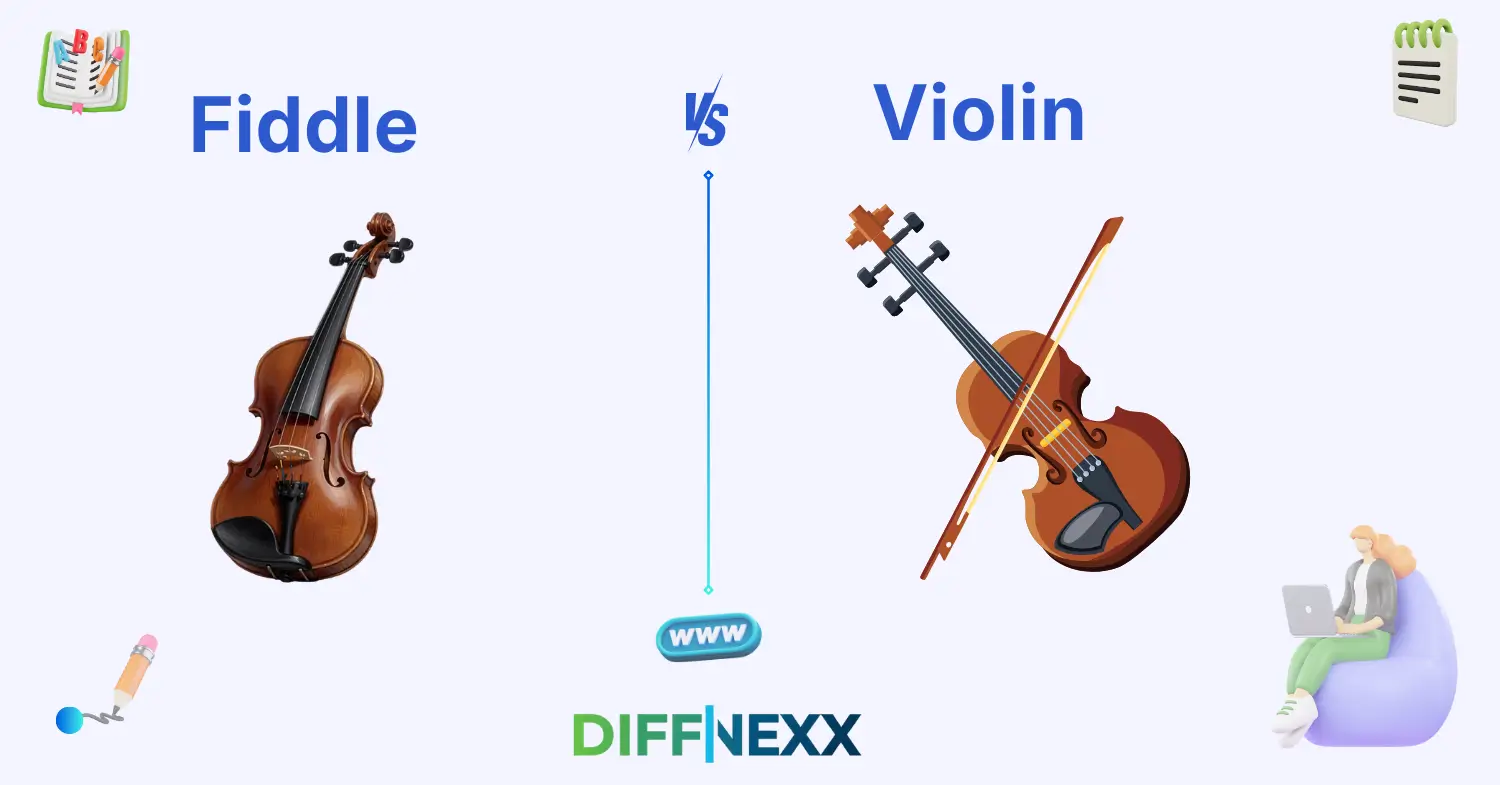
Difference between fiddle and violin often comes up when someone listens to music and hears the same instrument called by two different names. You might watch a folk performance and hear the word fiddle, but in an orchestra, people say violin. This makes many learners confused.
Difference between fiddle and violin is not about two completely different instruments. In most cases, they are the same instrument, but the style of music, playing method, and cultural use make the names different. Because of this, the difference between fiddle and violin is more about context than about the object itself.
Imagine a student learning music in school. The teacher says violin in class, but at home the student’s grandfather calls it a fiddle. Both are correct, but the situation changes the word.
To understand this clearly, we first need to look at the main difference before going deeper.
🎯 Key difference between the both
The main difference between fiddle and violin is the style of playing and the musical context, not the instrument itself.
Violin is usually used in classical music and formal settings.
Fiddle is commonly used in folk, country, or traditional music.
The instrument looks the same, but the technique, sound style, and cultural meaning are different.
🌍 Why is their difference necessary to know
Students learning English or music often see both words in books, concerts, and videos. Knowing the difference helps them understand musical vocabulary correctly.
For professionals such as musicians, teachers, and writers, using the right word is important. In music education, saying fiddle instead of violin may give a different meaning about the style of music.
In society, musical terms show culture and tradition. Classical music traditions from Europe and folk traditions from places like Ireland and the United States use the same instrument but different names, so the correct word shows knowledge and respect.
🔊 Pronunciation Section
Fiddle
US (Fiddle): /ˈfɪdəl/
UK (Fiddle): /ˈfɪdəl/
Violin
US (Violin): /ˌvaɪəˈlɪn/
UK (Violin): /ˌvaɪəˈlɪn/
Both words are easy to pronounce, but they are used in different musical situations. Now let’s define them clearly before comparing.
📚 Core Definitions
🎻 Fiddle
A fiddle is a violin played in folk, country, or traditional music styles.
The word sounds informal and friendly. It often suggests lively or dance music.
Example: He played the fiddle at the village festival.
🎼 Violin
A violin is a string instrument used in classical, orchestral, and formal music.
The word sounds more formal and technical. It is common in music schools and concerts.
Example: She practices the violin every day for orchestra.
📚 10 Clear Differences Between Fiddle and Violin
1️⃣ Emotional Intensity
Fiddle music often feels energetic and playful.
Violin music often feels controlled and expressive.
- Example 1 for Fiddle: The fiddle made the dance exciting.
- Example 2 for Violin: The violin sounded emotional in the concert.
2️⃣ Duration of Notes
Fiddle playing often uses short, quick notes.
Violin playing often uses long, smooth notes.
- Example 1 for Fiddle: The tune had fast short sounds.
- Example 2 for Violin: The violin held the note for a long time.
3️⃣ Focus of Playing
Fiddle focuses on rhythm and dance music.
Violin focuses on melody and harmony.
- Example 1 for Fiddle: The fiddle kept the dancers moving.
- Example 2 for Violin: The violin played the main melody.
4️⃣ Severity or Strictness
Fiddle playing allows more freedom.
Violin playing follows strict rules.
- Example 1 for Fiddle: He changed the tune while playing.
- Example 2 for Violin: She followed the written music exactly.
5️⃣ Rationality vs Creativity
Fiddle style often depends on feeling and improvisation.
Violin style depends on training and technique.
- Example 1 for Fiddle: The player added his own style.
- Example 2 for Violin: The player followed the score carefully.
6️⃣ Formality Level
Fiddle sounds informal.
Violin sounds formal.
- Example 1 for Fiddle: They played fiddle at the party.
- Example 2 for Violin: She performed violin at the concert hall.
7️⃣ Context of Use
Fiddle is common in folk and country music.
Violin is common in classical and orchestra music.
- Example 1 for Fiddle: The band used fiddle in the show.
- Example 2 for Violin: The orchestra used violin in the symphony.
8️⃣ Psychological Impact
Fiddle music often feels cheerful and lively.
Violin music can feel serious or emotional.
- Example 1 for Fiddle: The fiddle made everyone smile.
- Example 2 for Violin: The violin made the audience quiet.
9️⃣ Tone of Sound
Fiddle tone is rougher and brighter.
Violin tone is smoother and softer.
- Example 1 for Fiddle: The fiddle sounded sharp and strong.
- Example 2 for Violin: The violin sounded smooth and warm.
🔟 Expression Style
Fiddle players often move freely while playing.
Violin players often play with formal posture.
- Example 1 for Fiddle: He moved while playing the fiddle.
- Example 2 for Violin: She stood still with the violin.
🎯 Why Knowing the Difference Matters
Students need to know the difference to understand music lessons and books correctly. Many learners think fiddle and violin are different instruments, which can cause confusion.
Professionals such as musicians, teachers, and writers must use the correct term. In music education, the wrong word may describe the wrong style.
In society, music names show tradition and culture. Using the right word helps people communicate clearly about music.
Real-world consequences of confusion
If someone asks for violin music but receives fiddle music, the style may feel very different. In concerts, recordings, and lessons, this can cause misunderstanding.
🧠 Why People Get Confused
Similar spelling or pronunciation
Both words are short and easy, so people think they mean the same thing.
Semantic overlap
They describe the same instrument, so the meaning overlaps.
Context-based usage
In classical concerts people say violin, but in folk shows people say fiddle.
Influence of informal speech
People often say fiddle in casual talk, even when the instrument is a violin.
🎭 Connotation & Emotional Tone
Connotation = the emotional meaning associated with a word.
Fiddle
Positive: Fun and lively sound.
Example: The fiddle made the party joyful.
Negative: May sound less serious.
Example: Some think fiddle music is not formal.
Neutral: A name for the instrument.
Violin
Positive: Elegant and professional.
Example: The violin sounded beautiful in the hall.
Negative: May sound strict or serious.
Example: Violin practice can feel difficult.
Neutral: A musical instrument name.
🗣 Usage in Metaphors, Similes & Idioms
These words sometimes appear in expressions.
Example:
He fit the plan like a fiddle tune fits a dance.
Her voice was as smooth as a violin.
People also say:
“Fit as a fiddle” (healthy and strong).
Example:
After exercise, he felt fit as a fiddle.
📊 Comparison Table
| Feature | Fiddle | Violin |
|---|---|---|
| Meaning | Folk-style playing | Classical instrument name |
| Tone | Informal | Formal |
| Usage | Folk / country music | Classical / orchestra |
| Context | Dance and tradition | Concert and school |
| Formality | Casual | Professional |
⚖️ Which Is Better in What Situation?
When to use Fiddle
Use fiddle when talking about folk, country, or traditional music. It sounds natural in casual conversation and cultural events.
When to use Violin
Use violin in music class, orchestra, or formal writing. It is the correct term in education and classical music.
Situational clarity
Choosing the right word helps people understand the music style quickly.
Contextual correctness
In professional settings, violin is safer. In folk culture, fiddle sounds more natural.
📖 Literary or Cultural References
- Fiddler on the Roof (Musical, Joseph Stein, 1964) – Shows the cultural use of the fiddle.
- The Red Violin (Movie, Canada/Italy, 1998) – Focuses on the history of a violin.
❓ FAQs
1. Is fiddle the same as violin?
Yes, the instrument is the same. The difference is in the style of playing and the type of music. Fiddle usually means folk music, while violin means classical music.
2. Why do folk musicians say fiddle?
The word fiddle comes from older language and tradition. It became popular in folk and dance music, so the name stayed in those cultures.
3. Do fiddles look different from violins?
No, they usually look the same. Some players may change strings or setup, but the basic instrument is the same.
4. Is violin more formal than fiddle?
Yes, violin sounds more formal and is used in schools, orchestras, and classical concerts. Fiddle sounds more casual and traditional.
5. Can one person play both fiddle and violin?
Yes, many musicians play both styles. The difference is in technique, not the instrument.
🏁 Conclusion
The difference between fiddle and violin is mainly about style, context, and cultural meaning, not the instrument itself. Both names describe the same string instrument, but fiddle is used in folk and traditional music, while violin is used in classical and formal settings.
Knowing this difference helps students understand music lessons, helps professionals speak correctly, and helps listeners know what kind of music to expect. Small word choices can change meaning, especially in art and culture.
When you remember that fiddle is informal and violin is formal, the confusion becomes easy to solve. Learning differences like this makes your English and musical vocabulary clearer and more confident.

Mira Anand is a writer at Distinly.com who focuses on storytelling, communication, and social perspective. Her work highlights subtle differences in language and meaning across cultures and communities. With a clear and empathetic voice, Mira helps readers understand how narratives shape understanding, relationships, and modern dialogue in an increasingly connected world.