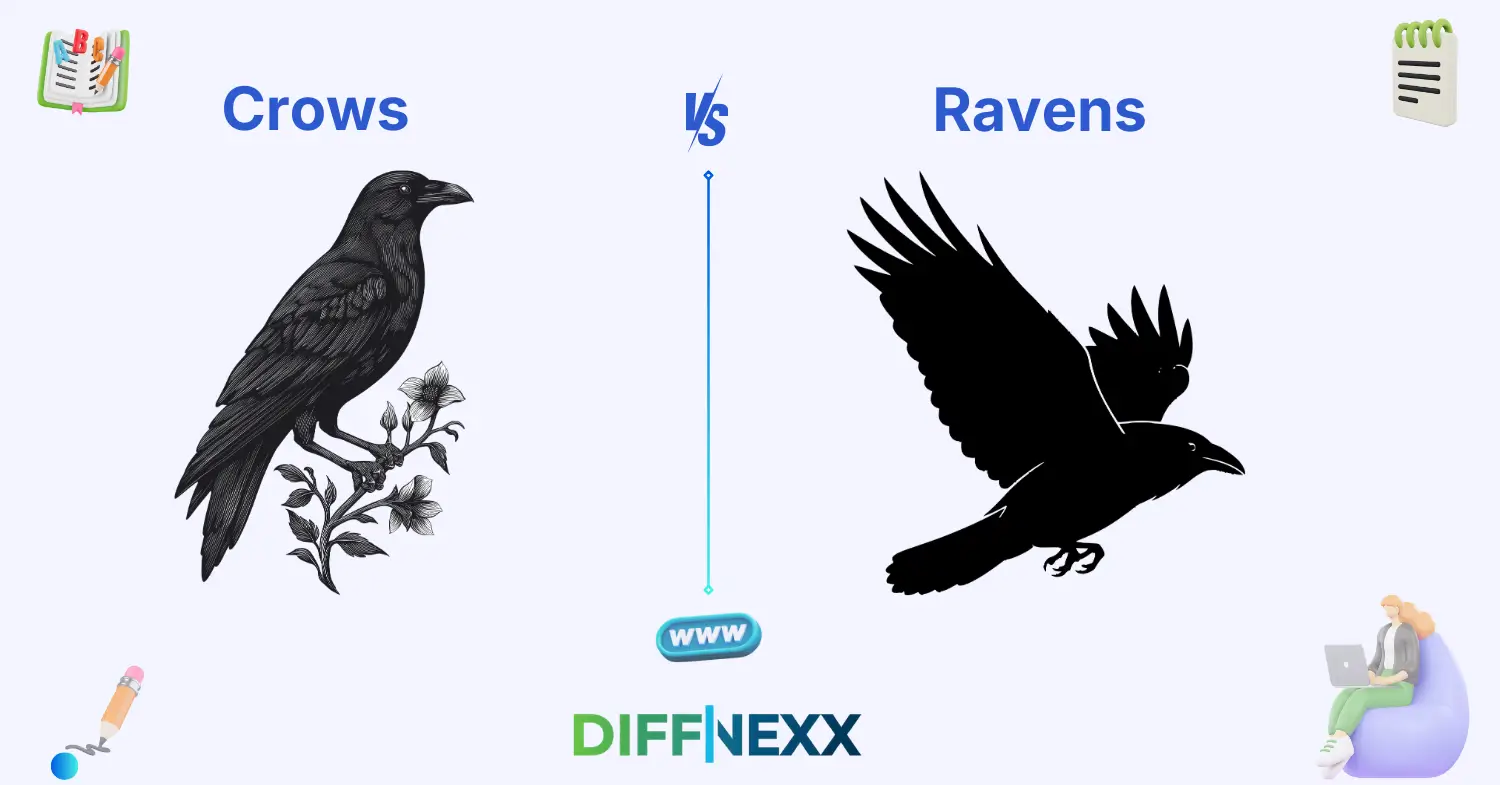
Difference between crows and ravens becomes clear when you spot a large black bird in the sky and wonder, “Is that a crow or a raven?” Many people see them daily but cannot tell them apart.
The difference between crows and ravens is easy once you know what to look for. Both are black birds from the same family, but they differ in size, sound, and behavior.
Understanding the difference between crows and ravens helps you observe nature better and speak more accurately.
Let’s break it down in a simple and clear way.
Key Difference Between the Both
The main difference between crows and ravens is their size and appearance.
- Crows = Smaller, slimmer birds
- Ravens = Larger, heavier birds with thicker beaks
Ravens also have deeper calls, while crows make sharper sounds.
Importance – Why Is Their Difference Necessary to Know
Knowing the difference between crows and ravens helps students learn about birds and ecosystems.
For experts like birdwatchers and researchers, correct identification is important for studying wildlife.
In society, people often use these birds in stories and symbols. Understanding them adds meaning to culture and communication.
🔊 Pronunciation Section
Crows
US: /kroʊz/
UK: /krəʊz/
Ravens
US: /ˈreɪvənz/
UK: /ˈreɪvənz/
Now that you can say both words correctly, let’s define them.
📚 Core Definitions
Crows
Crows are medium-sized black birds known for their intelligence and adaptability. They often live near humans and are social animals. The tone feels familiar and common.
Example:
A crow sat on the tree outside my house.
Ravens
Ravens are larger black birds with thick beaks and shaggy feathers. They often live in wild or open areas and have deeper voices. The tone feels mysterious and powerful.
Example:
A raven flew across the mountain sky.
📚 10 Clear Differences Between Crows and Ravens
1. Emotional Intensity
Crows feel ordinary and familiar. Ravens feel dramatic and striking.
- Example for Crows: A crow walks in the street calmly.
- Example for Ravens: A raven looks bold and powerful.
2. Duration (Lifespan)
Ravens usually live longer than crows.
- Example for Crows: Lives around 7–10 years.
- Example for Ravens: Can live 10–15 years or more.
3. Focus (Body Size)
Crows are smaller. Ravens are much larger.
- Example for Crows: Similar to a pigeon in size.
- Example for Ravens: Almost as big as a hawk.
4. Severity (Voice Sound)
Crows make sharp “caw” sounds. Ravens make deep “croak” sounds.
- Example for Crows: Loud and repetitive calls.
- Example for Ravens: Deep and echoing calls.
5. Rationality (Behavior)
Both are smart, but ravens show more complex problem-solving.
- Example for Crows: Use tools to find food.
- Example for Ravens: Solve puzzles and plan ahead.
6. Formality (Appearance)
Crows look neat and smooth. Ravens look rough and shaggy.
- Example for Crows: Clean feather look.
- Example for Ravens: Shaggy throat feathers.
7. Context of Use (Habitat)
Crows live near cities and towns. Ravens prefer forests, mountains, and wild areas.
- Example for Crows: Seen near houses and roads.
- Example for Ravens: Seen in remote areas.
8. Psychological Impact
Crows feel normal and everyday. Ravens often feel mysterious or symbolic.
- Example for Crows: Common sight in daily life.
- Example for Ravens: Often linked to myths.
9. Tone (Flight Style)
Crows flap their wings quickly. Ravens glide more smoothly.
- Example for Crows: Fast wing beats.
- Example for Ravens: Long gliding flight.
10. Expression Style (Tail Shape)
Crows have fan-shaped tails. Ravens have wedge-shaped tails.
- Example for Crows: Tail spreads evenly.
- Example for Ravens: Tail forms a pointed shape.
🎯 Why Knowing the Difference Matters
Students must understand the difference between crows and ravens to improve observation skills and learn biology clearly.
Professionals like wildlife experts need correct identification for research and conservation work.
In everyday life, using the correct word shows knowledge and avoids confusion in communication.
Real-world consequences of confusion
Misidentifying birds can lead to wrong data in research or misunderstandings in learning environments.
🧠 Why People Get Confused
Similar Spelling or Pronunciation
Both names sound simple and often appear together.
Semantic Overlap
Both are black birds from the same family.
Context-Based Usage
People see them in similar environments sometimes.
Influence of Informal Speech
Many people call all black birds “crows.”
🎭 Connotation & Emotional Tone
Connotation = the emotional meaning associated with a word.
Crows
- Neutral: Common bird
- Slight Negative: Sometimes linked with noise
- Example: Crows are seen in daily life.
Ravens
- Positive: Intelligence and mystery
- Negative: Sometimes linked with death in stories
- Example: Ravens appear in myths and legends.
🗣 Usage in Metaphors, Similes & Idioms
- “As the crow flies” (shortest distance)
- “Raven-haired” (dark black hair)
Example sentences:
- The village is close, as the crow flies.
- She has beautiful raven hair.
📊 Comparison Table
| Feature | Crows | Ravens |
|---|---|---|
| Meaning | Smaller black bird | Larger black bird |
| Tone | Common | Mysterious |
| Usage | Daily environments | Wild settings |
| Context | Cities, towns | Mountains, forests |
| Formality | Informal reference | More specific |
⚖️ Which Is Better in What Situation?
When to Use Crows
Use “crows” when referring to common black birds seen in cities or near homes.
When to Use Ravens
Use “ravens” when talking about larger birds in wild or remote areas.
Situational Clarity
Choose based on size, sound, and location.
Contextual Correctness
In learning or writing, correct usage improves accuracy and understanding.
📖 Literary or Cultural References
- Book: The Raven (Poem, Edgar Allan Poe, 1845)
- Movie: The Crow (USA, 1994) – Shows symbolic use of crows
❓ FAQs
1. Are crows and ravens the same bird?
No, they are different species, though they belong to the same family.
2. Which is bigger, a crow or a raven?
A raven is much larger than a crow.
3. Can crows and ravens live together?
Sometimes, but they usually prefer different habitats.
4. How can I tell them apart quickly?
Look at size, tail shape, and listen to their sound.
5. Are ravens smarter than crows?
Both are highly intelligent, but ravens often show more complex behavior.
🏁 Conclusion
The difference between crows and ravens becomes easy once you notice their size, sound, and behavior. Crows are smaller, common, and social birds. Ravens are larger, deeper-voiced, and often found in wild areas.
Understanding this difference improves your observation skills and helps you describe nature more clearly. It also adds depth to your knowledge of animals and culture.
Next time you see a black bird, take a closer look. You might be able to tell whether it’s a crow or a raven with confidence 🐦.

Ezra Hale is a thoughtful contributor to Distinly.com, where he explores philosophical ideas and the subtle differences behind everyday concepts. His writing blends logic, language, and human insight to clarify complex distinctions. Ezra encourages readers to think deeper, question assumptions, and appreciate the meaning behind words and ideas in modern discourse.