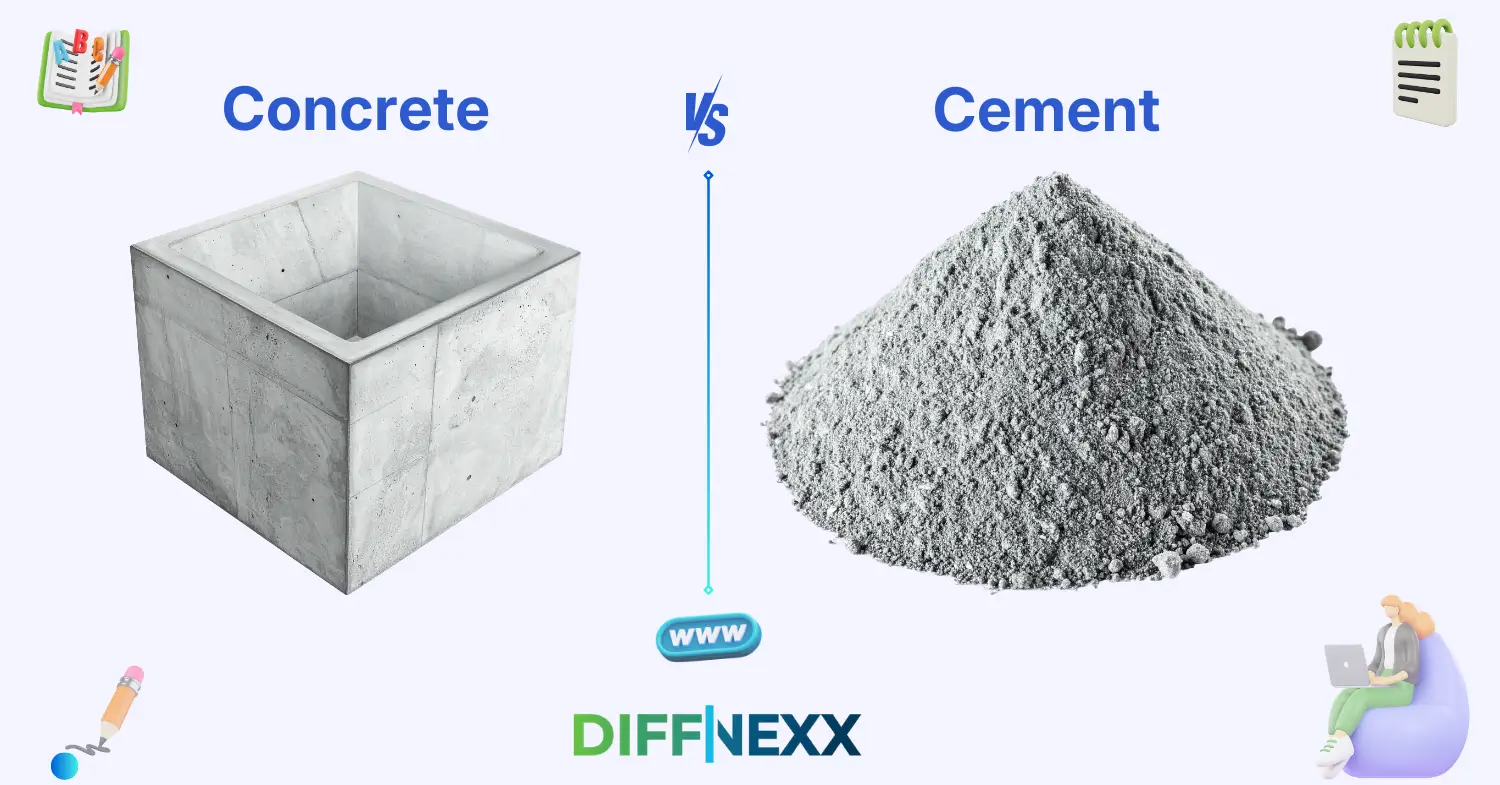
Difference between concrete and cement often confuses people at construction sites or even in daily conversations. Imagine watching a house being built. You hear workers say “cement,” but are they really using cement or something else?
The difference between concrete and cement is simple but important. Cement is just one ingredient, while concrete is the final building material. Many people use these words interchangeably, but they are not the same.
Understanding the difference between concrete and cement helps you speak accurately and understand construction basics better.
Let’s explore what makes them different.
Key Difference Between the Both
The main difference between concrete and cement is their role.
- Cement = A binding powder (ingredient)
- Concrete = A mixture made using cement, sand, gravel, and water
Cement is part of concrete. Concrete is the finished product.
Importance – Why Is Their Difference Necessary to Know
Knowing the difference between concrete and cement helps students understand basic engineering and construction terms.
For professionals like builders, architects, and engineers, correct usage is essential for clear communication and safety.
In society, construction is everywhere. Knowing these terms improves understanding of how buildings, roads, and bridges are made.
🔊 Pronunciation Section
Concrete
US: /ˈkɑːnkriːt/
UK: /ˈkɒŋkriːt/
Cement
US: /sɪˈmɛnt/
UK: /sɪˈment/
Now that you know how to say them, let’s define each clearly.
📚 Core Definitions
Concrete
Concrete is a strong building material made by mixing cement, sand, gravel, and water. It hardens over time and becomes very durable. The tone feels solid and reliable.
Example:
The road is made of concrete.
Cement
Cement is a fine powder that acts as a binder in construction. It holds other materials together when mixed with water. The tone feels basic and supportive.
Example:
Cement is used to make concrete.
📚 10 Clear Differences Between Concrete and Cement
1. Emotional Intensity
Concrete feels strong and complete. Cement feels basic and unfinished.
- Example for Concrete: The concrete wall stands firm.
- Example for Cement: Cement is still being mixed.
2. Duration
Concrete lasts for many years. Cement alone does not last as a structure.
- Example for Concrete: Buildings last decades.
- Example for Cement: Cement powder cannot stand alone.
3. Focus
Concrete focuses on structure. Cement focuses on binding materials.
- Example for Concrete: Used to build roads and houses.
- Example for Cement: Used to bind sand and gravel.
4. Severity (Strength)
Concrete is very strong. Cement is not strong by itself.
- Example for Concrete: Supports heavy loads.
- Example for Cement: Needs other materials for strength.
5. Rationality (Composition)
Concrete is a mixture of materials. Cement is a single ingredient.
- Example for Concrete: Mix includes sand and gravel.
- Example for Cement: Fine powder only.
6. Formality
Concrete is commonly used in construction talk. Cement is often misused in casual speech.
- Example for Concrete: Engineers say “concrete structure.”
- Example for Cement: People say “cement road” incorrectly.
7. Context of Use
Concrete is used for building structures. Cement is used in preparation.
- Example for Concrete: Used in bridges.
- Example for Cement: Used during mixing stage.
8. Psychological Impact
Concrete gives a sense of strength and safety. Cement feels like a raw material.
- Example for Concrete: Strong buildings feel secure.
- Example for Cement: Powder feels temporary.
9. Tone
Concrete has a solid tone. Cement has a soft and powdery tone.
- Example for Concrete: Hard and firm surface.
- Example for Cement: Fine and dusty texture.
10. Expression Style
Concrete appears as solid blocks. Cement appears as powder.
- Example for Concrete: Seen in walls and floors.
- Example for Cement: Seen in bags at construction sites.
🎯 Why Knowing the Difference Matters
Students must understand the difference between concrete and cement to learn construction and science concepts clearly.
Professionals need this knowledge for correct communication and safe building practices.
In daily life, people often discuss construction work. Using the right term avoids confusion and improves clarity.
Real-world consequences of confusion
If someone confuses them, it can lead to misunderstandings in construction. This may affect work quality or safety.
🧠 Why People Get Confused
Similar Spelling or Pronunciation
Both words are often used together in construction talk.
Semantic Overlap
Cement is part of concrete, so people mix them up.
Context-Based Usage
People hear “cement” more often, even when concrete is meant.
Influence of Informal Speech
In everyday language, “cement” is used incorrectly for all materials.
🎭 Connotation & Emotional Tone
Connotation = the emotional meaning associated with a word.
Concrete
- Positive: Strength, durability, reliability
- Neutral: Building material
- Example: Concrete represents strong foundations.
Cement
- Neutral: Basic material
- Slight Negative: Incomplete alone
- Example: Cement needs other materials to be useful.
🗣 Usage in Metaphors, Similes & Idioms
- “Set in concrete” (something fixed and unchangeable)
- “Cement a relationship” (to make it stronger)
Example sentences:
- The plan is set in concrete.
- They worked hard to cement their partnership.
📊 Comparison Table
| Feature | Concrete | Cement |
|---|---|---|
| Meaning | Final building material | Binding ingredient |
| Tone | Strong | Basic |
| Usage | Construction structures | Mixing material |
| Context | Buildings, roads | Preparation stage |
| Formality | Technical | Often misused |
⚖️ Which Is Better in What Situation?
When to Use Concrete
Use “concrete” when talking about finished structures like buildings, roads, or bridges.
When to Use Cement
Use “cement” when referring to the powder used in mixing materials.
Situational Clarity
Choose concrete for final results. Choose cement for ingredients.
Contextual Correctness
In construction or education, using the right word ensures clarity and accuracy.
📖 Literary or Cultural References
- Book: Structures: Or Why Things Don’t Fall Down (Engineering, J.E. Gordon, 1978)
- Movie: The Lego Movie (USA, 2014) – Shows construction concepts in a fun way
❓ FAQs
1. Is cement the same as concrete?
No, cement is an ingredient, while concrete is the final product made from it.
2. Can you build with cement alone?
No, cement alone is not strong enough. It must be mixed with other materials.
3. Why do people say “cement road”?
It is a common mistake. Most roads are actually made of concrete.
4. What are the main ingredients of concrete?
Concrete includes cement, sand, gravel, and water.
5. Which is stronger: cement or concrete?
Concrete is much stronger because it combines multiple materials.
🏁 Conclusion
The difference between concrete and cement is simple but very important. Cement is a binding ingredient, while concrete is the strong material used in construction.
Understanding this difference helps you use the right terms and improves your knowledge of how structures are built. It also makes communication clearer in both daily life and professional settings.
Next time you see a building or road, you will know exactly what it is made of. Keep learning and build your knowledge step by step 🏗️.

Ezra Hale is a thoughtful contributor to Distinly.com, where he explores philosophical ideas and the subtle differences behind everyday concepts. His writing blends logic, language, and human insight to clarify complex distinctions. Ezra encourages readers to think deeper, question assumptions, and appreciate the meaning behind words and ideas in modern discourse.