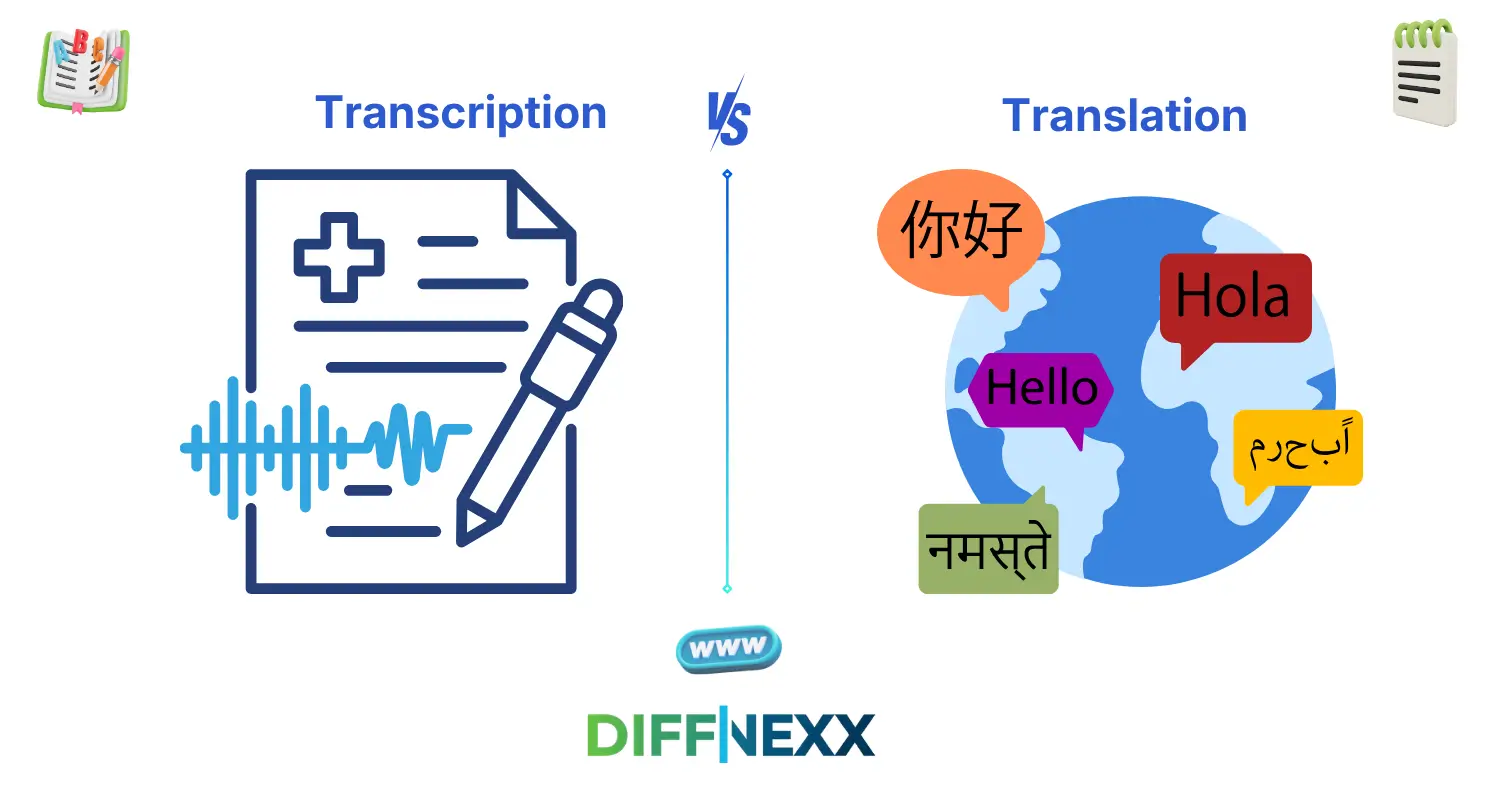
Difference between transcription and translation often confuses students, writers, and even professionals. Imagine you are watching a video in a foreign language. You may need written words of what is said, or you may want the meaning in your own language. These are two very different tasks.
The difference between transcription and translation becomes clear when we look at purpose. Transcription turns speech into written text in the same language. Translation changes text or speech from one language into another.
Many learners mix them up because both deal with language. However, the difference between transcription and translation lies in how the message is handled, not just what is said.
Let’s explore their key differences in detail so you can use each term correctly and confidently.
🔑 Key Difference Between the Both
The main difference is simple:
- Transcription focuses on converting spoken words into written form in the same language.
- Translation focuses on converting meaning from one language to another.
One records language. The other transforms it.
🌍 Importance – Why This Difference Matters
Understanding the difference helps both learners and experts communicate clearly. In education, students need transcription for notes and translation for understanding foreign content.
Professionals rely on this distinction daily. Journalists, researchers, and content creators use transcription for accuracy. Translators ensure ideas reach global audiences.
In society, this difference supports accessibility. Transcription helps people with hearing impairments. Translation bridges cultures and languages worldwide.
🔊 Pronunciation Section
Transcription
US: /trænˈskrɪp.ʃən/
UK: /trænˈskrɪp.ʃən/
Translation
US: /trænzˈleɪ.ʃən/
UK: /trænsˈleɪ.ʃən/
Now that you know how to say them, let’s define them clearly.
📚 Core Definitions
Transcription
Transcription means writing down spoken words exactly as they are heard. It focuses on accuracy and detail. The tone remains the same as the original speech.
Example: Writing a lecture word-for-word.
Translation
Translation means converting text or speech from one language into another. It focuses on meaning rather than exact words. The tone may change slightly to fit the target language.
Example: Changing an English article into Spanish.
📚 10 Clear Differences Between Transcription and Translation
1. Purpose
Transcription records speech. Translation conveys meaning across languages.
- Example (Transcription): Writing down a podcast.
- Example (Translation): Converting that podcast into French.
2. Language Use
Transcription uses the same language. Translation involves two languages.
- Example (Transcription): English audio → English text
- Example (Translation): English text → Urdu text
3. Focus
Transcription focuses on exact words. Translation focuses on meaning.
- Example (Transcription): Includes fillers like “um”
- Example (Translation): Removes unnecessary fillers
4. Accuracy Type
Transcription needs word accuracy. Translation needs meaning accuracy.
- Example (Transcription): Exact sentence match
- Example (Translation): Meaning match, not word-for-word
5. Creativity
Transcription requires little creativity. Translation requires some flexibility.
- Example (Transcription): Copying speech
- Example (Translation): Adjusting phrases
6. Context of Use
Transcription is used in meetings, interviews, and media. Translation is used in global communication.
- Example (Transcription): Court recordings
- Example (Translation): International websites
7. Skills Required
Transcription needs listening skills. Translation needs language knowledge.
- Example (Transcription): Understanding accents
- Example (Translation): Knowing grammar and culture
8. Output Style
Transcription produces written text from audio. Translation produces a new version in another language.
- Example (Transcription): Subtitle script
- Example (Translation): Multilingual subtitle
9. Time Process
Transcription depends on audio length. Translation depends on text complexity.
- Example (Transcription): 1-hour audio → long time
- Example (Translation): Short text → quick
10. Error Impact
Errors in transcription distort facts. Errors in translation distort meaning.
- Example (Transcription): Wrong word recorded
- Example (Translation): Wrong idea communicated
🎯 Why Knowing the Difference Matters
Students need this knowledge to choose the right task. If they confuse the two, they may write incorrect assignments or misunderstand instructions.
Professionals must be precise. A journalist using transcription instead of translation may fail to reach a global audience. A translator ignoring transcription may miss details.
Clear communication depends on this distinction. Misuse can cause confusion, errors, or even misinformation.
Real-world consequences of confusion
Mixing them up can lead to wrong subtitles, poor research data, or failed communication in international settings.
🧠 Why People Get Confused
Similar Spelling or Pronunciation
Both words start with “trans-,” which makes them look similar.
Semantic Overlap
Both deal with language and communication, which creates confusion.
Context-Based Usage
People often use them loosely in daily speech.
Influence of Informal Speech
In casual conversation, people don’t always distinguish between them.
🎭 Connotation & Emotional Tone
Connotation = the emotional meaning associated with a word.
Transcription
- Neutral: It is technical and factual.
- Example: “The transcription of the meeting is ready.”
Translation
- Neutral to Positive: It suggests connection and understanding.
- Example: “The translation helped me understand the story.”
🗣 Usage in Metaphors, Similes & Idioms
While not common in idioms, both can appear in figurative language.
- “He transcribed every word like a machine.” (means exact copying)
- “She translated his feelings into words.” (means interpreting meaning)
These uses show how transcription is about accuracy, while translation is about interpretation.
📊 Comparison Table
| Feature | Transcription | Translation |
|---|---|---|
| Meaning | Speech to text | One language to another |
| Tone | Neutral, exact | Flexible, meaning-based |
| Usage | Audio recordings | Global communication |
| Context | Same language | Different languages |
| Formality | Technical | Linguistic and cultural |
⚖️ Which Is Better in What Situation?
When to Use Transcription
Use transcription when you need a written record of speech. For example, lectures, interviews, or meetings.
When to Use Translation
Use translation when you need to understand or share content across languages.
Situational Clarity
If the language stays the same, choose transcription. If the language changes, choose translation.
Contextual Correctness
Always think about your goal. Are you recording or interpreting? That will guide your choice.
📖 Literary or Cultural References
- Book: The Translator (Fiction, Leila Aboulela, 1999)
- Movie: Arrival (USA, 2016) – focuses on language translation and communication
These works highlight the importance of translation in understanding meaning across cultures.
❓ FAQs
1. Is transcription the same as translation?
No, they are different. Transcription writes spoken words in the same language. Translation changes language entirely. Each serves a unique purpose.
2. Can transcription include translation?
Not directly. However, some projects may include both steps. First, speech is transcribed, then it is translated.
3. Which is harder: transcription or translation?
Translation is usually harder. It requires deep knowledge of languages and culture. Transcription mainly needs strong listening skills.
4. Do both require language skills?
Yes, but in different ways. Transcription needs listening and typing accuracy. Translation needs grammar, vocabulary, and cultural understanding.
5. Where are these used in real life?
Transcription is used in media, law, and education. Translation is used in international business, travel, and global communication.
🏁 Conclusion
The difference between transcription and translation is clear when you focus on purpose. Transcription records speech exactly as it is. Translation changes language to share meaning with others.
Both play important roles in communication. One ensures accuracy, while the other ensures understanding across cultures. Knowing when to use each helps avoid confusion and improves clarity.
As a learner or professional, mastering this difference will strengthen your language skills. Keep practicing, and you will use both terms with confidence and precision.

Ezra Hale is a thoughtful contributor to Distinly.com, where he explores philosophical ideas and the subtle differences behind everyday concepts. His writing blends logic, language, and human insight to clarify complex distinctions. Ezra encourages readers to think deeper, question assumptions, and appreciate the meaning behind words and ideas in modern discourse.