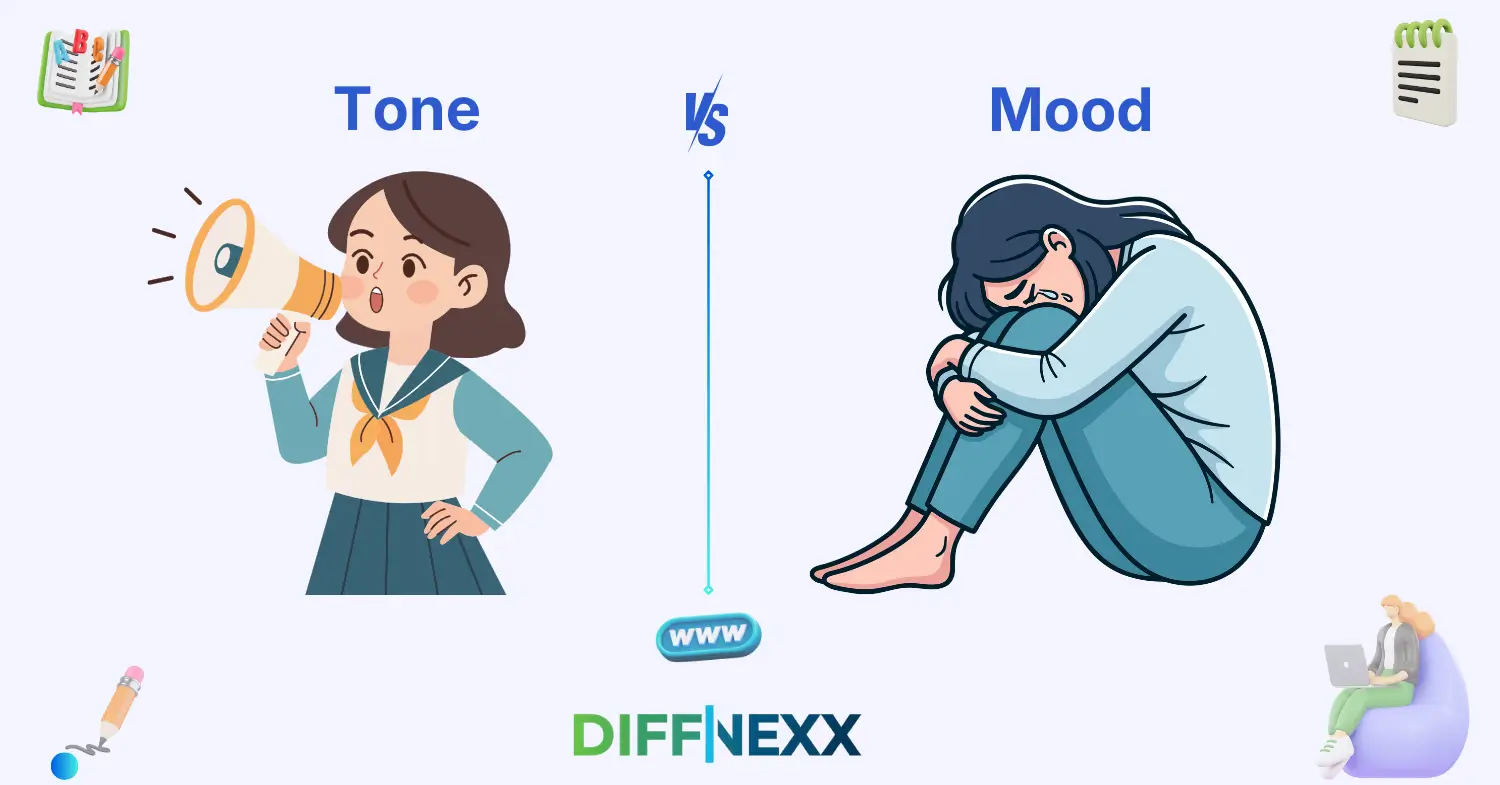
The difference between tone and mood is a concept that often trips up even the most enthusiastic readers. While both terms describe the emotional landscape of a story, they come from two different directions. Tone is the author’s voice and attitude, whereas mood is the feeling the reader gets from the setting and atmosphere.
Understanding the difference between tone and mood helps you unlock deeper meanings in books, movies, and everyday conversations. By recognizing these two separate layers, you can see how an author might use a sarcastic voice to describe a sad event. Let’s dive into the difference between tone and mood to help you become a master of literary analysis. 📚
Whether you are writing a poem or analyzing a film, knowing these terms is your secret weapon for clear communication.
Key difference between the both
The primary difference between tone and mood is the “source” of the emotion. Tone is provided by the creator (author or speaker) and reflects their personal opinion or attitude toward the subject. Mood is the emotional atmosphere created for the audience, designed to make the reader feel a specific way.
Importance for learners and experts
For English learners, knowing the difference between tone and mood is essential for high-level comprehension. It allows you to understand irony, sarcasm, and subtext. If you only look at the mood, you might miss a satirical tone that completely changes the meaning of a sentence.
For experts such as editors, critics, and creative writers, this distinction is a professional requirement. It allows them to manipulate a story’s impact with precision. In society, understanding these nuances helps us navigate media bias and advertising, as we can separate the “feeling” an ad creates (mood) from the “intent” of the brand (tone). 🖋️
Pronunciation Section
Tone US: /toʊn/ UK: /təʊn/
Mood US: /muːd/ UK: /muːd/
Now that we have the sounds right, let’s move into the specific definitions to establish total clarity.
Core Definitions
Tone
Tone is the author’s or speaker’s attitude toward a subject, character, or the audience. It is expressed through word choice (diction) and sentence structure. The emotional tone can be anything from cynical and formal to playful and objective.
- Example: A news reporter using a neutral, serious tone to describe a complex political event.
Mood
Mood is the atmosphere or emotional setting created by a piece of literary work. It is what the reader feels while experiencing the story, often built through descriptions of the environment and sensory details. The mood can be eerie, romantic, gloomy, or joyful.
- Example: A mystery novel starting with a “dark and stormy night” to create a suspenseful mood.
10 Clear Differences Between Tone and Mood
1. The Source of Emotion
The tone originates entirely from the creator of the work. The mood is an internal emotional response that happens within the reader or audience member.
- Tone Example: An author writing about a villain with a mocking, judgmental attitude.
- Mood Example: A reader feeling terrified because the scene is set in a haunted graveyard.
2. Focus of the Words
Tone focuses on the “voice” and the “attitude” of the person speaking. Mood focuses on the “feeling” and the “atmosphere” of the place or situation being described.
- Tone Example: “The politician’s speech was predictably hollow and repetitive.” (Critical tone)
- Mood Example: “The sun set over the quiet valley, painting the hills in soft gold.” (Peaceful mood)
3. Duration of the Feeling
Tone can shift rapidly within a single paragraph if the author’s attitude changes. Mood tends to be more sustained, lasting through an entire chapter or scene to build a specific environment.
- Tone Example: Moving from a formal tone to a sudden, angry outburst in a letter.
- Mood Example: A horror movie keeping a tense, scary atmosphere for the first hour.
4. Method of Creation
Authors create tone primarily through word choice and syntax (how sentences are built). They create mood through imagery, setting, and sensory descriptions.
- Tone Example: Using words like “obnoxious” or “brilliant” to show a clear opinion.
- Mood Example: Describing the smell of pine trees and the sound of a crackling fire.
5. Rationality and Logic
Tone is often more rational because it reflects a person’s specific viewpoint or argument. Mood is more emotional and instinctive, hitting the reader’s “gut” before they even analyze the words.
- Tone Example: A lawyer presenting a logical, persuasive argument in court.
- Mood Example: The feeling of unease you get when music in a movie turns to a low, heavy bass.
6. Formality Levels
Tone is often categorized by its level of formality (formal, informal, slangy). Mood is categorized by emotional states (anxious, depressed, excited).
- Tone Example: A professional email written with a polite, respectful tone.
- Mood Example: A birthday party scene that feels energetic and festive.
7. Context of Use
Tone is used to show the relationship between the speaker and the subject. Mood is used to immerse the audience in a different world or time.
- Tone Example: A teacher using a stern tone to show authority to students.
- Mood Example: An author describing a futuristic city to create a cold, robotic mood.
8. Psychological Impact
Tone influences how we perceive the “truth” or “reliability” of the speaker. Mood influences our emotional connection and empathy for the characters.
- Tone Example: A sarcastic tone making us doubt if a character is telling the truth.
- Mood Example: A sad mood making the audience cry during a funeral scene.
9. Expression Style
Tone is “active”—it is the act of expressing an opinion. Mood is “passive”—it is the result of the setting acting upon the reader.
- Tone Example: “I cannot believe the audacity of this plan!” (Active opinion)
- Mood Example: The silence of the empty hall felt heavy and cold. (Passive atmosphere)
10. Severity and Intensity
Tone can be subtle, like a slight “hint” of annoyance. Mood is often much more intense, as it aims to wrap the reader in a total sensory experience.
- Tone Example: A dry, “British” humor that is very understated.
- Mood Example: An epic battle scene that feels overwhelming and chaotic.
Why Knowing the Difference Matters
Students must know the difference between tone and mood to excel in literature and composition classes. When writing an essay, a student needs to control their own tone (usually formal and objective) while describing the mood of the book they are reading. Confusing the two leads to shallow analysis and lower grades.
Professionals in marketing, leadership, and public relations must master these concepts to influence their audience. A brand might want to create a “luxurious mood” in their store while maintaining a “helpful tone” in their customer service. If the tone and mood don’t match correctly, customers feel confused or manipulated.
Socially, the consequences of confusion involve misinterpreting human interactions. If your friend tells a sad story with a “humorous tone,” they might be trying to cope with pain. If you only react to the “sad mood” of the story, you might miss their attempt at a joke and make the situation awkward.
Real-world consequences of confusion
In the 2026 digital landscape, tone is often lost in text messages and emails. This leads to “tone-deaf” communication where a sender feels they are being funny, but the recipient feels the mood is hostile. Mastering these terms helps us be more mindful of how our digital “voice” sounds. 📱
Why People Get Confused
Semantic Overlap
In casual conversation, we use “mood” to describe everything. We say, “I’m not in the mood for his tone.” This makes it hard for learners to separate the two when they become technical literary terms.
Influence of Informal Speech
Social media trends often use “vibe” to mean both tone and mood. This simplifies language but erases the important distinction between the speaker’s attitude and the viewer’s feeling.
Context-based Usage
In some creative fields, like music production, the terms are used almost interchangeably. A “moody track” might refer to both the artist’s tone and the listeners’ reaction.
Connotation & Emotional Tone
(Connotation = the emotional meaning attached to a word.)
For Tone:
- Positive/Neutral: Associated with clarity, voice, and perspective.
- Example: “The author’s appreciative tone made the biography a joy to read.”
For Mood:
- Positive/Immersive: Associated with feeling, environment, and experience.
- Example: “The whimsical mood of the film transported me back to my childhood.”
Usage in Metaphors, Similes & Idioms
- “Read the room”: An idiom about identifying the mood of a social situation before choosing your tone.
- Sentence: “Before you start joking, read the room; everyone is quite upset.”
- “Tone-deaf”: Describing someone who doesn’t understand the appropriate attitude for a situation.
- Sentence: “His cheerful speech at the funeral was completely tone-deaf.”
Comparison Table
| Feature | Tone | Mood |
| Meaning | Author’s attitude | Reader’s feeling |
| Tone | Specific / Pointed | General / Atmospheric |
| Usage | Through Diction (Word Choice) | Through Imagery and Setting |
| Context | Intellectual / Opinionated | Emotional / Sensory |
| Formality | High (determines social level) | Low (determines emotional level) |
Which Is Better in What Situation?
When to use Tone
Use “tone” when you are analyzing a person’s intent or opinion. It is the best word for discussing speeches, persuasive essays, or the “voice” of a narrator.
When to use Mood
Use “mood” when you are describing the setting or the “vibe” of a scene. It is perfect for talking about movies, interior design, or the atmosphere of a party.
Situational Clarity
If a friend is being sarcastic, you are reacting to their tone. If you enter a spa and feel relaxed, you are reacting to the mood.
Contextual Correctness
In a literary essay, always remember: The author sets the tone, but the reader feels the mood.
Literary or Cultural References
- “The Tell-Tale Heart” (Short Story, Edgar Allan Poe, 1843): Features a nervous, erratic tone that creates a terrifying, claustrophobic mood.
- “The Great Gatsby” (Novel, F. Scott Fitzgerald, 1925): Uses a cynical, reflective tone to describe a glamorous yet empty mood of 1920s parties.
- “Stranger Things” (TV Series, USA, 2016-Present): Uses an 80s nostalgic tone to build an eerie, supernatural mood.
FAQs
1. Can tone and mood be the same? Yes. In a simple story, an author might have a happy tone about a happy event, creating a happy mood. However, they are most interesting when they are different!
2. How do I find the tone in a text? Look at the adjectives the author uses. If they describe a car as an “old clunker,” the tone is likely critical or mocking. If they call it a “vintage treasure,” the tone is appreciative.
3. Does music have tone? In music, “tone” refers to the quality of a sound. However, in a literary sense, an artist’s “tone” is their lyrical attitude, while the “mood” is the overall feeling of the melody.
4. Why is mood easier to identify than tone? Mood is a direct emotional experience. It’s easier to say “I feel scared” than it is to analyze “The author seems to be using irony to criticize the government.”
5. Can mood change without the tone changing? Yes. An author might maintain a serious, objective tone while moving the characters from a sunny park (happy mood) into a dark cave (scary mood).
Conclusion
The difference between tone and mood is what makes storytelling a multi-dimensional experience. Tone is the “who” the personality and attitude of the voice behind the words. Mood is the “where” the emotional weather of the world the characters inhabit.
When you learn to distinguish between these two, you stop just “reading” and start “decoding.” You can see the artist’s hand at work, shaping your emotions while expressing their own views.
Whether you are a student, a professional, or a lifelong reader, mastering this distinction will deepen your connection to every story you encounter.
Keep an eye on the setting, but always keep an ear out for the voice.

Mira Anand is a writer at Distinly.com who focuses on storytelling, communication, and social perspective. Her work highlights subtle differences in language and meaning across cultures and communities. With a clear and empathetic voice, Mira helps readers understand how narratives shape understanding, relationships, and modern dialogue in an increasingly connected world.