The difference between meiosis and mitosis explains how life both stays the same and changes over time. Mitosis is the process of duplication; it is how your body repairs itself and grows.
Think back to the last time you scraped your knee. Within a few days, a fresh layer of skin appeared, perfectly replacing the damaged tissue. Now, think about how you came to exist in the first place, a unique combination of your parents’ traits, yet entirely different from either of them. These two everyday miracles are powered by two distinct biological “engines” hidden deep inside your cells.
Meiosis is the process of creation; it is how special cells are made to start a new generation. While they both involve a cell dividing into new parts, their goals could not be further apart.
Understanding the difference between meiosis and mitosis is like learning the difference between a photocopier and a mixing bowl. One makes an exact copy, while the other stirs things up to create something new.
By mastering the difference between meiosis and mitosis, you gain a deeper appreciation for the complex machinery that keeps you and all living things alive and evolving. 🧬Let’s dive into the fascinating world of cellular division to see how these processes work.
Key difference between the both
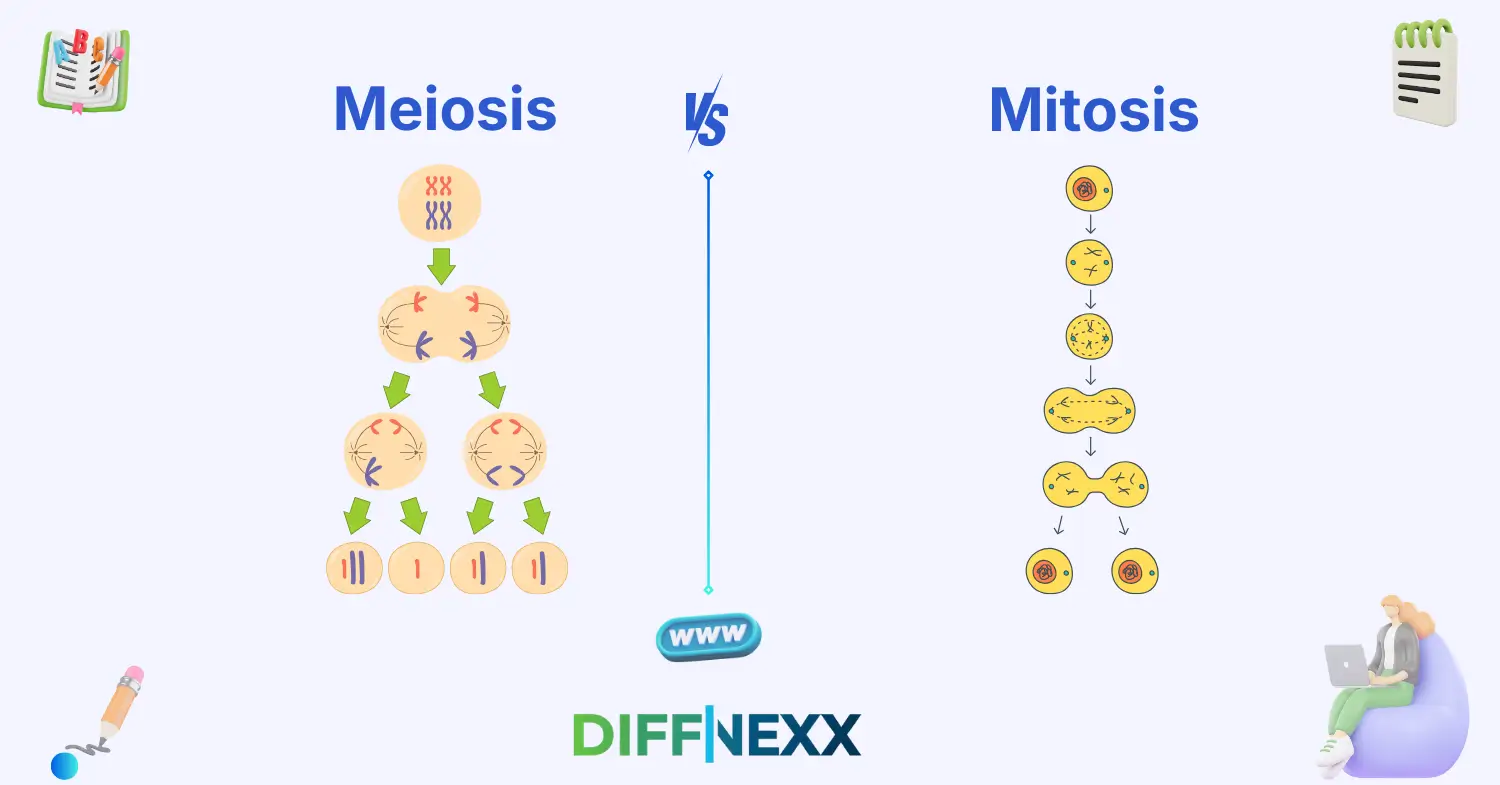
The fundamental difference between meiosis and mitosis is the number of resulting cells and their genetic makeup. Mitosis creates two identical “daughter” cells with the same number of chromosomes as the parent. Meiosis involves two rounds of division to create four unique cells, each with only half the genetic material of the original parent cell.
Importance of the difference for learners and experts
For English learners and students, the difference between meiosis and mitosis is a cornerstone of scientific literacy. These terms frequently appear in textbooks, news articles about genetics, and medical discussions. Knowing the distinction helps you follow complex conversations about health, ancestry, and biology without getting lost in the “m-words.”
For experts in medicine, biotechnology, and agriculture, this knowledge is vital for solving real-world problems. Mitosis is studied to understand how cancer spreads (uncontrolled cell division), while meiosis is the key to understanding fertility and genetic disorders. In society, these processes are the foundation of everything from farming better crops to developing life-saving gene therapies. 🌍
Pronunciation Section
Mitosis
US: /maɪˈtoʊsɪs/
UK: /maɪˈtəʊsɪs/
Meiosis
US: /maɪˈoʊsɪs/
UK: /maɪˈəʊsɪs/
The names sound nearly identical, but the internal “scripts” they follow are worlds apart. Let’s look at the definitions of each.
Core Definitions
Mitosis
Mitosis is a type of cell division that results in two daughter cells each having the same number and kind of chromosomes as the parent nucleus. It is the body’s way of growing and repairing tissue. The emotional tone is one of stability, consistency, and maintenance.
- Example: Your liver cells dividing to replace old cells and keep your liver functioning perfectly.
Meiosis
Meiosis is a specialized type of cell division that reduces the chromosome number by half, creating four haploid cells. This process is essential for sexual reproduction and leads to genetic variety. The emotional tone is one of diversity, potential, and new beginnings.
- Example: The production of sperm or egg cells that will eventually combine to form a new individual.
10 Clear Differences Between Meiosis and Mitosis
1. Number of Divisions
Mitosis involves only one single round of cell division. Meiosis is more complex and requires two successive rounds of division, known as Meiosis I and Meiosis II.
- Example for Mitosis: A skin cell splitting once to make two skin cells.
- Example for Meiosis: A germ cell dividing twice to produce four reproductive cells.
2. Genetic Relationship
Mitosis produces cells that are exact genetic clones of the parent. Meiosis produces cells that are genetically unique and different from both the parent and each other.
- Example for Mitosis: The new cells on your healed finger have the exact same DNA as the old ones.
- Example for Meiosis: A brother and sister looking different despite having the same parents.
3. Purpose of Use
The goal of mitosis is growth, tissue repair, and asexual reproduction. The goal of meiosis is solely to produce gametes (eggs and sperm) for sexual reproduction.
- Example for Mitosis: A starfish growing back a lost arm.
- Example for Meiosis: A flowering plant producing pollen to fertilize another flower.
4. Chromosome Number
Mitosis maintains the “diploid” number, meaning the new cells have 46 chromosomes (in humans). Meiosis creates “haploid” cells, meaning they only have 23 chromosomes.
- Example for Mitosis: A cell with 46 chromosomes dividing into two cells with 46 each.
- Example for Meiosis: A cell with 46 chromosomes ending up as four cells with 23 each.
5. Homologous Pairing
In mitosis, homologous chromosomes (matching pairs from mom and dad) do not pair up. In meiosis, these pairs find each other and huddle together during the first stage.
- Example for Mitosis: Chromosomes lining up in a single file line during division.
- Example for Meiosis: Chromosome pairs “dancing” together before they are pulled apart.
6. Genetic “Crossing Over”
Meiosis features a process called “crossing over,” where chromosomes swap bits of DNA to create new combinations. Mitosis never allows this; it keeps the DNA exactly as it found it.
- Example for Mitosis: Copying a document exactly as it is written.
- Example for Meiosis: Shuffling two decks of cards together to get a random mix.
7. Location in the Body
Mitosis happens in “somatic” cells, which are all the cells in your body like bone, blood, and skin. Meiosis only happens in “germ” cells located in the reproductive organs.
- Example for Mitosis: Cells in your hair follicles dividing to make your hair grow longer.
- Example for Meiosis: Cells in an ovary preparing for a future pregnancy.
8. Duration of the Process
Mitosis is generally a much shorter process, often completed in a few hours. Meiosis can take much longer—in humans, the process in females can actually span years.
- Example for Mitosis: Rapidly replacing cells in the lining of your stomach every few days.
- Example for Meiosis: The long, slow maturation of egg cells over a woman’s lifetime.
9. Functional Outcome
Mitosis results in the “status quo,” ensuring the body remains functional. Meiosis results in “evolutionary fuel,” providing the variation that allows species to adapt to their environment.
- Example for Mitosis: Keeping a car in good repair by replacing identical parts.
- Example for Meiosis: Designing a brand-new car model with a unique set of features.
10. Expression Style in Language
In scientific writing, mitosis is often described as “cyclic” because it repeats. Meiosis is described as “terminal” for that specific cell, as the resulting gametes either find a partner or eventually fade away.
- Example for Mitosis: “The mitotic cycle continues throughout the organism’s life.”
- Example for Meiosis: “The culmination of meiosis results in the formation of haploid gametes.”
Why Knowing the Difference Matters
Students must know the difference between meiosis and mitosis to pass foundational biology exams. These concepts are the “ABC’s” of life science. If a student confuses the two, they will struggle to understand how traits are inherited or why certain genetic diseases occur.
Professionals in healthcare and research must distinguish these terms to treat patients. For example, cancer treatments often target mitosis to stop tumors from growing. Fertility doctors, on the other hand, focus on meiosis to help people conceive. Using the wrong term could lead to a misunderstanding of a diagnosis or a research goal.
Socially, understanding these processes helps people make informed decisions about their own health. When people understand meiosis, they better comprehend the risks of certain hereditary conditions. It fosters a scientifically literate society that can engage with topics like GMOs, cloning, and reproductive rights with clarity and reason.
Real-world consequences of confusion
Mistaking mitosis for meiosis in a lab report could lead to incorrect data analysis. In a medical setting, explaining a “mitotic error” to a patient when you mean a “meiotic error” could lead them to believe their condition is localized to their own body rather than something that could be passed to their children. 🏥
Why People Get Confused
Similar Spelling and Pronunciation
Both words start with “m,” end in “osis,” and have the same number of syllables. For a non-native speaker or a new student, they sound like the same word repeated twice.
Semantic Overlap
Both are forms of “cell division.” Since they share the same basic stages (Prophase, Metaphase, Anaphase, Telophase), it’s easy to assume they are the same thing.
Influence of Informal Speech
People often use “cell division” as a catch-all term. Because meiosis is rarely discussed outside of biology class or a doctor’s office, “mitosis” sometimes becomes the “default” word people reach for when they mean any kind of cell splitting.
Connotation & Emotional Tone
(Connotation = the emotional meaning attached to a word.)
For Mitosis:
- Neutral/Stable: It suggests reliability, healing, and the steady work of staying alive.
- Example: “The wound healed perfectly thanks to healthy mitosis.”
For Meiosis:
- Positive/Dynamic: It suggests uniqueness, family, and the mystery of new life.
- Example: “Meiosis ensures that every child is a one-of-a-kind masterpiece.”
Usage in Metaphors & Similes
- “Like mitosis”: Often used to describe something that is multiplying quickly and identically.
- Sentence: “The small start-up grew like mitosis, opening identical offices in every city.”
- “A meiotic mix”: A less common metaphor for a diverse and complex blend.
- Sentence: “The festival was a meiotic mix of cultures, creating something entirely new.”
Comparison Table
| Feature | Mitosis | Meiosis |
| Meaning | Exact cell duplication | Specialized reduction division |
| Tone | Stable / Routine | Creative / Dynamic |
| Usage | Growth and Repair | Sexual Reproduction |
| Context | Somatic (Body) Cells | Germ (Sex) Cells |
| Formality | Technical/Scientific | Technical/Scientific |
Which Is Better in What Situation?
When to use Mitosis
Use “mitosis” when you are talking about someone growing taller, skin healing from a cut, or a lizard regrowing its tail. It is the correct term for any process where the “identity” of the cell stays the same.
When to use Meiosis
Use “meiosis” when you are discussing how babies are made, why siblings look different, or the origin of genetic diversity. It is the proper term for the “mixing” of life’s ingredients.
Situational Clarity
In a hospital, use “mitosis” when discussing tissue biopsies. In a fertility clinic, use “meiosis” to discuss egg or sperm quality.
Contextual Correctness
If you are explaining why you have your mother’s eyes but your father’s nose, the credit goes to meiosis. If you are explaining why you have a new fingernail after losing one, that’s mitosis. 💅
Literary or Cultural References
- “The Lives of a Cell” (Book, Lewis Thomas, 1974): A classic collection of essays that describes the beauty of cellular processes.
- “Inside Out” (Movie, USA, 2015): While not strictly about cell division, it uses the idea of distinct parts creating a whole, similar to genetic diversity.
- “The Immortal Life of Henrietta Lacks” (Book, Rebecca Skloot, 2010): Focuses on “HeLa” cells, which have undergone endless mitosis, raising ethical questions about science.
FAQs
1. Does mitosis happen in bacteria?
Technically, bacteria use a simpler process called “binary fission.” Mitosis is a more complex version of division used by eukaryotes (cells with a nucleus), like humans and plants.
2. Can things go wrong during these processes?
Yes. Errors in mitosis can lead to cancer. Errors in meiosis can lead to conditions like Down syndrome, where a cell ends up with too many or too few chromosomes.
3. Do plants do meiosis?
Yes! Any living thing that reproduces sexually—including flowers, trees, and even some fungi—undergoes meiosis to produce seeds or spores.
4. Why is meiosis called “reduction division”?
Because it “reduces” the number of chromosomes from 46 down to 23. This is necessary so that when a sperm (23) meets an egg (23), the baby ends up with the correct number (46).
5. Which process is more common?
Mitosis is happening billions of times in your body right now. Meiosis is much rarer, occurring only in specific cells at specific times in your life.
Conclusion
The difference between meiosis and mitosis is the difference between keeping a story going and starting a brand-new chapter. Mitosis ensures that your body remains a functioning, cohesive whole, repairing the daily wear and tear of life.
Meiosis ensures that life itself never becomes stale, constantly shuffling the genetic deck to create the incredible diversity we see in the world around us.
Understanding these two processes gives you a front-row seat to the logic of nature. One is about the safety of the same; the other is about the beauty of the different.
By knowing which is which, you can speak more clearly about science, health, and the very essence of what makes us human. Keep exploring the wonders of biology it’s the most personal story you’ll ever read.

Ezra Hale is a thoughtful contributor to Distinly.com, where he explores philosophical ideas and the subtle differences behind everyday concepts. His writing blends logic, language, and human insight to clarify complex distinctions. Ezra encourages readers to think deeper, question assumptions, and appreciate the meaning behind words and ideas in modern discourse.