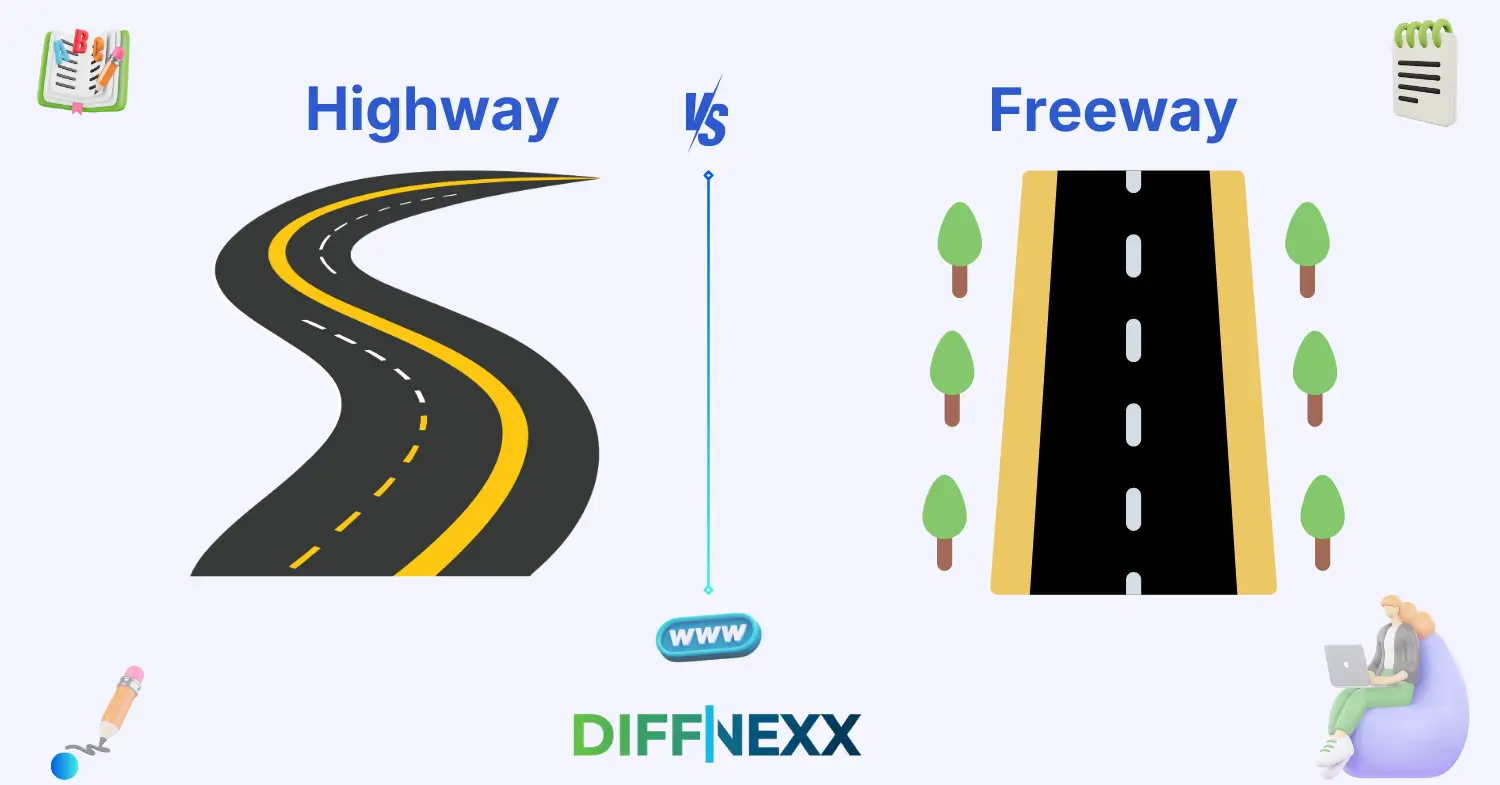
The difference between highway and freeway is a fundamental concept in civil engineering and daily navigation. While both are major public roads designed for travel between destinations, they vary significantly in their design and rules. A highway is a broad term that covers many types of main roads, while a freeway is a specific, high-speed version of a highway.
Understanding the difference between highway and freeway can save you time and stress behind the wheel. It helps you anticipate whether you will encounter stoplights, pedestrians, or toll booths. By mastering the difference between highway and freeway, you become a more confident traveler and a better communicator. 🚗
Let’s dive into the specifics of these asphalt arteries to see what sets them apart.
Key difference between the both
The primary difference between highway and freeway lies in “controlled access.” A freeway is a type of highway that has no traffic lights, no intersections, and no property driveways; you can only enter or exit via specialized ramps. A highway, while also a major road, may include intersections with other streets, traffic signals, and even crosswalks for pedestrians.
Importance for learners and experts
For English learners, knowing the difference between highway and freeway is a matter of functional fluency. In North America especially, using these terms correctly helps you give and receive directions accurately. It prevents confusion when reading road signs or listening to traffic reports on the radio.
For urban planners and transportation experts, this distinction is vital for safety and logistics. Freeways are designed for maximum efficiency and high-volume transit, whereas highways often serve as the main street for smaller communities. In society, recognizing these differences helps citizens participate in discussions about infrastructure, taxes, and local development. 🛣️
Pronunciation Section
Highway
US: /ˈhaɪˌweɪ/
UK: /ˈhaɪweɪ/
Freeway
US: /ˈfriːˌweɪ/
UK: /ˈfriːweɪ/
Now that we can say these terms correctly, let’s establish their formal definitions to build a solid foundation.
Core Definitions
Highway
A highway is any main public road that connects cities or towns. It is a broad category that includes everything from two-lane rural roads to massive multi-lane thoroughfares. The emotional tone is often one of “the journey” or “the open road.”
- Example: Driving on Route 66, passing through various small towns and stopping at local diners.
Freeway
A freeway is a specific type of divided highway designed for high-speed vehicular traffic with fully controlled access. It is “free” of obstacles like stop signs, pedestrians, and toll booths (though some modern freeways do have tolls). The emotional tone is one of “speed” and “efficiency.”
- Example: Using the Interstate 5 to zip across the state without ever having to hit the brakes for a red light.
10 Clear Differences Between Highway and Freeway
1. Access Control
Freeways use “controlled access,” meaning you can only enter or exit at specific ramps. Highways may have “at-grade” intersections where you can turn directly onto a side street or pull into a gas station.
- Example for Highway: Slowing down to turn right into a farmhouse driveway.
- Example for Freeway: Following a long, curved off-ramp to reach a different road.
2. Traffic Signals
You will frequently find traffic lights, stop signs, or roundabouts on many highways. Freeways are designed to never have these interruptions, allowing traffic to flow constantly.
- Example for Highway: Waiting at a red light where the road crosses a local street.
- Example for Freeway: Maintaining a steady speed for hundreds of miles without stopping.
3. Pedestrians and Cyclists
Highways often have shoulders or sidewalks that allow for pedestrians and bicycles. Freeways strictly prohibit non-motorized traffic for safety reasons due to high speeds.
- Example for Highway: Seeing a cyclist riding on the side of a coastal road.
- Example for Freeway: Signs at the entrance stating “No Pedestrians – No Bicycles.”
4. Speed Limits
Freeways generally have the highest speed limits allowed by law because they lack intersections. Highways typically have lower speed limits, especially as they pass through residential or commercial areas.
- Example for Highway: The speed limit dropping from 55 mph to 35 mph as you enter a town.
- Example for Freeway: A consistent speed limit of 70 mph across the entire county.
5. Road Design (Dividers)
Freeways always feature a median or physical barrier separating traffic moving in opposite directions. Many highways are “undivided,” meaning only a painted yellow line separates you from oncoming cars.
- Example for Highway: A simple two-lane road with a dashed line in the middle.
- Example for Freeway: A wide grassy strip or concrete wall between the North and South lanes.
6. Cross-Traffic
On a highway, cars from side streets can cross your path at intersections. On a freeway, all crossing traffic uses overpasses or underpasses so they never physically intersect with your lane.
- Example for Highway: A car waiting at a stop sign to cross the main road you are on.
- Example for Freeway: Seeing a bridge above you where a different road passes over.
7. Formality and Legal Classification
“Highway” is a legal catch-all term that can even include bridges or tunnels in some jurisdictions. “Freeway” is a technical classification used by engineers to describe a specific standard of road.
- Example for Highway: A state law referring to all public paths as “highways.”
- Example for Freeway: An engineering blueprint labeled “Proposed Freeway Expansion.”
8. Psychological Impact
Driving on a highway often feels more engaged with the landscape and local culture. Driving on a freeway can feel “isolated” or repetitive, as you are separated from the surrounding environment by sound walls and fences.
- Example for Highway: Noticing the unique architecture of a town as you drive through its center.
- Example for Freeway: Feeling like you are in a “tunnel” of concrete barriers and signs.
9. Tone of Travel
The tone of a highway is often exploratory or scenic. The tone of a freeway is purely functional, focused on getting from Point A to Point B as quickly as possible.
- Example for Highway: Taking the “scenic highway” to look at autumn leaves.
- Example for Freeway: Taking the freeway to ensure you aren’t late for a business meeting.
10. Expression Style
In casual speech, people use “highway” to describe the road’s destination. People often use “freeway” to describe the road’s speed or lack of tolls.
- Example for Highway: “I’m taking the Pacific Coast Highway.”
- Example for Freeway: “Jump on the freeway; it’s faster than taking the local roads.”
Why Knowing the Difference Matters
Students must know the difference between highway and freeway to navigate internships or university commutes safely. If a student is told a job is “just off the highway,” they might expect a simple turn. If it’s off a freeway, they need to know which exit number to look for, as missing it could mean a ten-mile detour.
Professionals, especially those in logistics, delivery, or sales, must distinguish these road types to estimate travel times accurately. A 20-mile trip on a freeway takes much less time than 20 miles on a highway with twelve traffic lights. Miscalculating this can lead to missed deadlines and unhappy clients.
Socially, confusing these terms can lead to poor directions and frustrated friends. In some regions, like California, the word “freeway” is almost exclusively used. In other places, “highway” is the standard. Knowing the local preference helps you fit in and communicate smoothly with residents.
Real-world consequences of confusion
Using a bicycle on a freeway by mistake is a major safety hazard and can result in heavy fines or accidents. Similarly, expecting a freeway to have “fast food” exits every mile (as some rural highways do) can leave a driver stranded with an empty tank of gas in a remote area. ⛽
Why People Get Confused
Semantic Overlap
Because every freeway is technically a highway, people often use the broader term for everything. It is like calling every square a “rectangle”—it is true, but it misses the specific details.
Context-based Usage
Regional dialects play a huge role. In the UK, they use “Motorway.” In the Eastern US, they often say “Parkway” or “Expressway.” This variety of names for similar roads makes it hard for learners to keep them straight.
Influence of Informal Speech
In movies and music, “highway” is often used because it sounds more poetic. “Highway to Hell” or “Life is a Highway” wouldn’t sound the same if they used the word “freeway.” This reinforces “highway” as the default word in our minds.
Connotation & Emotional Tone
(Connotation = the emotional meaning attached to a word.)
For Highway:
- Positive/Neutral: Suggests adventure, road trips, and connection.
- Example: “We took the old highway to see the historic landmarks.”
For Freeway:
- Neutral/Stressful: Suggests commuting, heavy traffic, and high-speed efficiency.
- Example: “The freeway was packed with cars during the morning rush hour.”
Usage in Metaphors, Similes & Idioms
- “Highway robbery”: An idiom used to describe something that is extremely overpriced.
- Sentence: “Charging ten dollars for a bottle of water is highway robbery!”
- “My way or the highway”: A phrase meaning you must follow my rules or leave.
- Sentence: “In this classroom, it’s my way or the highway.”
Comparison Table
| Feature | Highway | Freeway |
| Meaning | Any main public road | High-speed, controlled-access road |
| Tone | Scenic / Exploratory | Functional / Efficient |
| Usage | Connects towns and cities | Connects major urban hubs |
| Context | May have lights/intersections | No lights/intersections |
| Formality | General/Broad | Technical/Specific |
Which Is Better in What Situation?
When to use Highway
Use “highway” when you are talking about the general system of roads or when you are traveling through rural areas and small towns. It is the best word for scenic routes and historic roads.
When to use Freeway
Use “freeway” when you want to emphasize speed and a lack of stops. It is the correct term for the large, multi-lane systems in major cities where you enter via an on-ramp.
Situational Clarity
If you are giving directions to someone who is nervous about high speeds, tell them to “take the highway” if it avoids the 70 mph freeway traffic.
Contextual Correctness
If you are writing a formal report on infrastructure, use “freeway” to refer to Grade-Separated roads and “highway” for At-Grade arterial roads.
Literary or Cultural References
- On the Road (Book, Jack Kerouac, 1957): A classic novel that romanticizes the American highway system.
- Cars (Movie, USA, 2006): A film that focuses on a town (Radiator Springs) that was forgotten when the new freeway was built.
- The Phantom Tollbooth (Book, Norton Juster, 1961): Uses a highway as a metaphor for the journey of learning and discovery.
FAQs
1. Is a freeway always free to use?
Originally, the name “freeway” referred to being free of traffic obstacles, not necessarily free of cost. However, most people assume it means no tolls. If a freeway has a toll, it is often called a “tollway” or “turnpike.”
2. Can I walk my dog on a highway?
On many rural highways, yes, provided there is a shoulder. However, it is never allowed on a freeway.
3. What is the difference between a freeway and an expressway?
These terms are very similar. In some states, an “expressway” might allow some intersections, whereas a “freeway” never does. The definitions vary by state.
4. Why do some highways have names and others have numbers?
Most highways are part of a numbered system (like US-101) to help with long-distance navigation, but locals often give them names (like “The Pacific Coast Highway”) for cultural reasons.
5. Which is safer to drive on?
Statistically, freeways are safer per mile driven. Because there is no cross-traffic and no pedestrians, there are fewer opportunities for side-impact collisions.
Conclusion
The difference between highway and freeway is a perfect example of how specific language can improve our daily lives.
While both roads serve the same goal getting us where we need to go the “how” is very different. The highway invites us to see the world, stop at local shops, and navigate through intersections. The freeway demands our focus on speed and efficiency, stripping away the obstacles to keep us moving.
Knowing which one you are on helps you drive safer and plan better. It allows you to choose between the beauty of a slow journey and the practicality of a fast arrival.
Next time you plan a trip, look at your map and see if you are taking the highway or the freeway. Your choice will define the character of your drive.

Mira Anand is a writer at Distinly.com who focuses on storytelling, communication, and social perspective. Her work highlights subtle differences in language and meaning across cultures and communities. With a clear and empathetic voice, Mira helps readers understand how narratives shape understanding, relationships, and modern dialogue in an increasingly connected world.