Difference between cement and concrete is something many people notice when they see buildings, roads, or construction work. Imagine you are watching workers make a floor, and one person says they are using cement, while another says they are pouring concrete. This small confusion happens very often in daily life.
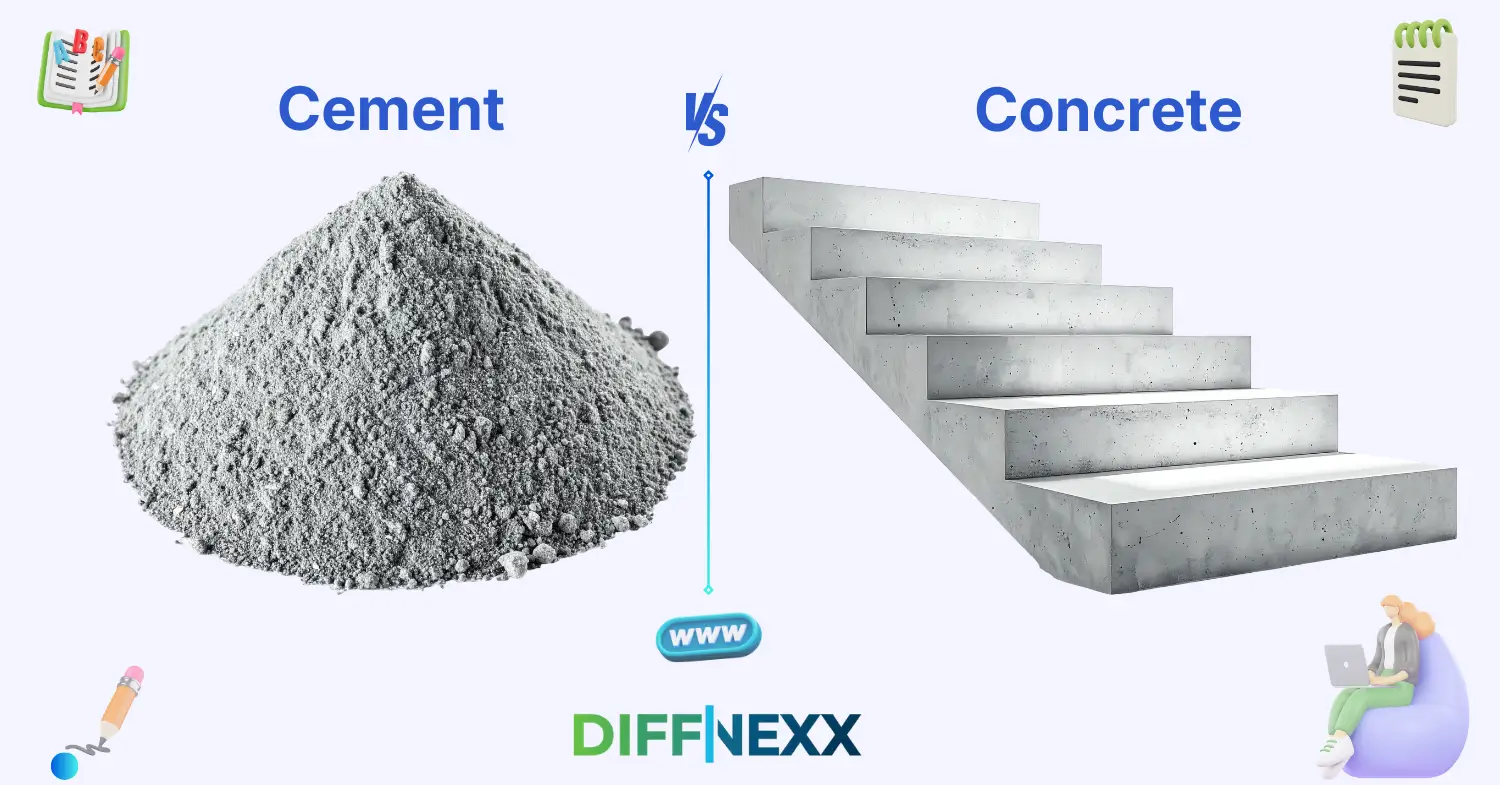
The difference between cement and concrete is simple but very important. Cement is a fine powder used in construction, while concrete is the strong material made by mixing cement with sand, gravel, and water. Many people think both words mean the same thing, but they do not.
Understanding the difference between cement and concrete helps students, builders, engineers, and even everyday speakers use the correct word. These terms are common in science, engineering, and daily conversation, so learning them improves accuracy.
Before going deeper, let us first understand the key difference between these two materials.
⚖️ Key Difference Between the Both
The main difference is that cement is an ingredient, while concrete is the final product.
Cement works like glue that holds materials together.
Concrete is the strong solid material formed after mixing cement, sand, gravel, and water.
In simple words:
- Cement = binding powder
- Concrete = finished building material
🌍 Importance – Why Their Difference Is Necessary to Know
Knowing the difference between cement and concrete is important for learners, professionals, and society. These words are used in education, engineering, construction, and daily speech.
For students, correct vocabulary helps in exams and writing. Many learners lose marks because they confuse these two words.
For professionals such as engineers, architects, and builders, the difference is very important. Using the wrong term may cause misunderstanding at the work site.
In society, correct language shows knowledge and education. When people use the right word, communication becomes clear and professional.
🔊 Pronunciation Section
Cement
US: /sɪˈment/
UK: /sɪˈment/
Concrete
US: /ˈkɑːnkriːt/
UK: /ˈkɒŋkriːt/
Both words are easy to say, but their meanings are different.
Now let us define each word clearly before comparing them.
📚 Core Definitions
🧪 Cement
Cement is a fine gray powder used as a binding material in construction.
When mixed with water, it becomes sticky and helps hold sand and stones together.
It is usually not used alone.
Example:
Workers mixed cement with water and sand.
🧱 Concrete
Concrete is a strong building material made from cement, sand, gravel, and water.
After mixing, it becomes hard and durable.
It is used for buildings, roads, and bridges.
Example:
The wall is made of concrete.
🔍 10 Clear Differences Between Cement and Concrete
1️⃣ Basic Meaning
Cement is a powder used in construction.
Concrete is the solid material made from cement and other ingredients.
- Example for Cement: Add cement to the mix.
- Example for Concrete: The road is made of concrete.
2️⃣ Function
Cement works as a binder.
Concrete works as the final building material.
- Example for Cement: Cement holds the sand together.
- Example for Concrete: Concrete makes strong walls.
3️⃣ Composition
Cement is made from limestone and clay.
Concrete is made from cement, sand, gravel, and water.
- Example for Cement: Cement is produced in factories.
- Example for Concrete: Concrete is mixed at the site.
4️⃣ Strength
Cement alone is weak.
Concrete becomes very strong after drying.
- Example for Cement: Wet cement breaks easily.
- Example for Concrete: Concrete supports heavy buildings.
5️⃣ Usage Context
Cement is used as an ingredient.
Concrete is used in construction structures.
- Example for Cement: Buy cement bags.
- Example for Concrete: Pour concrete here.
6️⃣ Form
Cement is powder before mixing.
Concrete is liquid when mixed and solid after drying.
- Example for Cement: The cement bag is open.
- Example for Concrete: The concrete became hard.
7️⃣ Durability
Cement alone does not last long.
Concrete is very durable.
- Example for Cement: Cement cracks easily alone.
- Example for Concrete: Concrete lasts many years.
8️⃣ Common Usage in Speech
People often say cement when they mean concrete.
Correct usage keeps meaning clear.
- Example for Cement: Bring the cement.
- Example for Concrete: Pour the concrete.
9️⃣ Professional vs Casual Language
Professionals use correct terms.
Casual speakers often mix them.
- Example for Cement: Engineers ordered cement.
- Example for Concrete: Builders poured concrete.
🔟 Role in Construction
Cement is part of the mixture.
Concrete is the final structure.
- Example for Cement: Cement binds materials.
- Example for Concrete: Concrete forms buildings.
🎯 Why Knowing the Difference Matters
Students must know the difference to write correctly in science and engineering subjects. Using the wrong word can change the meaning.
Professionals must use the correct term because construction depends on accuracy. A small mistake can cause confusion.
In daily life, correct words improve communication and show knowledge.
⚠️ Real-world consequences of confusion
If a worker asks for concrete but gets cement, the work stops.
In exams, wrong words can give wrong answers.
🧠 Why People Get Confused
Similar spelling or pronunciation
Both words are used in construction, so people think they mean the same.
Semantic overlap
Cement is part of concrete, so the meanings are connected.
Context-based usage
People often use cement for all construction materials.
Influence of informal speech
In daily talk, rules are ignored, so confusion happens.
🎭 Connotation & Emotional Tone
Connotation = the emotional meaning associated with a word.
Cement
Positive → building, joining
Example: Cement helps build houses.
Neutral → construction material
Example: Cement is used in mixing.
Negative → dust, pollution
Example: Cement dust can be harmful.
Concrete
Positive → strong, durable
Example: Concrete buildings last long.
Neutral → building material
Example: Concrete is used in roads.
Negative → hard, cold
Example: The concrete floor feels cold.
🗣 Usage in Metaphors, Similes & Idioms
- “Set in concrete” = fixed and cannot change
- “Cement a relationship” = make stronger
Example with cement:
They cemented their friendship.
Example with concrete:
The decision is set in concrete.
📊 Comparison Table
| Feature | Cement | Concrete |
|---|---|---|
| Meaning | Binding powder | Final material |
| Tone | Technical | Practical |
| Usage | Ingredient | Structure |
| Context | Mixing | Construction |
| Formality | Technical | Common |
⚖️ Which Is Better in What Situation?
When to use Cement
Use cement when talking about the powder used in construction.
Example: The workers bought cement bags.
When to use Concrete
Use concrete when talking about the final solid material.
Example: The bridge is made of concrete.
Situational clarity
In science or engineering, always use correct terms.
Contextual correctness
Choose the word based on whether you mean the ingredient or the final product.
📖 Literary or Cultural References
Book: Structures: Or Why Things Don’t Fall Down – J. E. Gordon, 1978
Movie: The Bridge on the River Kwai (1957)
Both show the importance of strong building materials like concrete.
❓ FAQs
1. What is the main difference between cement and concrete?
The main difference between cement and concrete is that cement is an ingredient, while concrete is the final building material. Cement is a fine powder that acts as a binder when mixed with water. Concrete is made by mixing cement with sand, gravel, and water. After mixing, concrete becomes hard and strong, which makes it useful for construction.
2. Why do people use the word cement when they mean concrete?
Many people use the word cement instead of concrete because cement is the most important ingredient in the mixture. In daily conversation, people often use simple words without thinking about the technical meaning. Because cement is part of concrete, the two words are sometimes used incorrectly. However, in engineering and construction, using the correct term is very important.
3. Which is stronger, cement or concrete?
Concrete is much stronger than cement alone. Cement by itself can crack easily and is not used for building structures. When cement is mixed with sand, gravel, and water, it forms concrete, which becomes very hard after drying. This is why concrete is used for buildings, bridges, and roads.
4. Can you build a house using only cement?
No, you cannot build a house using only cement. Cement needs other materials like sand, gravel, and water to become strong enough for construction. When these materials are mixed together, they form concrete, which is suitable for building. Using only cement would not provide enough strength or durability.
5. Why is it important to know the difference between cement and concrete?
Knowing the difference between cement and concrete helps students, professionals, and everyday speakers use the correct word. In school subjects like science and engineering, the correct term is necessary for accurate answers. In construction work, using the wrong word can cause confusion or mistakes. Understanding the difference also improves vocabulary and communication skills.
🏁 Conclusion
The difference between cement and concrete is simple but very important. Cement is a binding powder, while concrete is the strong material made from cement, sand, gravel, and water. Many people use these words as if they mean the same thing, but correct usage makes communication clear.
Learning this difference helps students, professionals, and everyday speakers avoid mistakes. It also improves understanding in science, engineering, and daily conversation.
Keep learning small vocabulary differences like this. Each new word you understand makes your English stronger, clearer, and more confident.

Aamer Shahzad is the founder of Distinly.com, a fast-growing educational platform focused on high-intent “difference between” topics. With over 8 years of experience in English language education and analytical writing, I specialize in breaking down complex “difference between” topics into clear, structured, and easy-to-understand explanations. Distinly.com is your go-to resource for enhancing English skills and writing with confidence.
I specializes in building search-optimized, research-driven comparison content designed for clarity, authority, and long-term digital asset value.