Imagine walking through a historic European city. On one corner, you see a grand cathedral with intricate statues and stained glass. A few blocks away, you find a simple, modern building with a plain wooden cross. Both are Christian churches, yet they feel worlds apart.
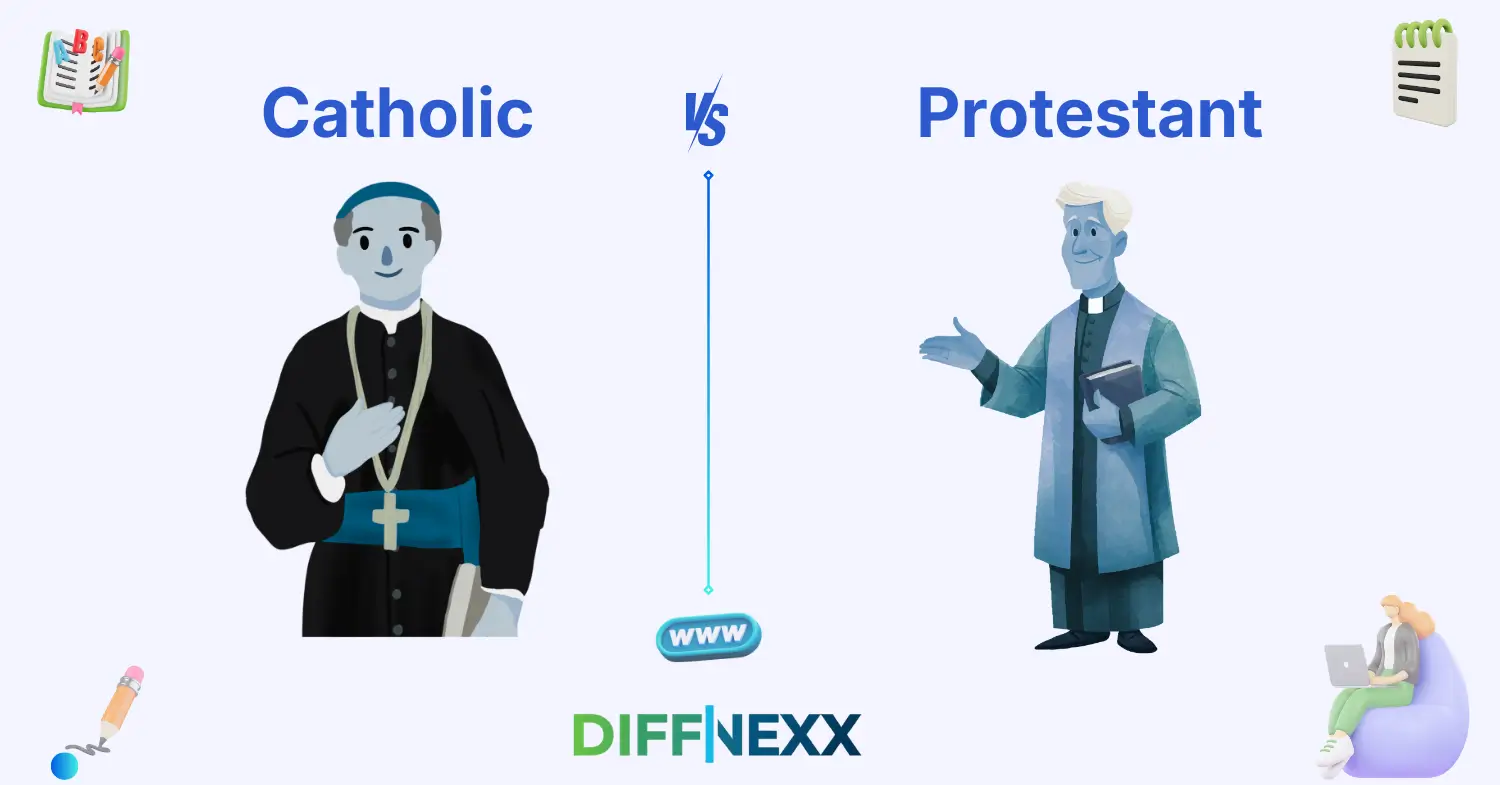
The difference between Catholic and Protestant traditions is one of the most significant divides in global history. While both groups follow the teachings of Jesus Christ, they have different ways of expressing their faith.
Understanding the difference between Catholic and Protestant practices helps us navigate history, art, and modern social dynamics.
Catholicism represents the oldest organized branch of Christianity, led by the Pope. Protestantism emerged later as a movement seeking reform, leading to thousands of different denominations like Baptists, Methodists, and Lutherans. By exploring the difference between Catholic and Protestant, we can better appreciate the diversity of the Christian world.
This guide will break down these complex topics into simple, easy-to-understand points for learners and experts alike.
Key difference between the both
The fundamental difference between Catholic and Protestant lies in authority. Catholics believe that the Church, through the Pope and ancient traditions, has the final say in interpreting the Bible. Protestants believe that the Bible alone is the ultimate authority, and every individual can read and interpret it for themselves.
Importance of the difference for learners and experts
Knowing the difference between Catholic and Protestant is vital for understanding Western civilization. For learners, it explains why certain holidays are celebrated differently or why art varies across cultures. It provides a roadmap for navigating religious conversations without causing accidental offense.
For experts in sociology, history, or international relations, these differences explain political alliances and historical conflicts. In many societies, these religious identities shape voting patterns, family structures, and community values. Recognizing these nuances fosters empathy and clearer communication in our globalized world 🌍.
Pronunciation Section
Catholic
US: /ˈkæθlɪk/
UK: /ˈkæθlɪk/
Protestant
US: /ˈprɒtɪstənt/
UK: /ˈprɒtɪstənt/
Now that we can say the names correctly, let’s define what these terms actually represent.
Core Definitions
Catholic
The term “Catholic” comes from a Greek word meaning “universal.” It refers to the Roman Catholic Church, which follows the leadership of the Pope in Vatican City. It is characterized by ancient rituals, a set hierarchy of priests, and a deep respect for church tradition.
- Example: A person attending a “Mass” where they receive the Eucharist from a priest.
Protestant
“Protestant” comes from the word “protest.” It refers to the movement that began in the 1500s (the Reformation) to change certain practices of the Catholic Church. It is a broad umbrella that includes many different groups who emphasize personal faith and the Bible.
- Example: A person attending a service focused on a long sermon and singing contemporary worship songs.
10 Clear Differences Between Catholic and Protestant
1. Authority of the Pope
Catholics believe the Pope is the successor of Saint Peter and the head of the global church. He provides the final word on matters of faith and morals. Protestants do not recognize the Pope’s authority and believe no single human leads the entire church.
- Catholic Example: Following a new decree issued by the Vatican.
- Protestant Example: A local church board making its own decisions.
2. The Role of the Bible
For Protestants, the Bible is the only source of divine revelation (Sola Scriptura). Catholics also value the Bible but give equal weight to “Sacred Tradition,” which includes teachings passed down through church history.
- Catholic Example: Using both the Bible and the Catechism for teaching.
- Protestant Example: Holding a “Bible-only” study group.
3. Salvation and Grace
Protestants generally believe that people are saved by faith alone in Jesus Christ. Catholics believe that while faith is necessary, “good works” and participation in the sacraments are also essential parts of the journey to heaven.
- Catholic Example: Performing acts of penance after a mistake.
- Protestant Example: Emphasizing a “personal relationship” with Jesus to be saved.
4. The Eucharist (Holy Communion)
Catholics believe in “transubstantiation,” meaning the bread and wine literally become the body and blood of Christ. Most Protestants view Communion as a symbolic memorial or a spiritual presence, but not a physical change.
- Catholic Example: Kneeling in reverence before the bread (the Host).
- Protestant Example: Passing a tray of crackers and juice to remember the Last Supper.
5. Purgatory
The Catholic faith teaches that there is a place called Purgatory where souls are purified before entering Heaven. Protestants generally reject this idea, believing that a person goes directly to Heaven or Hell based on their faith.
- Catholic Example: Praying for a deceased relative to help them reach Heaven.
- Protestant Example: Celebrating a “home-going” service, believing the person is already with God.
6. The Virgin Mary and Saints
Catholics show great honor to Mary and the saints, asking them to pray to God on their behalf. Protestants believe they should pray directly to God alone and see Mary as a respected historical figure but not someone to be prayed through.
- Catholic Example: Lighting a candle in front of a statue of Saint Jude.
- Protestant Example: Praying directly to Jesus in a quiet room.
7. Priesthood and Celibacy
In the Roman Catholic Church, priests must remain unmarried (celibate). Most Protestant denominations allow their ministers, pastors, or orators to marry and have families.
- Catholic Example: A priest living in a rectory dedicated solely to his parish.
- Protestant Example: A pastor’s wife and children helping out at a church picnic.
8. Number of Sacraments
Catholics observe seven sacraments (Baptism, Confirmation, Eucharist, Penance, Anointing of the Sick, Holy Orders, and Matrimony). Most Protestant groups recognize only two: Baptism and Communion.
- Catholic Example: A teenager receiving the Sacrament of Confirmation.
- Protestant Example: A church focusing primarily on adult baptism.
9. Church Decor and Architecture
Catholic churches are often highly decorated with statues, icons, and crucifixes to inspire the senses. Protestant churches tend to be simpler, often featuring a plain cross rather than a crucifix (which shows Jesus’ body).
- Catholic Example: A church filled with colorful stained glass and gold altars.
- Protestant Example: A “white-box” style chapel with simple wooden pews.
10. Individual Interpretation
Protestants encourage individuals to read the Bible and find meaning for themselves. Catholics believe the Church’s teaching office (Magisterium) is necessary to ensure the Bible is interpreted correctly and consistently.
- Catholic Example: Checking a church document to understand a difficult verse.
- Protestant Example: Sharing “what this verse means to me” in a small group.
Why Knowing the Difference Matters
Students must know the difference between Catholic and Protestant to pass history and literature exams. Much of the world’s greatest art, from the Sistine Chapel to Bach’s music, is rooted in these specific religious identities. Without this knowledge, students miss the deeper meaning of historical events like the Thirty Years’ War.
Professionals, especially those in healthcare, social work, or diplomacy, need this clarity to show respect. Knowing a patient’s or client’s background helps you provide better support. For instance, a Catholic patient might want a priest for “Last Rites,” while a Protestant might prefer a simple prayer with their family.
Socially, confusing the two can lead to awkward moments or misunderstandings. Religion is a deeply personal topic. Showing that you understand the unique traditions of each group builds trust and strengthens community bonds.
Real-world consequences of confusion
Mistaking a Catholic for a Protestant (or vice versa) can lead to practical errors. In a wedding or funeral setting, the etiquette differs. You might expect a short service and find yourself in a two-hour Mass. More seriously, in places like Northern Ireland, these distinctions have historically carried heavy political weight.
Why People Get Confused
Similar vocabulary
Both groups use terms like “grace,” “faith,” “baptism,” and “salvation.” However, they often define these words slightly differently, which leads to confusion for outsiders.
Semantic overlap
Because both are “Christian,” people often use the terms interchangeably. It’s like confusing “Apple” and “Microsoft”—both make computers, but their systems work very differently.
Influence of informal speech
In popular media, “church” is often used as a generic term. Movies frequently show Catholic priests when they want a “religious” look, leading people to think all Christian leaders wear collars and live in stone buildings.
Connotation & Emotional Tone
(Connotation = the emotional meaning associated with a word.)
For Catholic:
- Tone: Traditional / Formal.
- Explanation: The word often carries a sense of ancient mystery, global unity, and structured ritual.
- Example: “The Catholic cathedral felt timeless and solemn.”
For Protestant:
- Tone: Individualistic / Diverse.
- Explanation: The word suggests a focus on the “protest” for truth, personal freedom, and a variety of styles.
- Example: “The Protestant service was lively and focused on the speaker’s message.”
Usage in Metaphors, Similes & Idioms
- “More Catholic than the Pope”: Used to describe someone who follows rules more strictly than the person who made them.
- Sentence: “John is more Catholic than the Pope when it comes to office filing rules.”
- “Protestant Work Ethic”: A phrase referring to the value of hard work and frugality.
- Sentence: “Her success is due to her strong Protestant work ethic.”
Comparison Table
| Feature | Catholic | Protestant |
| Primary Authority | The Pope and Church Tradition | The Bible Alone |
| Tone | Formal, Ritualistic, Ancient | Diverse, Personal, Modern |
| View of Mary | Highly honored (Intercessor) | Respected (Mother of Jesus) |
| Sacraments | Seven | Usually Two |
| Clergy | Priests (mostly celibate) | Pastors/Ministers (may marry) |
| Worship Focus | The Eucharist (Communion) | The Sermon (Preaching) |
Which Is Better in What Situation?
When to use Catholic
Use this term when referring specifically to the Church headed by the Pope. It is the correct term for historical discussions about the Middle Ages or when discussing the demographics of countries like Italy, Poland, or Brazil.
When to use Protestant
Use this as a broad category for non-Catholic Western Christians. It is useful when discussing the Reformation or the religious landscape of the United States, Northern Europe, and many parts of Sub-Saharan Africa.
Situational clarity
If you are invited to a “Mass,” it is Catholic. If you are invited to a “Service” or “Meeting,” it is likely Protestant.
Contextual correctness
Always check if someone belongs to a specific denomination (like Anglican or Baptist) before using “Protestant,” as many people prefer their specific group name.
Literary or Cultural References
- The Power and the Glory (Novel, Graham Greene, 1940): Explores the life of a Catholic “whiskey priest” in Mexico.
- Lady Bird (Movie, USA, 2017): Portrays life in a Catholic high school and the nuances of the faith.
- The Scarlet Letter (Novel, Nathaniel Hawthorne, 1850): Highlights the strict Protestant (Puritan) culture of early America.
FAQs
1. Are Catholics also Christians?
Yes, Catholics are the largest group of Christians in the world. All Catholics are Christians, but not all Christians are Catholics. They believe in the Trinity and the divinity of Jesus Christ.
2. Why do Protestants have so many different churches?
Because Protestants believe in the individual interpretation of the Bible, groups have split over time due to different views on baptism, music, and church leadership. This has resulted in thousands of denominations.
3. Do Catholics and Protestants use the same Bible?
Mostly, yes. However, the Catholic Bible includes seven additional books in the Old Testament (the Deuterocanonical books) that Protestants generally do not include in their versions.
4. Can a Protestant receive communion in a Catholic church?
Generally, no. The Catholic Church views Communion as a sign of complete unity in faith and authority. Since Protestants do not recognize the Pope or the same view of the Eucharist, they are usually asked not to take it.
5. Is the “Church of England” Catholic or Protestant?
It is often described as “both” or a “middle way.” While it broke away from the Pope (making it Protestant), it kept many Catholic-style rituals and structures.
Conclusion
Understanding the difference between Catholic and Protestant traditions opens up a deeper understanding of our world. While both share a foundation in the teachings of Jesus, their paths diverged centuries ago over questions of authority, ritual, and how one reaches heaven.
Catholics find strength in ancient traditions and global unity under the Pope. Protestants find their identity in the “Bible alone” and the freedom of individual faith.
Clarifying these differences isn’t about deciding who is “right.” Instead, it is about building a bridge of knowledge. When we know why a friend fasts during Lent or why a neighbor emphasizes Bible study, we become more culturally aware.
Keep exploring these unique histories and stay curious about the diverse ways people express their beliefs! 🌟

Ezra Hale is a thoughtful contributor to Distinly.com, where he explores philosophical ideas and the subtle differences behind everyday concepts. His writing blends logic, language, and human insight to clarify complex distinctions. Ezra encourages readers to think deeper, question assumptions, and appreciate the meaning behind words and ideas in modern discourse.